


It’s not been a good year and half for sporting progress around the world.
In March 2020, the global pandemic brought almost all competitions to a standstill, and as a sense of normality has returned, sporting federations in the Middle East and around the world have struggled to get back on track after a long period of inaction.
But for the guardians of at least one sport in Saudi Arabia, the last year was anything but wasted.
“During the pandemic we did not stop working,” said Ahmed Al-Sabban, president of the Saudi Fencing Federation. “We had online lectures, daily training sessions on Zoom from the club and centers. We even got older players to give talks to the younger ones about their experiences in fencing.”
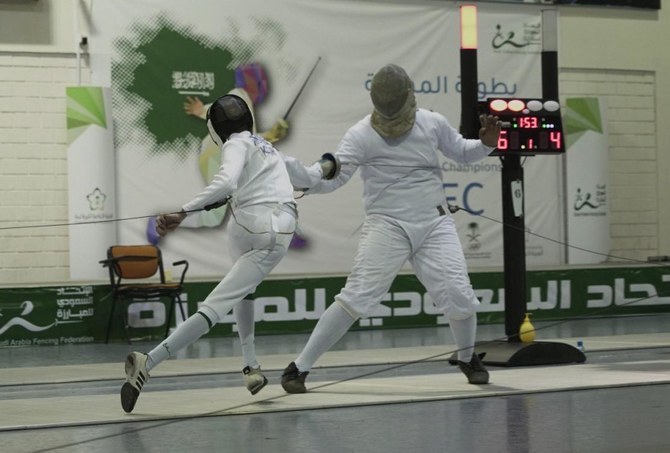
While other sports in the Kingdom had no option but to wait out the lockdowns and disruptions, the fencing federation took part in the 2020 AF Virtual Fencing Junior Intercontinental Sabre Cup in June 2020, as the pandemic raged.
“We didn’t stop, on the contrary, we were very active,” Al-Sabban said. “During the lockdown we also returned to the regular season and we organized tournaments for boys and girls, and the last participation for us was the qualification for the Tokyo Olympics in the Asian Zone.”
The Asian Olympic Qualifying Tournament took place in Tashkent, Uzbekistan at the end of April, and produced some encouraging Saudi performances, if not qualification, for Tokyo.
“Unfortunately we did not succeed in getting any spots but we did have a third-place finish among the Asian countries,” he said. “It was an excellent result, especially as Jawad Al-Dawood had not taken part in any competition since 2019, there was no adequate preparation before the qualification games. But for me third place was a fine result and shows that we are capable of qualifying in the future, thanks to our program for the next four years.
“Hopefully we can qualify for Paris 2024, and hopefully our new program of participation abroad will start after Tokyo for both men and women,” said Al-Sabban, who represented Saudi’s national fencing team in the 1980s.
Last week Al-Sabban was re-elected as president of the Saudi Fencing Federation — a post he first landed in 2017 — until 2024, and has already set out plans to increase participation in fencing among young Saudis.
“According to our program over the next four years we will look to participate in every senior competition that can gain us points, because that will help our ranking for Paris 2024,” he said. “For the age groups for boys and girls we will focus primarily on the Arab and Asian competitions for the under-17s. In 2019 we had our under-17s in the Asia league, and we were ranked first. We may even have overlooked the seniors in favor of the ages groups recently, but it was unintentional. Thankfully, as a federation we now have better presence than before, with centers in Jeddah, Riyadh, Madina, Macca and Taif.”
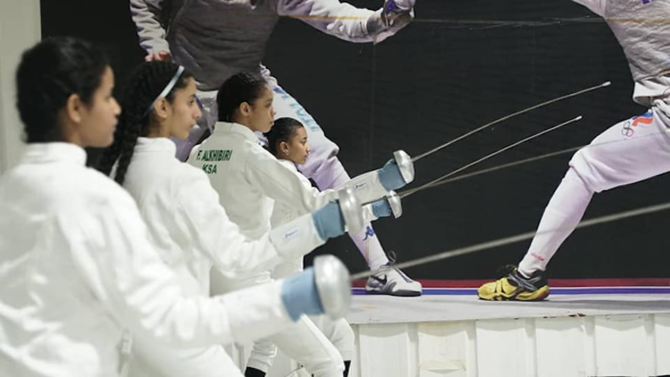
It is perhaps in women’s fencing where the biggest steps have been taken, with Saudi female athletes increasingly embracing a sport that is seen as elegant, competitive and, crucially, culturally modest. It is something the federation has purposefully pushed for.
“We’ve worked on it. It’s a noble sport, a sophisticated sport, like equestrian activities,” Al-Sabban said. “It’s a unique, royal, sport and the participation has been great. And not just from the targeted younger female fencers, but in recent times we’ve seen a rise in women taking up fencing for fun, taking part in local competitions for fun.”
Another sign of the popularity of fencing among women in the Kingdom is the emergence of Malaak Al-Sultan, Hana Hilmy and Wudyan Al-Maliki as the first three female referees in the history of Saudi fencing. The course to train them was at the Fencing Hall at Prince Saud Bin Juluwi Sports City in Al-Raakah, Al-Khobar.
“We organzied the first program for Saudi female fencing referees, and we graduated the first group,” Al-Sabban said. “We have a plan in the next five years to have a holistic set-up which is capable of organizing and refereeing women’s tournaments. We also have an agreement with the International Fencing Federation that Saudi Arabia will be the designated destination in the Middle East to train and graduate referees.”
For Al-Sabban, the long-term aim is for the Kingdom to produce fencers who are not simply content to qualify for events, but to be competitive and win medals as well.
“The Asian Zone is the strongest in the world, because it includes Korea, Japan and China,” he said. “So my ambition is to be in the top six or top 10 in Asia, and if I’m honest I’d say that fencing in the recent past, though not ignored, was slow on the uptake. In the 1980s and 1990s, fencing in Saudi Arabia was quite advanced. Now we have ambitions to be ranked among the top six or 10 in Asia again. We will work to ensure qualifications through our ranking in Asia. We have a long-term plan.”
The plan is to spread awareness of the game and ensure that facilities are provided for those wishing to take the sport up. After that, top-class training programs are on the agenda.
“Can you believe that in Riyadh demand for participation has surpassed availability?” Al-Sabban said. “In Jeddah participation is good also, but in Riyadh it’s very high. Soon we will be partnering with Mahd Academy, where fencing will be one of the prioritized sports. From there we will target schools and the private sector. In Makkah there is a private academy, and there are Olympic centers in Jeddah, Riyadh and Al Sharqiya. The spread to schools level will be via Mahd,” he said.


