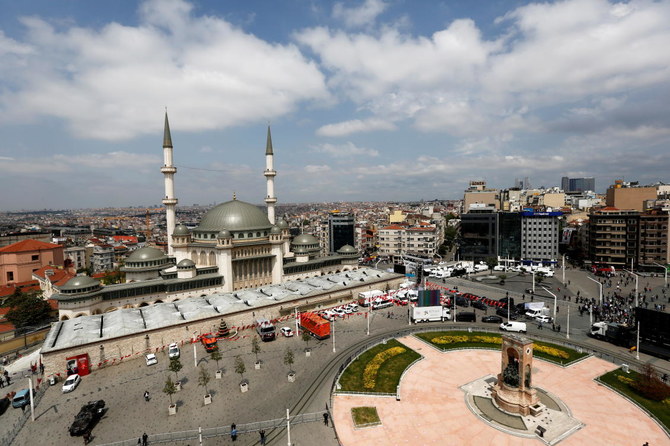
ISTANBUL: Turkish President Tayyip Erdogan inaugurated an imposing new mosque in Istanbul on Friday, fulfilling a decades-old goal of his and stamping a religious identity on the landmark Taksim Square in the heart of the city.
The Taksim mosque and its 30-meter-high dome loom symbolically over a monument to the foundation of the Turkish republic by Mustafa Kemal Ataturk, whose staunchly secular legacy has been eroded by nearly two decades of Erdogan’s rule.
Erdogan waved to the crowd which gathered in the square before entering the mosque for Friday prayers.
Construction of the mosque began in February 2017 in a project championed by Erdogan, a devout Muslim, and his Islamist-rooted AK Party, but which was beset for decades by court battles and public debate.
Officials on Friday shared on Twitter a video showing Erdogan in 1994, the year he became Istanbul mayor, pointing from the top of a building toward the area where he said he would build the mosque, the exact spot where it now stands.
It is one of many construction projects with which Erdogan has left his mark on Turkey, including a huge hilltop mosque overlooking the Asian side of Istanbul. Last year he reconverted into a mosque the city’s Haghia Sophia, for centuries the world’s largest church before being turned into a mosque and museum in turn.
Supporters of the Taksim project argued there were not enough Muslim places of worship close to one of the city’s busiest hubs. Opponents saw it as a bid to impose a religious tone on the square, featuring a cultural center dedicated to Ataturk which was demolished and is being rebuilt.
The mosque complex, with two towering minarets, will be able to host as many as 4,000 worshippers and includes an exhibition hall, a library, car park and soup kitchen, state-owned Anadolu news agency said.
Pro-government newspapers hailed the new mosque. Aksam’s headline mocked critics who fear creeping religiosity: “It looks great. A mosque was built in Taksim and neither has sharia law come, nor has the republic collapsed,” it said.
The inauguration also coincides with the date when protests began just 100 meters away in Gezi Park, before growing into massive protests against Erdogan’s government which spread across Turkey in June 2013.
The Gezi protests began on May 28, 2013 after demolition work began in one corner of the park the previous evening, knocking down a wall and some trees, drawing a small group of protesters who camped out at the site.
The anniversary of the protests is generally marked on May 31, when the protests escalated. In June of that year, hundreds of thousands of people took to the streets in demonstrations against a plan to build a replica Ottoman barracks on Gezi Park.

Turkey’s Erdogan inaugurates major new mosque in heart of Istanbul
https://arab.news/j9s8n
Turkey’s Erdogan inaugurates major new mosque in heart of Istanbul
- The Taksim mosque and its 30-meter-high dome loom symbolically over a monument to the foundation of the Turkish republic
Women main victims of Sudan conflict abuses: minister to AFP
- Khalifa said sexual violence has been reported on both sides, but she insisted it is “systematic” among the RSF
- Her ministry has documented more than 1,800 rapes between April 2023 and October 2025
PORT SUDAN: Women are the main victims of abuse in Sudan’s war, facing “the world’s worst” sexual violence and other crimes committed with impunity, a rights activist turned social affairs minister for the army-backed government told AFP.
The Sudanese army and the paramilitary Rapid Support Forces (RSF) have been locked in a brutal conflict since April 2023 that has killed tens of thousands of people, displaced around 11 million and been marked by widespread sexual violence.
Sulaima Ishaq Al-Khalifa said abuses against women routinely accompanied looting and attacks, with reports of rape often perpetrated as “the family witnessed” the crime.
“There is no age limit. A woman of 85 could be raped, a child of one year could be raped,” the trained psychologist told AFP at her home in Port Sudan.
The longtime women’s rights activist, recently appointed to the government, said that women were also being subjected to sexual slavery and trafficked to neighboring countries, alongside forced marriages arranged to avoid shame.
Khalifa said sexual violence has been reported on both sides, but she insisted it is “systematic” among the RSF, who she says use it “as a weapon of war” and for the purposes of “ethnic cleansing.”
Her ministry has documented more than 1,800 rapes between April 2023 and October 2025 — a figure that does not include atrocities documented in western Darfur and the neighboring Kordofan region from late October onwards.
“It’s about... humiliating people, forcing them to leave their houses and places and cities. And also breaking... the social fabrics,” Khalifa said.
“When you are using sexual violence as a weapon of war, that means you want to extend... the war forever,” because it feeds a “sense of revenge,” she added.
- ‘War crimes’ -
A report by the SIHA Network, an activist group that documents abuses against women in the Horn of Africa, found that more than three-quarters of recorded cases involved rape, with 87 percent attributed to the RSF.
The United Nations has repeatedly raised alarm over what it describes as targeted attacks on non?Arab communities in Darfur, while the International Criminal Court (ICC) has opened a formal investigation into “war crimes” by both sides.
Briefing the UN Security Council in mid-January, ICC deputy prosecutor Nazhat Shameem Khan said investigators had uncovered evidence of an “organized, calculated campaign” in El-Fasher — the army’s last stronghold in Darfur captured by the RSF in late October.
The campaign, Khan added, involved mass rapes and executions “on a massive scale,” sometimes “filmed and celebrated” by the perpetrators and “fueled by a sense of complete impunity.”
Darfur endured a brutal wave of atrocities in the early 2000s, and a former Janjaweed commander — from the militia structure that later evolved into the RSF — was recently found guilty by the International Criminal Court of multiple war crimes, including rape.
“What’s happening now is much more ugly. Because the mass rape thing is happening and documented,” said Khalifa.
RSF fighters carrying out the assaults “have been very proud about doing this and they don’t see it as a crime,” she added.
“You feel that they have a green light to do whatever they want.”
In Darfur, several survivors said RSF fighters “have been accusing them of being lesser people, like calling them ‘slaves’, and saying that when I’m attacking you, assaulting you sexually, I’m actually ‘honoring’ you, because I am more educated than you, or (of) more pure blood than you.”
- ‘Torture operation’ -
Women in Khartoum and Darfur, including El-Fasher, have described rapes carried out by a range of foreign nationals.
These were “mercenaries from West Africa, speaking French, including from Mali, Burkina Faso, Nigeria, Chad, as well as Colombia and Libya” — allegedly fighting alongside the RSF, Khalifa added.
Some victims were abducted and held as sexual slaves, while others were sold through trafficking networks operating across Sudan’s porous borders, said Khalifa.
Many of these cases remain difficult to document because of the collapse of state institutions.
In conservative communities, social stigma also remains a major obstacle to documenting the scale of the abuse.
Families often force victims into marriage to “cover up what happened,” particularly when pregnancies result from rape, according to the minister.
“We call it a torture operation,” she said, describing “frightening” cases in which children and adolescent girls under 18 are forced into marriage.


