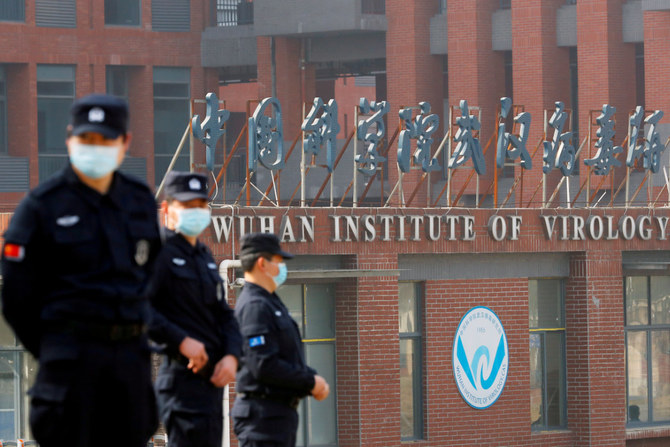
WASHINGTON: President Joe Biden on Wednesday ordered US intelligence officials to “redouble” their efforts to investigate the origins of the COVID-19 pandemic, including any possibility the trail might lead to a Chinese laboratory.
After months of minimizing that possibility as a fringe theory, the Biden administration is joining worldwide pressure for China to be more open about the outbreak, aiming to head off GOP complaints the president has not been tough enough as well as to use the opportunity to press China on alleged obstruction.
Biden asked US intelligence agencies to report back within 90 days. He directed US national laboratories to assist with the investigation and the intelligence community to prepare a list of specific queries for the Chinese government. He called on China to cooperate with international probes into the origins of the pandemic.
Republicans, including former President Donald Trump, have promoted the theory that the virus emerged from a laboratory accident rather than naturally through human contact with an infected animal in Wuhan, China.
Biden in a statement said the majority of the intelligence community had “coalesced” around those two scenarios but “do not believe there is sufficient information to assess one to be more likely than the other.” He revealed that two agencies lean toward the animal link and “one leans more toward” the lab theory, “each with low or moderate confidence.”
“The United States will also keep working with like-minded partners around the world to press China to participate in a full, transparent, evidence-based international investigation and to provide access to all relevant data and evidence,” said Biden.
His statement came after weeks of the administration endeavoring to avoid public discussion of the lab leak theory and privately suggesting it was farfetched.
In another sign of shifting attitudes, the Senate approved two Wuhan lab-related amendments without opposition, attaching them to a largely unrelated bill to increase US investments in innovation.
One of the amendments, from Sen. Rand Paul, R-Kentucky, would block US funding of Chinese “gain of function” research on enhancing the severity or transmissibility of a virus. Paul has been critical of Dr. Anthony Fauci, the government’s top infectious-disease expert, and aggressively questioned him at a recent Senate hearing over the work in China. The other amendment was from GOP Sen. Joni Ernst of Iowa and it would prevent any funding to the Wuhan Institute of Virology.
Both were approved without roll call votes as part of the broader bill that is still under debate in the Senate.
As for the origin of pandemic, Fauci, a White House coronavirus adviser, said Wednesday that he and most others in the scientific community “believe that the most likely scenario is that this was a natural occurrence, but no one knows that 100 percent for sure.”
“And since there’s a lot of concern, a lot of speculation and since no one absolutely knows that, I believe we do need the kind of investigation where there’s open transparency and all the information that’s available, to be made available, to scrutinize,” Fauci said at a Senate hearing.
White House press secretary Jen Psaki said Tuesday that the White House supports a new World Health Organization investigation in China, but she added that an effective probe “would require China finally stepping up and allowing access needed to determine the origins.”
Biden still held out the possibility that a firm conclusion may never be reached, given the Chinese government’s refusal to fully cooperate with international investigations.
“The failure to get our inspectors on the ground in those early months will always hamper any investigation into the origin of COVID-19,” he said.
The Chinese embassy in Washington, without mentioning the Biden order, accused unnamed political forces of being fixated on a blame game while ignoring the urgent need to combat the pandemic.
“Smear campaign and blame shifting are making a comeback, and the conspiracy theory of ‘lab leak’ is resurfacing,” it said in a statement posted Wednesday on its website.
Administration officials continue to harbor strong doubts about the lab leak theory. Rather, they view China’s refusal to cooperate in the investigation — particularly on something of such magnitude — as emblematic of other irresponsible actions on the world stage.
Privately, administration officials say the end result, if ever known, won’t change anything, but note China’s stonewalling is now on display for the world to see.
The State Department, which ended one Trump-era probe into the Chinese lab theory this spring, said it was continuing to cooperate with other government agencies and pressed China to cooperate with the world.
“China’s position that their part in this investigation is complete is disappointing and at odds with the rest of the international community that is working collaboratively across the board to bring an end to this pandemic and improve global health security,” said spokesman Ned Price.
Research into the origins of the virus is critically important, said Arinjay Banerjee, a virologist at the Vaccine and Infectious Disease Organization in Saskatchewan, Canada, because, “If you don’t know where it came from, how are you going to stop it from spreading it again?”
“The great probability is still that this virus came from a wildlife reservoir,” he said, pointing to the fact that spillover events – when viruses jump from animals to humans – are common in nature, and that scientists already know of two similar beta coronaviruses that evolved in bats and caused epidemics when humans were infected, SARS1 and MERS. “The evidence we so far have suggests that this virus came from wildlife,” he said
However, the case is not completely closed. “There are probabilities, and there are possibilities,” said Banerjee. “Because nobody has identified a virus that’s 100 percent identical to SARS-CoV-2 in any animal, there is still room for researchers to ask about other possibilities.”
Andy Slavitt, Biden’s senior adviser for the coronavirus, said Tuesday that the world needs to “get to the bottom ... whatever the answer may be.”
“We need a completely transparent process from China; we need the WHO to assist in that matter,“” Slavitt said. “We don’t feel like we have that now.”
___
AP writers Christina Larson, Matthew Lee, Lisa Mascaro and Ken Moritsugu contributed.

US President Biden orders more intel investigation of COVID-19 origin
Short Url
https://arab.news/5bvs4
US President Biden orders more intel investigation of COVID-19 origin
- Probe should not rule out the possibility the trail might lead to a Chinese laboratory
- Biden administration joins worldwide pressure for China to be more open about the outbreak
Campaigning starts for Bangladesh’s first national election after Hasina’s ouster
DHAKA: Campaigning began Thursday for Bangladesh’s first national elections since the 2024 uprising that ousted longtime Prime Minister Sheikh Hasina.
The major political parties held campaign rallies in the capital, Dhaka, and elsewhere ahead of Feb. 12 election, which is seen as the most consequential in Bangladesh’s history as it follows Hasina’s ouster and is being held under an interim government with voters also deciding on proposed political reforms.
The interim government led by Nobel Peace Prize laureate Muhammad Yunus has pledged to hold a free and fair election, but questions were raised after his administration banned Hasina’s former ruling Awami League party. The Awami League and the Bangladesh Nationalist Party have historically dominated the country’s electorate.
There are also concerns about the country’s law and order situation, but the government says they will keep the voting peaceful.
Yunus assumed office three days after Hasina left the country for India on Aug. 5, 2024, following the deaths of hundreds of protesters and others in a violent crackdown.
With the Awami League excluded from the election, a 10-party alliance led by Jamaat-e-Islami, an Islamist party, is seeking to expand its influence. Jamaat-e-Islami has long faced criticism from secular groups who say its positions challenge Bangladesh’s secular foundations. A new party formed by student leaders of the uprising, the National Citizen Party, or NCP, is also part of the alliance.
Tarique Rahman, BNP chairman and the son of former Prime Minister Khaleda Zia, is widely seen as a leading contender for prime minister. His party has drawn strong support rooted in the political legacy of his mother, who died last month. Rahman returned to Bangladesh last month after 17 years in exile in the United Kingdom.
Rahman launched his campaign in the northeastern city of Sylhet with an address to thousands of supporters at a rally Thursday. He is scheduled to visit several other districts in the coming days.
In Sylhet, Rahman criticized the Jamaat-e-Islami party for using religious sentiment to get votes. He said that if elected, he would uphold national sovereignty and work for women and young people.
“Now we must establish the right to vote, rebuild the nation, and make it economically self-reliant,” he said.
Jamaat-e-Islami and the NCP began their campaigns in the capital, Dhaka.
“There are terrorism (crimes), extortion, corruption and forcible possession, (our fight) is against them to establish a just Bangladesh, and alongside to build a safe Dhaka for women and children,” said Nasiruddin Patwari, a leader of the National Citizen Party.
The election will also include a referendum on a national charter, with the interim government seeking voter support for what it describes as a new political course built on reforms. The charter was signed last year by 25 of the country’s 52 registered political parties. The Awami League opposed the idea and several other parties declined to sign the document.
Rahman’s return has reenergized his supporters.
“Under his leadership, in the coming time we want to see a self-reliant Bangladesh and organizing this country through a democratic process,” said Ali Akbar Rajan, a BNP supporter, at Rahman’s rally in Sylhet. “He will emerge as a successful statesman, that is what we hope for,“
The July National Charter, named after the uprising that began in July 2024 and led to the fall of Hasina, is currently nonbinding. Supporters of the charter say a referendum is needed to make it legally binding and a part of the constitution. Only Parliament can change the constitution in Bangladesh.
The interim government says the charter would bring more checks and balances to avoid authoritarian administrations, including by giving the presidency more authority to balance what had been a powerful prime minister position. It also proposes term limits for legislators, and measures to prevent conflicts of interest, money laundering and corruption.
The major political parties held campaign rallies in the capital, Dhaka, and elsewhere ahead of Feb. 12 election, which is seen as the most consequential in Bangladesh’s history as it follows Hasina’s ouster and is being held under an interim government with voters also deciding on proposed political reforms.
The interim government led by Nobel Peace Prize laureate Muhammad Yunus has pledged to hold a free and fair election, but questions were raised after his administration banned Hasina’s former ruling Awami League party. The Awami League and the Bangladesh Nationalist Party have historically dominated the country’s electorate.
There are also concerns about the country’s law and order situation, but the government says they will keep the voting peaceful.
Yunus assumed office three days after Hasina left the country for India on Aug. 5, 2024, following the deaths of hundreds of protesters and others in a violent crackdown.
With the Awami League excluded from the election, a 10-party alliance led by Jamaat-e-Islami, an Islamist party, is seeking to expand its influence. Jamaat-e-Islami has long faced criticism from secular groups who say its positions challenge Bangladesh’s secular foundations. A new party formed by student leaders of the uprising, the National Citizen Party, or NCP, is also part of the alliance.
Tarique Rahman, BNP chairman and the son of former Prime Minister Khaleda Zia, is widely seen as a leading contender for prime minister. His party has drawn strong support rooted in the political legacy of his mother, who died last month. Rahman returned to Bangladesh last month after 17 years in exile in the United Kingdom.
Rahman launched his campaign in the northeastern city of Sylhet with an address to thousands of supporters at a rally Thursday. He is scheduled to visit several other districts in the coming days.
In Sylhet, Rahman criticized the Jamaat-e-Islami party for using religious sentiment to get votes. He said that if elected, he would uphold national sovereignty and work for women and young people.
“Now we must establish the right to vote, rebuild the nation, and make it economically self-reliant,” he said.
Jamaat-e-Islami and the NCP began their campaigns in the capital, Dhaka.
“There are terrorism (crimes), extortion, corruption and forcible possession, (our fight) is against them to establish a just Bangladesh, and alongside to build a safe Dhaka for women and children,” said Nasiruddin Patwari, a leader of the National Citizen Party.
The election will also include a referendum on a national charter, with the interim government seeking voter support for what it describes as a new political course built on reforms. The charter was signed last year by 25 of the country’s 52 registered political parties. The Awami League opposed the idea and several other parties declined to sign the document.
Rahman’s return has reenergized his supporters.
“Under his leadership, in the coming time we want to see a self-reliant Bangladesh and organizing this country through a democratic process,” said Ali Akbar Rajan, a BNP supporter, at Rahman’s rally in Sylhet. “He will emerge as a successful statesman, that is what we hope for,“
The July National Charter, named after the uprising that began in July 2024 and led to the fall of Hasina, is currently nonbinding. Supporters of the charter say a referendum is needed to make it legally binding and a part of the constitution. Only Parliament can change the constitution in Bangladesh.
The interim government says the charter would bring more checks and balances to avoid authoritarian administrations, including by giving the presidency more authority to balance what had been a powerful prime minister position. It also proposes term limits for legislators, and measures to prevent conflicts of interest, money laundering and corruption.
© 2026 SAUDI RESEARCH & PUBLISHING COMPANY, All Rights Reserved And subject to Terms of Use Agreement.


