

PM Khan, service chiefs briefed on regional, national security by top spy agency 

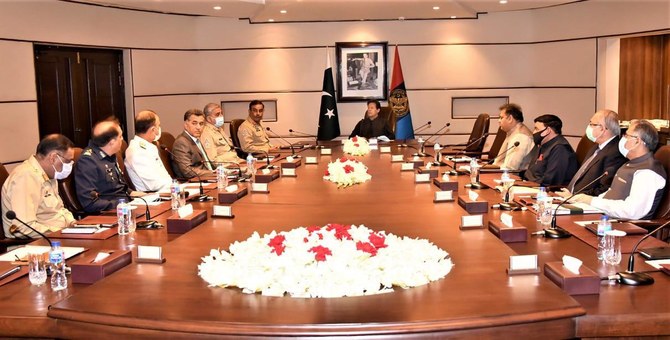
Prime Minister Imran Khan (center) receives briefing at the Inter-Services Intelligence (ISI) Secretariat on May 24, 2021. (Photo courtesy: Prime Minister's Office)
Short Url
Updated 24 May 2021
Follow

PM Khan, service chiefs briefed on regional, national security by top spy agency 

  • PM accompanied by top officials including foreign minister, army, air and naval chiefs 
  • Khan appreciates 'diligent' national security efforts, preparedness of ISI

ISLAMABAD:  Prime Minister Imran Khan and top civilian and military leaders of Pakistan were given a briefing on regional and national security on Monday during a visit to the Inter-Services Intelligence (ISI) Secretariat. 
The leaders, which included Foreign Minister Shah Mahmood Qureshi, Chief of the Army Staff General Qamar Javed Bajwa, Chief of the Naval Staff Admiral Muhammad Amjad Khan Niazi and Chief of the Air Staff Air Chief Marshal Zaheer Ahmed Babar, were received at the ISI Secretariat by ISI chief Lt Gen Faiz Hameed, according to a press release by the Prime Minister's Office.
“A comprehensive briefing was given to the National and Military leadership on the regional and national security situation,” the statement said. “Prime Minister appreciated the diligent efforts of Inter Services Intelligence for National Security and expressed his satisfaction over professional preparedness.”

Five publicly known meetings between Khan and the army chief and ISI director general have taken place in the past few months under this format, Pakistan’s Dawn news reported. 
Others at Monday’s meeting were Defence Minister Pervaiz Khattak, Information Minister Chaudhry Fawad Hussain, Interior Minister Sheikh Rashid Ahmed and Chairman Joint Chiefs of Staff Committee General Nadeem Raza.


Pakistan remembers Benazir Bhutto, first woman PM in Muslim world, on death anniversary

Updated 5 sec ago
Follow

Pakistan remembers Benazir Bhutto, first woman PM in Muslim world, on death anniversary

  • Bhutto was daughter of ex-PM Zulfikar Ali Bhutto who was hanged during reign of former military ruler Gen. Zia-ul-Haq
  • Year before assassination in 2007, Bhutto signed landmark deal with rival Nawaz Sharif to prevent army interventions

ISLAMABAD: Prime Minister Shehbaz Sharif and other Pakistani leaders on Saturday paid tribute to Benazir Bhutto, the first woman prime minister in the Muslim world who was assassinated 18 years ago in a gun and bomb attack after a rally in the city of Rawalpindi.

Born on Jun. 21, 1953, Bhutto was elected premier for the first time in 1988 at the age of 35. She was deposed in 1990, re-elected in 1993, and ousted again in 1996, amid allegations of corruption and mismanagement which she denied as being politically motivated.

Bhutto only entered politics after her father was hanged in 1979 during military ruler Gen. Zia-ul-Haq’s reign. Throughout her political career, she had a complex and often adversarial relationship with the now ruling Sharif family, but despite the differences signed a ‘Charter of Democracy’ in 2006 with three-time former PM Nawaz Sharif, pledging to strengthen democratic institutions and prevent military interventions in Pakistan in the future.

She was assassinated a year and a half later.

“Mohtarma Benazir Bhutto took exemplary steps to strengthen the role of women, protect the rights of minorities, and make Pakistan a peaceful, progressive, and democratic state,” PM Shehbaz Sharif, younger brother of ex-PM Nawaz Sharif, said in a statement on Saturday.

“Her sacrifices and services are a beacon of light for the nation.”

President Asif Ali Zardari, Bhutto’s widower, said Bhutto believed in an inclusive Pakistan, rejected sectarianism, bigotry and intolerance, and consistently spoke for the protection of minorities.

“Her vision was of a federation where citizens of all faiths could live with dignity and equal rights,” he said. “For the youth of Pakistan, her life offers a clear lesson: speak up for justice, organize peacefully and do not surrender hope in the face of adversity.”

Powerful families like the Bhuttos and the Sharifs of Pakistan to the Gandhis of India and the Bandaranaike family of Sri Lanka have long dominated politics in this diverse region since independence from British colonial rule. But none have escaped tragedy at the hands of rebels, militants or ambitious military leaders.

It was Zulfikar Ali Bhutto, Bhutto’s father, who founded the troubled Bhutto dynasty, becoming the country’s first popularly elected prime minister before being toppled by the army in 1977 and later hanged. Both his sons died in mysterious circumstances.

Before her assassination on Dec. 27, 2007, Bhutto survived another suicide attack on her motorcade that killed nearly 150 people as she returned to Pakistan after eight years in exile in October 2007.

Bhutto’s Oxford-educated son, Bilawal Bhutto-Zardari, now leads her Pakistan Peoples Party, founded by her father, and was foreign minister in the last administration of PM Shehbaz Sharif.

Aseefa Bhutto Zardari, Bhutto’s daughter who is currently the first lady of Pakistan, said her mother lived with courage and led with compassion in life.

“Her strength lives on in every voice that refuses injustice,” she said on X.

Pakistan has been ruled by military regimes for almost half its history since independence from Britain in 1947. Both former premiers Imran Khan and the elder Sharif, Nawaz, have alleged that they were ousted by the military after they fell out with the generals. The army says it does not interfere in politics.