

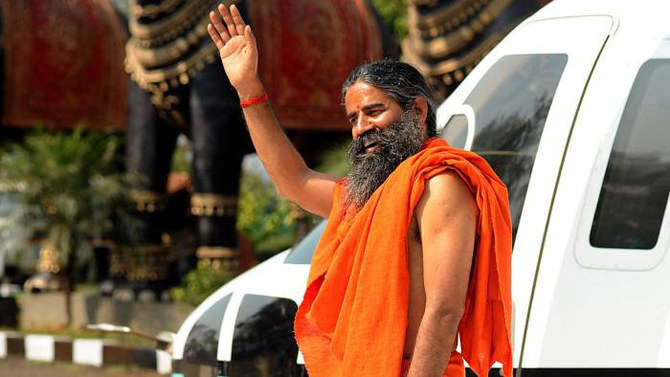

NEW DELHI: In the wake of widespread outrage coming from doctors, India’s Health Minister Dr. Harsh Vardhan has asked controversial yoga guru Baba Ramdev to withdraw his recent comments blaming heath workers for huge numbers of coronavirus deaths as the country is in a grip of a second wave of the pandemic.
“The people of the country are very hurt with your remark on allopathic medicines,” Harshvardhan said in an open letter to Ramdev.
“You have not only insulted corona warriors, but have hurt the feelings of the people of the country,” he said, as he asked the guru to “think hard on it and withdraw your statements completely.”
The Indian Medical Association (IMA), one of India’s premier medical bodies, earlier demanded that the government take action against Ramdev.
“We have already filed a case against him and sent a legal notice. We will launch a national campaign,” Dr. Jayesh Lele, IMA secretary, told Arab News.
He added that Ramdev’s comments were “discouraging” for medical practitioners and health workers, and would “hamper the fight against the virus.”
Lele said: “With his false statement, people will suffer, as they will hesitate to visit hospitals, delay treatments and fall prey to the virus. This is why the government should act against Ramdev.”
On Thursday, the popular guru, who enjoys a massive cult following across India, blamed medical practitioners for the country’s growing death toll amid a deadly second coronavirus wave in the country.
“Lakhs of patients have died because of allopathic medicines, rather than a shortage of oxygen,” he told supporters in the northern Indian city of Haridwar, where he runs a yoga training center and oversees an $100 million business empire selling Ayurvedic products.
The use of traditional medicines has been widely promoted by Ramdev, who also holds yoga camps attended by thousands in India and abroad.
On Saturday, when medical practitioners demanded action against the guru, his deputy and main aide, Balkrishna, said that the video in which Ramdev is heard making the comments was “truncated” and that the yoga guru had “no ill will” toward modern science or its practitioners.
“It is necessary to mention that the event was a private event, and Ramdev was reading out a forwarded WhatsApp message received by him and various other members who were taking part in the event,” Balkrishna said in a statement.
“He believes that allopathy is a progressive science, and a combination of allopathy, Ayurveda and yoga will be beneficial,” he added.
The controversy is not the first time that Ramdev has ruffled feathers with his remarks.
As a divisive figure who reportedly enjoys close contact with government figures, Ramdev’s critics blame him for exploiting his followers to advance sales of his product lines.
In February this year, he launched the Ayurvedic tablet Coronil, which can reportedly cure coronavirus. At the time, Ramdev claimed that the medicine had received certification from the Ayush ministry, set up by the Indian government in 2014 to promote alternative therapies, such as yoga and traditional Ayurveda medicine.
While launching the drug, Ramdev said: “It will work not only for the treatment, prevention and cure of coronavirus, but also for other symptoms.”
However, various experts and research studies disputed his claims.
Dr. Nirmalya Mohapatra from the Dr. Ram Manohar Lohia Hospital in the capital New Delhi, said that Ramdev “was doing this just to sell his product.”
Mohapatra added: “Ramdev’s statement is very unwelcome and will do more harm, and the government should make an example out of him by filing a case against him.
“The fear is that people might not take proper care of themselves if they get infected.”
On Sunday, India registered 240,000 cases and more than 3700 coronavirus-related deaths, a slight decline from the fatality count reported last week.
The second wave has been deadly for India, with thousands of lives lost due to a lack of oxygen and hospital beds.
Meanwhile, Ramdev’s statement has also ignited a debate in India about the use of homemade concoctions to treat the deadly disease, with experts fearing that his “attack on modern medical treatment” could further undermine India’s faith in science.
Dr. Prashant Munde in the western Indian city of Pune said that he felt “demoralized” by the recent controversy.
Munde added: “For the last year, we have put our lives at stake to save lives despite limited resources, and if Ramdev publicly speaks against the doctors, it is not only demoralizing for us, but also limits our ability to convince people to receive vaccinations.
“The doubt created by such people is affecting vaccination levels. Some districts of Maharashtra are resisting vaccination, and such a statement will further boost this resistance.
He demanded that the government boost doctors’ morale after “the loss of close to 500 members in the last two months.”
New Delhi-based Dr. Harjit Singh Bhatti, national president of the Progressive Medicos and Scientists Forum, said that Ramdev’s comments were “both political and invited violence against doctors.”
He added: “The kind of following Ramdev has will further increase vaccine hesitancy among people and his followers, and people will not take the medical fraternity’s efforts seriously.
“Ramdev has put health workers in danger, a group that is already facing emotional outbursts from people losing their loved ones. An anti-doctor statement by an influential person endangers the lives of health workers, who are already stretched to the limit.”
He accused the yoga guru of promoting “duplicitous products by attacking medical science” and was “doubtful whether the government will take any action against him.
“Ramdev is part of the ruling party’s ecosystem of promoting traditional ancient Indian science and religious texts and myths at the cost of modern science,” Bhatti said, adding: “Promoting science runs against the grain of present political thought.”


