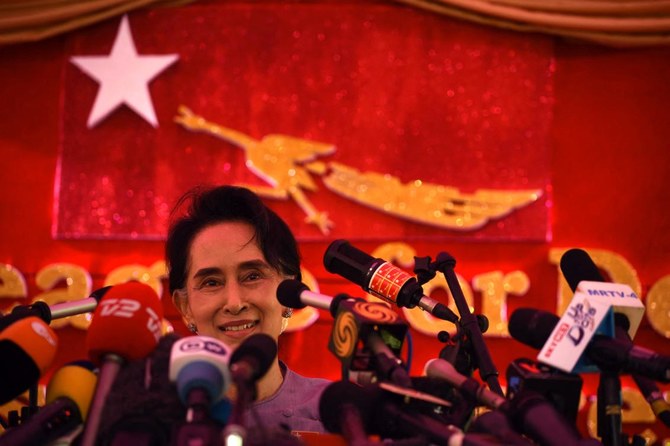
Myanmar’s junta leader Min Aung Hlaing said deposed leader Aung San Suu Kyi was healthy at home and would appear in court in a few days, in his first interview since overthrowing her in a Feb. 1 coup.
The coup has plunged the Southeast Asian country into chaos and one of several ethnic armed groups opposed to the ruling junta advanced to attack a military post in a northwestern jade mining town on Saturday, local media said.
Suu Kyi, a Nobel Peace Prize laureate for her long struggle against previous military rulers, is among more than 4,000 people detained since the coup. She faces charges that range from illegally possessing walkie-talkie radios to violating a state secrets law.
“Daw Aung San Suu Kyi is in good health. She is at her home and healthy. She is going to face trial at the court in a few days,” Min Aung Hlaing said by video link with the Hong Kong-based Chinese language broadcaster Phoenix Television on May 20, in excerpts released on Saturday.
The interviewer asked him what he thought of the performance of Suu Kyi, 75, who is widely admired in the country of 53 million for her campaign that had brought tentative democratic reforms which were cut short by the coup.
“She tried all she could,” Min Aung Hlaing responded.
He reiterated that the army had seized power because it had identified fraud in an election won by Suu Kyi’s party in November — although its accusations were rejected by the then election commission.
He said the army would hold elections and potential changes to the constitution had been identified and would be made if they were “the people’s will.”
Suu Kyi’s next court appearance is due on Monday in the capital Naypyidaw. So far she has appeared only by video link and as yet to be allowed to speak directly to her lawyers.
The junta has cited security reasons for not allowing her to speak to her lawyers in private at a time the military authorities have not established control of the country in the face of daily protests, strikes and renewed insurgencies.
The Kachin Independence Army (KIA) attacked an army post at Hkamti township in the Sagaing region early on Saturday, the Irrawaddy and Mizzima online publications said. Pictures showed columns of dark smoke rising from the scene.
KIA spokesman Naw Bu told Reuters he was aware of the attack but could give no details. Reuters was unable to reach a junta spokesman for comment.
Mizzima said the site attacked was near a mining venture that involves the military-owned Myanma Economic Holdings Ltd. conglomerate. Independent broadcaster DVB said three members of the security forces had been wounded and nine were captured by the insurgents.
Reuters was unable to confirm the reports independently.
Since the coup, open conflict resumed between the army and the KIA, which has been fighting for greater autonomy for the Kachin people for some six decades and has voiced support for anti-junta protesters.
Mizzima said the army used jets in attacks on the KIA at Hkamti, a town on the Chindwin river in a remote region rich in jade and gold about 50 km (30 miles) from the border with India.
The army has carried out numerous bombing attacks on KIA positions in recent weeks and has also clashed with ethnic armies in the east and west of Myanmar.
Security forces have killed at least 812 people since the coup, according to the Assistance Association for Political Prisoners activist group.
Min Aung Hlaing said the actual figure was around 300 and that 47 police had also been killed.
Myanmar media reported that a soldier had been killed in a shooting in the commercial hub, Yangon, on Saturday.

Myanmar junta leader says Aung San Suu Kyi will soon appear
Short Url
https://arab.news/76bef
Myanmar junta leader says Aung San Suu Kyi will soon appear
- The military coup has plunged the Southeast Asian country into chaos
Sweden plans to tighten rules for gaining citizenship
STOCKHOLM: Sweden said Monday it planned to tighten rules to acquire citizenship, introducing “honest living” and financial requirements, a language and general knowledge test and raising the residency requirement from five to eight years.
If approved by parliament, the new rules would enter into force on June 6, Sweden’s national holiday, and would apply even to applications already being processed.
Migration Minister Johan Forssell, whose right-wing minority government holds a majority with the backing of the far-right Sweden Democrats, told reporters it was currently too easy to acquire Swedish citizenship.
“Citizenship needs to mean more than it does today,” he said.
“Pride is something you feel when you’ve worked hard at something. But working hard is not something that has characterised citizenship.
“It has been possible to become a citizen after five years without knowing a single word of Swedish, without knowing anything about our Swedish society, without having any own income.”
Referring to a case that recently made headlines, he said: “You can even become one while you’re sitting in custody accused of murder.
“This obviously sends completely wrong signals, both to those who do right by themselves and those who are already citizens.”
Following a large influx of migrants to Sweden during the 2015 migrant crisis, successive left- and right-wing governments have tightened asylum and migration rules.
The country has for years struggled to integrate migrants, with many not learning the language and living in disadvantaged areas with higher crime and jobless rates.
Under the new rules, those who have criminal records — in their home country or in Sweden — and who have served their sentence would have to wait up to 17 years before being allowed to apply for citizenship, up from the current 10 years.
In addition, those deemed to not adhere to “honest living” requirements would not be granted citizenship.
That could include racking up mountains of debt, being served restraining orders or even having a drug addiction.
Applicants would also have to have a monthly pre-tax income of 20,000 kronor ($2,225), excluding pensioners and students.
The citizenship tests would be similar to those used in neighboring Denmark and the United States, the government said, with the first tests due to be held in August.
If approved by parliament, the new rules would enter into force on June 6, Sweden’s national holiday, and would apply even to applications already being processed.
Migration Minister Johan Forssell, whose right-wing minority government holds a majority with the backing of the far-right Sweden Democrats, told reporters it was currently too easy to acquire Swedish citizenship.
“Citizenship needs to mean more than it does today,” he said.
“Pride is something you feel when you’ve worked hard at something. But working hard is not something that has characterised citizenship.
“It has been possible to become a citizen after five years without knowing a single word of Swedish, without knowing anything about our Swedish society, without having any own income.”
Referring to a case that recently made headlines, he said: “You can even become one while you’re sitting in custody accused of murder.
“This obviously sends completely wrong signals, both to those who do right by themselves and those who are already citizens.”
Following a large influx of migrants to Sweden during the 2015 migrant crisis, successive left- and right-wing governments have tightened asylum and migration rules.
The country has for years struggled to integrate migrants, with many not learning the language and living in disadvantaged areas with higher crime and jobless rates.
Under the new rules, those who have criminal records — in their home country or in Sweden — and who have served their sentence would have to wait up to 17 years before being allowed to apply for citizenship, up from the current 10 years.
In addition, those deemed to not adhere to “honest living” requirements would not be granted citizenship.
That could include racking up mountains of debt, being served restraining orders or even having a drug addiction.
Applicants would also have to have a monthly pre-tax income of 20,000 kronor ($2,225), excluding pensioners and students.
The citizenship tests would be similar to those used in neighboring Denmark and the United States, the government said, with the first tests due to be held in August.
© 2026 SAUDI RESEARCH & PUBLISHING COMPANY, All Rights Reserved And subject to Terms of Use Agreement.


