

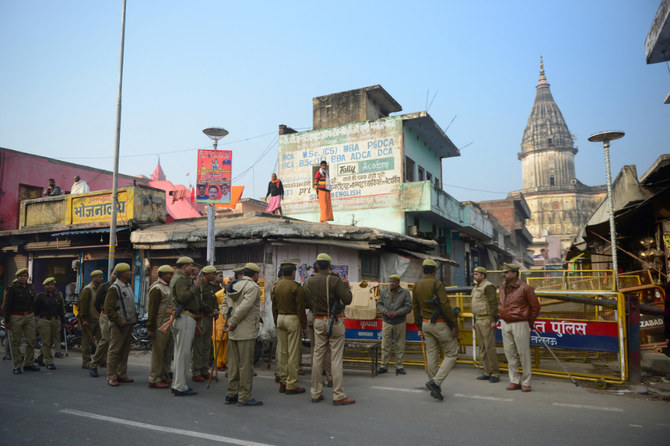

NEW DELHI: Fear has gripped the Muslim community in northern India after a local administration defied a court order and razed a century-old mosque in Uttar Pradesh.
The demolition of the 112-year-old mosque in the town of Ram Sanehi Ghat in the Barabanki district was one of the most inflammatory actions against the state’s Muslim community since the razing of the 16th-century Babri Masjid by a Hindu mob in the neighboring town of Ayodhya in 1992.
Despite a high court decision staying any kind of demolition until May 31, the local administration bulldozed the building on Monday after declaring it an “illegal structure.”
“This was a mosque where people have been offering prayers for decades, and the demolition has sent shock waves among people fearing arrests and reprisals from the administration for resisting the action,” one of the mosque’s committee members, Mohammed Nasim, told Arab News on Thursday.
“What was the urgency to demolish it when the whole state is fighting a grim battle against the pandemic? he said.
Uttar Pradesh, India’s largest and most populous state, is governed by Yogi Adityanath, a politician from the country’s ruling Bharatiya Janata Party (BJP), known for his anti-Muslim sentiment.
The local administration denied any wrongdoing, saying there was no mosque at the demolition site.
“I am not aware of any mosque being demolished,” Barabanki District Magistrate Dr. Adarsh Singh told Arab News. “It was an illegal residential property.”
But Zufar Farooqui, chairman of the Uttar Pradesh Central Sunni Waqf Board, questioned the magistrate’s claim: “The mosque has been standing in front of the residence of the Subdivision District Magistrate for years. This cannot be denied. How did the mosque become an illegal structure? It is registered with Sunni Waqf Board.”
On March 15, the district administration asked the mosque committee to clarify the issue of its ownership. The committee said it had submitted all the required documents and on the same day moved the high court fearing that the mosque might face “imminent demolition.” The court said the district administration was only seeking documentation.
Next month, on the grounds of a rapid surge in coronavirus disease (COVID-19) infections in the state, the Allahabad High Court ruled on April 24 that any order of eviction, dispossession or demolition would remain suspended until May 31.
As bulldozers entered the site on Monday, the incident sent shock waves among the Muslim community, which constitutes nearly half of the town’s population of 30,000.
“To create fear, the local administration filed a case against 28 people and then released them. One was booked under the draconian National Security Act,” Nasim said.
Nasim’s neighbor, Israr Ahmad, told Arab News that people did not hold protests when the demolition was taking place for “fear of arrest.”
“We are scared. We are not allowed to go near the site,” Ahmad said. “Our only hope is that the high court takes note of that.”
As the pandemic wreaks havoc in the state, observers question the timing and intention of the demolition drive, with some suggesting that its purpose was to distract attention from the administration’s failures in its response to the COVID-19 crisis.
“The failure to manage the pandemic has impacted the BJP’s core voters, and they are again resorting to divisive politics to sway voters before the next election,” Deepak Kabir, a social activist from the state capital of Lucknow, told Arab News.
According to Lucknow-based political analyst Asad Rizvi, the demolition was “a planned attack on the mosque,” as Ayodhya and Barabanki are neighboring districts.
“The BJP government both in the center and the state is facing unprecedented criticism for its handling of the second wave of COVID-19,” he said. “This is an attempt to divert the attention of the people away from their failure when they know that they are going to have state elections within nine months.”


