



LONDON: On May 8, Saudi Minister of State for Foreign Affairs Adel Aljubeir took to Twitter to ask whether or not those who have accused the Kingdom of the so-called Bezos Hack would come forward and acknowledge their mistake, or “simply delete their tweets and hope that their positions at the time disappear into the sunset?”
The Bezos Hack refers to an incident in January 2020 when Saudi Arabia’s Crown Prince Mohammed bin Salman was accused, without any proof, of illegally tapping into the phone of Amazon’s Executive Chairman Jeff Bezos. The crown prince was accused of leaking news of the affair with presenter Lauren Sanchez to US tabloid the National Enquirer because of Bezos’s ownership of the Washington Post.
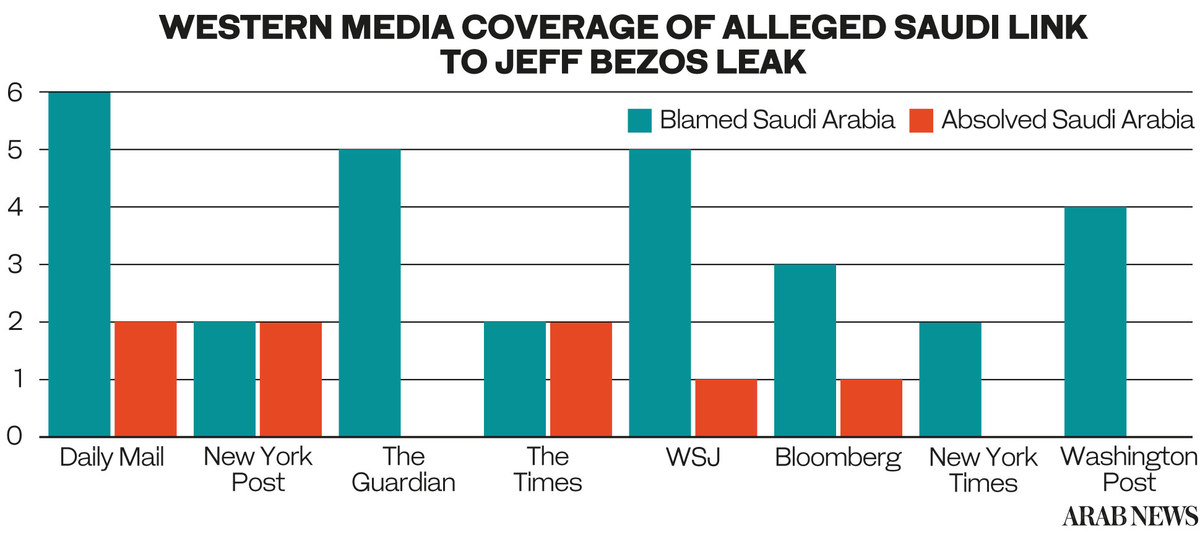
For over a year, major Western news outlets — from the New York Times and Washington Post to Britain’s Guardian and Daily Telegraph — have peddled story after story of the alleged leak by Saudi Arabia and each revelation that came afterwards.
And yet, when Bloomberg Businessweek published an excerpt from journalist and author Brad Stone’s tell-all book on the Amazon chief which revealed the truth behind the leak, the final follow-up story never came.
“This was a serious accusation and if evidence emerges that it’s untrue it’s important that media outlets either report this or correct their previous stories,” William Neal, a London-based strategic communications consultant, told Arab News.
“More broadly, too often Western outlets are keen to cast Saudi Arabia in a negative light rather than reporting the facts. Their audience deserves to see the full picture, not partial reporting,” Neal said.
The truth — which appears to have involved nothing more than Sanchez’s Hollywood B-list agent brother selling his sister out for $200,000 in what was described as a “public-relations masterstroke” from Bezos — was not as useful to the outlets as a falsified Saudi connection was.
The Saudi angle, as Stone notes, was “only a fog of overlapping events, weak ties between disparate figures and more strange coincidences.”
He added: “For Bezos and his advisers, though, who were still trying to positively spin the embarrassing events surrounding his divorce, such a cloud of uncertainty was at the very least distracting from the more unsavory and complicated truth.”
A two-week media monitoring period by Arab News since the Bloomberg Businessweek revelation saw few Western outlets publish features on the latest update or correct their previous reporting, which has now been proven to be unsubstantiated.
Outlets including the New York Times and CNN, among others, did not run the story — a decision which goes against their supposed professional journalism practices and industry norms. Meanwhile, the Bezos-owned Washington Post found itself in its own conflict of interest where it vehemently defended its owner throughout the ordeal, while keeping silent over the latest findings.
“I would say that it does show bias when media outlets don’t take the time to correct incorrect claims, and issue corrections when new information comes out. Or sometimes what we'll see is they will issue the correction, but they'll do it quietly. So then, the original incorrect story got a lot more attention.” Julie Mastrine, director of marketing at AllSides, a US media watchdog, told Arab News.
“Our position is that ‘there is no such thing as unbiased news’ and what people really need to do is become aware of that and then learn how to spot bias and read broadly across the political spectrum so that they get multiple perspectives that can kind of challenge them to think critically and consider multiple angles.”
The Bezos-Washington Post conflict of interest has, however, been the subject of coverage by the New York Post and the Wall Street Journal. They, as well as the Daily Mail and The Times of London, have published features revealing how Bezos took advantage of his ownership of the Washington Post and of former US President Donald Trump’s alleged ties to the National Enquirer to cast himself as a “political target.”
The Journal’s Holman W. Jenkins wrote in a column: “Seldom will you find a newspaper admitting that it lied to you unless it can push the blame off on a plagiarizing or fabulizing reporter who will be said to have defrauded his or her own editors and institution. Now the Washington Post has an owner who fits this description.”
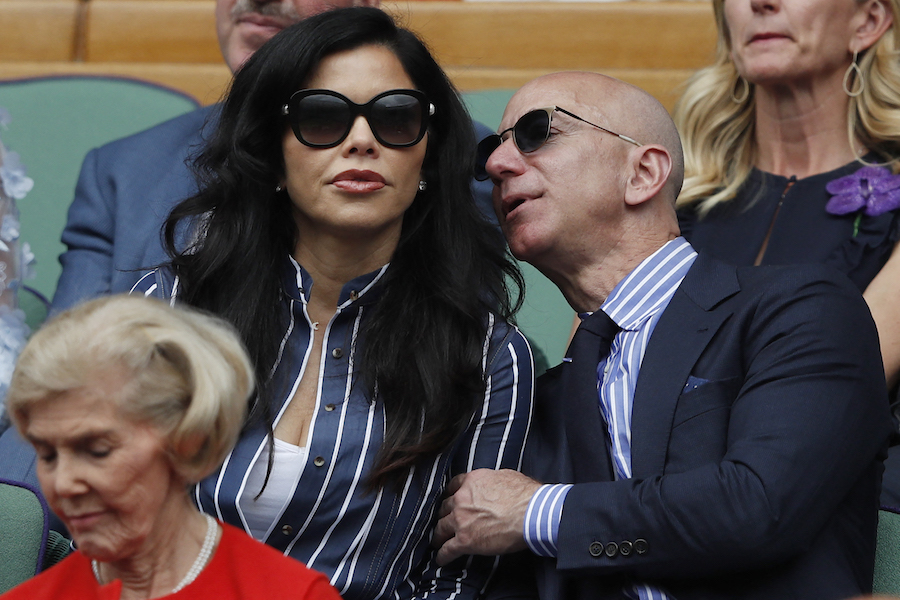
Amazon Founder Jeff Bezos (R) and his partner US new anchor Lauren Sanchez. (File/AFP)
A Saudi newspaper editor and a member of the Saudi Journalists Association said: “This wouldn’t be the first time that Western media has been accused of foregoing the standards of journalism that it holds others accountable for.”
They added: “It is understandable that in our industry, most editors prefer bad news and scandals. Nobody is asking these British and American newspapers for favorable coverage of Saudi Arabia, what we as fellow journalists expect of them however is to abide by their own professional standards and retract or apologize for the false stories they published.”
Other examples of bias in Western media came last March when a Houthi-caused fire at a Yemeni migrant detention center killed scores of Ethiopians. Fewer than a handful of Western media outlets covered the incident. Meanwhile, any mistakes committed by Saudi Arabia — ones that the Kingdom has acknowledged and apologized for — are immediately scrutinized by the press.
The lack of coverage of the migrant fire even stoked criticism from one of Black Lives Matter Greater New York’s founding members.
“This is an issue that needs attention. This is something that can’t be ignored. This is something I won’t ignore. There are 44 people murdered and the news isn’t paying attention,” Hawk Newsome said in an interview on the Arab News-sponsored Ray Hanania radio show.
“I have strong reason to believe that the news isn’t paying attention because they’re black people. It’s my duty to fight for black people across the world.”
Twitter: @Tarek_AliAhmad


