

Italy and UNESCO sign €1 million agreement to restore Beirut’s Sursock museum damaged in port blasts

1 / 2
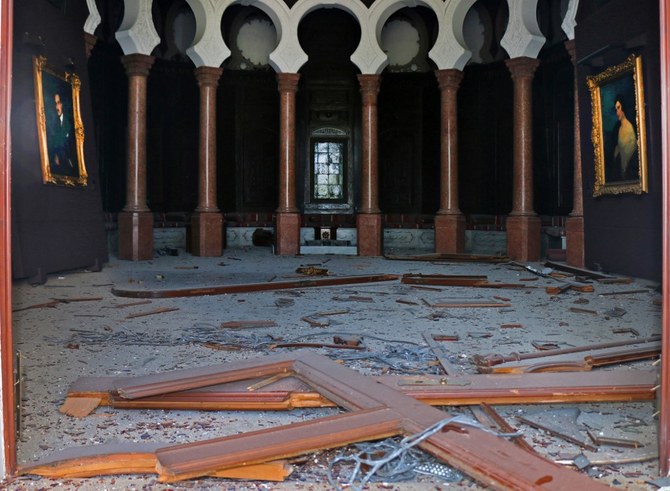
The agreement was signed in front of the damaged facade of the Sursock Museum. (Supplied)
2 / 2
The Sursock Museum suffered severe damage during the Beirut Port blast. (AFP/File)
Short Url
Updated 17 May 2021
Follow

Italy and UNESCO sign €1 million agreement to restore Beirut’s Sursock museum damaged in port blasts

  • Cost of restoring the museum has been estimated at nearly €2.5 million
  • Historic villa suffered severe damage during the explosion in August

RIYADH: Italy and the UN’s cultural arm have signed a €1 million ($1.21 million) funding agreement to renovate one of  Beirut’s most famous museums.

Located in a historic villa in Achrafieh, the Sursock Museum was severely damaged in the Beirut port blasts last August.

The building houses more than 1,500 works of art along with other valuable collections.

The memorandum of understanding was signed by the Italian Deputy Minister of Foreign Affairs Marina Sereni and the director of UNESCO’s Beirut office, Costanza Farina, in the presence of the chairman of the museum’s board of trustees, Dr. Tarek Mitri.
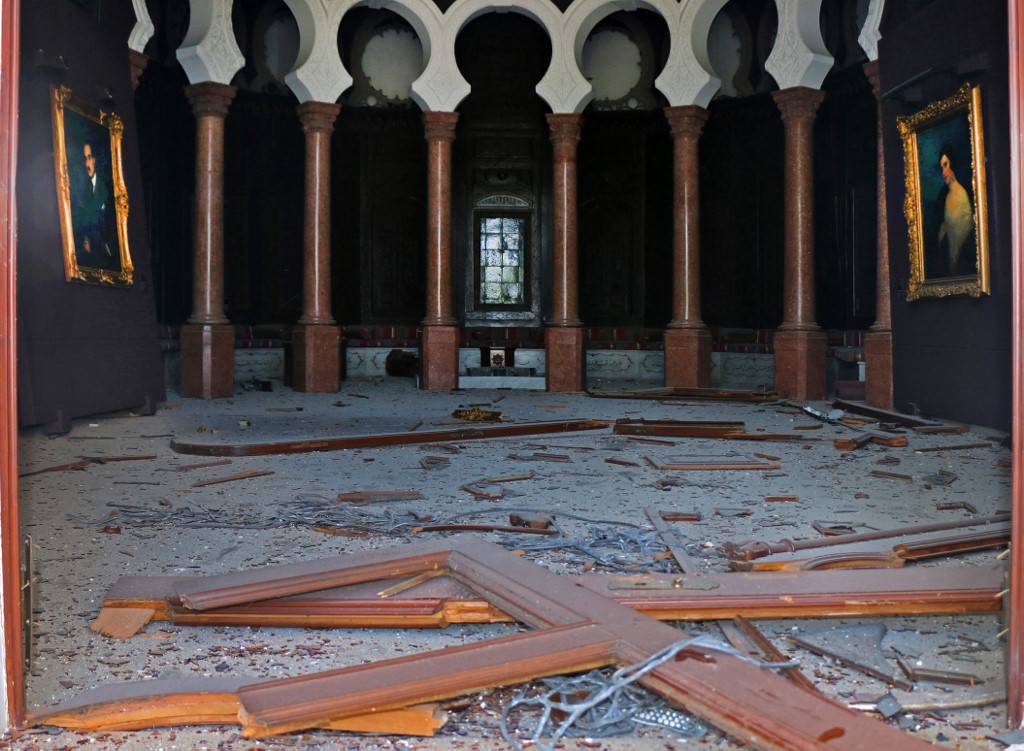


The Sursock Museum suffered severe damage during the Beirut Port blast. (AFP/File) 

“We firmly believe that culture and the protection of heritage are needed in times of crisis, more than ever,” Sereni said. “To this end, the Lebanese population can continue counting on the support and the partnership of the Italian Government and its people.”

The cost of restoring the museum has been estimated at nearly €2.5 million with France already giving €500,000 to replace the smashed stained-glass windows and wood-lined Arab salon.

The new funding will come through the Italian Agency for Development Cooperation (AICS) and be used under UNESCO’s Li Beirut initiative, which aims to repair schools, heritage buildings, museums and galleries damaged in the Beirut blasts. 

“The Italian Cooperation and UNESCO’s support for the reconstruction of the museum is invaluable,” Zeina Arida, director of the Sursock Museum, said. “It will allow Beirut and its citizens to reclaim a space that has become a second home for so many people in the cultural sector and the local community at large, a space which aims to promote openness and support knowledge production.”

Farina said the funding was the largest contribution so far to the Li Beirut initiative.

“I salute Italy for its positive response to our call that will support the rehabilitation and revitalization of the museum as a heritage building as well as a promoter of cultural life,” she said.

Sursock Museum was set up in the 1912 villa donated by Lebanese collector Nicolas Sursock. It opened in 1961 and became a major hub for Lebanese artists, while hosting exhibitions from around the world.
It stayed open during much of the Lebanese Civil War and underwent a major renovation in 2008.

Located just 800 meters from the center of the port blast, the museum suffered severe structural damage.

First responders enter devastated Aleppo neighborhood after days of deadly fighting

Updated 12 January 2026
Follow

First responders enter devastated Aleppo neighborhood after days of deadly fighting

  • The US-backed SDF, which have played a key role in combating the Daesh group in large swaths of eastern Syria, are the largest force yet to be absorbed into Syria’s national army

ALEPPO, Syria: First responders on Sunday entered a contested neighborhood in Syria’ s northern city of Aleppo after days of deadly clashes between government forces and Kurdish-led forces. Syrian state media said the military was deployed in large numbers.
The clashes broke out Tuesday in the predominantly Kurdish neighborhoods of Sheikh Maqsoud, Achrafieh and Bani Zaid after the government and the Syrian Democratic Forces, the main Kurdish-led force in the country, failed to make progress on how to merge the SDF into the national army. Security forces captured Achrafieh and Bani Zaid.
The fighting between the two sides was the most intense since the fall of then-President Bashar Assad to insurgents in December 2024. At least 23 people were killed in five days of clashes and more than 140,000 were displaced amid shelling and drone strikes.
The US-backed SDF, which have played a key role in combating the Daesh group in large swaths of eastern Syria, are the largest force yet to be absorbed into Syria’s national army. Some of the factions that make up the army, however, were previously Turkish-backed insurgent groups that have a long history of clashing with Kurdish forces.
The Kurdish fighters have now evacuated from the Sheikh Maqsoud neighborhood to northeastern Syria, which is under the control of the SDF. However, they said in a statement they will continue to fight now that the wounded and civilians have been evacuated, in what they called a “partial ceasefire.”
The neighborhood appeared calm Sunday. The United Nations said it was trying to dispatch more convoys to the neighborhoods with food, fuel, blankets and other urgent supplies.
Government security forces brought journalists to tour the devastated area, showing them the damaged Khalid Al-Fajer Hospital and a military position belonging to the SDF’s security forces that government forces had targeted.
The SDF statement accused the government of targeting the hospital “dozens of times” before patients were evacuated. Damascus accused the Kurdish-led group of using the hospital and other civilian facilities as military positions.
On one street, Syrian Red Crescent first responders spoke to a resident surrounded by charred cars and badly damaged residential buildings.
Some residents told The Associated Press that SDF forces did not allow their cars through checkpoints to leave.
“We lived a night of horror. I still cannot believe that I am right here standing on my own two feet,” said Ahmad Shaikho. “So far the situation has been calm. There hasn’t been any gunfire.”
Syrian Civil Defense first responders have been disarming improvised mines that they say were left by the Kurdish forces as booby traps.
Residents who fled are not being allowed back into the neighborhood until all the mines are cleared. Some were reminded of the displacement during Syria’s long civil war.
“I want to go back to my home, I beg you,” said Hoda Alnasiri.