

SoftBank joins top earners with $37bn Vision Fund profit

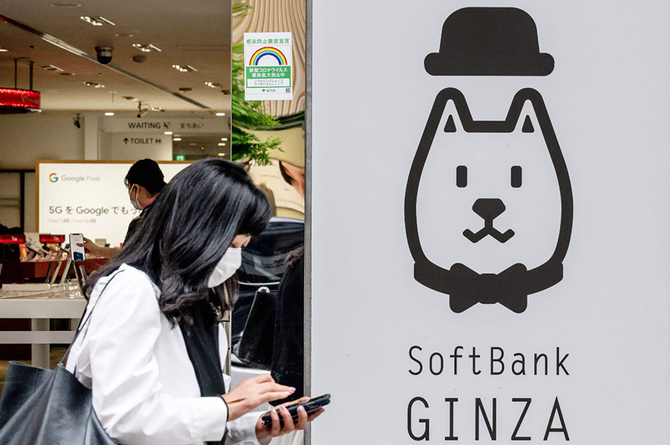
A woman walks past a logo of the SoftBank Group in Tokyo on Wednesday. (AFP)
Short Url
Updated 13 May 2021
Follow

SoftBank joins top earners with $37bn Vision Fund profit

  • SoftBank has hiked its committed capital in the second fund to $30 billion from $10 billion

TOKYO: SoftBank Group Corp. on Wednesday reported a record fourth quarter 4.03 trillion yen ($36.99 billion) Vision Fund unit profit from an investment gain on Coupang, putting it among the world’s biggest earning firms a year after an unprecedented loss.

Group net profit was 4.99 trillion yen ($45.88 billion) in the year ended March, beating the $42.5 billion made by Warren Buffett’s Berkshire Hathaway Inc. in its last business year.

It also compares with a 962 billion yen loss a year earlier after teetering tech bets depressed the value of Softbank’s portfolio.

“It’s clearly validation of Masa’s thesis,” Navneet Govil, Vision Fund’s chief financial officer, told Reuters in an interview, referring to company founder and CEO Masayoshi Son.

Market enthusiasm for tech stocks drove the public listing of SoftBank-backed e-commerce firm Coupang and used-car trading platform Auto1 Group and the rising share price of ride-hailing firm Uber during the quarter.

To sustain Softbank’s position among the global corporate elite, Son will have to replicate that fourth quarter performance with other yet-to-list companies in the Vision fund portfolio. Son has likened that to laying golden eggs.

Candidates including ride-hailing firm Didi, TikTok owner Bytedance and truck service platform Full Truck Alliance have strong revenue growth, healthy market share and a clear path to profitability, according to Govil.

These companies are “sizeable investments with significant value to be unlocked,” he said.

Much of Vision Fund’s gain, however, is on paper with the value of the portfolio locked up in the stock market amid concern over frothy valuations and a boom in special purpose acquisition vehicles (SPACs), which has drawn regulatory scrutiny.

The total fair value of the first $100 billion Vision Fund and the smaller second fund was $154 billion at the end of March, with SoftBank distributing $22.3 billion to limited partners.

SoftBank has hiked its committed capital in the second fund to $30 billion from $10 billion, reflecting the breadth of investment opportunities, Govil said.

Two of SoftBank’s highest profile bets, space sharing firm WeWork and ride-hailing firm Grab, have outlined plans to list via SPAC mergers, with Vision Fund reportedly in talks to use its own such vehicle to list portfolio company Mapbox. The Grab deal offers further upside for the Vision Fund should the transaction go through, Govil said.

The group’s trading arm, SB Northstar, is expanding deal making this week leading a $1 billion investment in acquisitive e-commerce firm THG.

SB Northstar and the broader group recorded a 233 billion yen loss on investments in listed stocks and derivatives as efforts to work cash reserves outside the Vision Fund sputter.

SoftBank has completed a 2.5 trillion yen buyback program launched last year, which pushed the stock price to two-decade highs in March. The end of the buyback pulls support at a time when shares are sliding in line with weakness in US tech stocks.


First EU–Saudi roundtable on critical raw materials reflects shared policy commitment

Updated 16 January 2026
Follow

First EU–Saudi roundtable on critical raw materials reflects shared policy commitment

RIYADH: The EU–Saudi Arabia Business and Investment Dialogue on Advancing Critical Raw Materials Value Chains, held in Riyadh as part of the Future Minerals Forum, brought together senior policymakers, industry leaders, and investors to advance strategic cooperation across critical raw materials value chains.

Organized under a Team Europe approach by the EU–GCC Cooperation on Green Transition Project, in coordination with the EU Delegation to Saudi Arabia, the European Chamber of Commerce in the Kingdom and in close cooperation with FMF, the dialogue provided a high-level platform to explore European actions under the EU Critical Raw Materials Act and ResourceEU alongside the Kingdom’s aspirations for minerals, industrial, and investment priorities.

This is in line with Saudi Vision 2030 and broader regional ambitions across the GCC, MENA, and Africa.

ResourceEU is the EU’s new strategic action plan, launched in late 2025, to secure a reliable supply of critical raw materials like lithium, rare earths, and cobalt, reducing dependency on single suppliers, such as China, by boosting domestic extraction, processing, recycling, stockpiling, and strategic partnerships with resource-rich nations.

The first ever EU–Saudi roundtable on critical raw materials was opened by the bloc’s Ambassador to the Kingdom, Christophe Farnaud, together with Saudi Deputy Minister for Mining Development Turki Al-Babtain, turning policy alignment into concrete cooperation.

Farnaud underlined the central role of international cooperation in the implementation of the EU’s critical raw materials policy framework.

“As the European Union advances the implementation of its Critical Raw Materials policy, international cooperation is indispensable to building secure, diversified, and sustainable value chains. Saudi Arabia is a key partner in this effort. This dialogue reflects our shared commitment to translate policy alignment into concrete business and investment cooperation that supports the green and digital transitions,” said the ambassador.

Discussions focused on strengthening resilient, diversified, and responsible CRM supply chains that are essential to the green and digital transitions.

Participants explored concrete opportunities for EU–Saudi cooperation across the full value chain, including exploration, mining, and processing and refining, as well as recycling, downstream manufacturing, and the mobilization of private investment and sustainable finance, underpinned by high environmental, social, and governance standards.

From the Saudi side, the dialogue was framed as a key contribution to the Kingdom’s industrial transformation and long-term economic diversification agenda under Vision 2030, with a strong focus on responsible resource development and global market integration.

“Developing globally competitive mineral hubs and sustainable value chains is a central pillar of Saudi Vision 2030 and the Kingdom’s industrial transformation. Our engagement with the European Union through this dialogue to strengthen upstream and downstream integration, attract high-quality investment, and advance responsible mining and processing. Enhanced cooperation with the EU, capitalizing on the demand dynamics of the EU Critical Raw Materials Act, will be key to delivering long-term value for both sides,” said Al-Babtain.

Valere Moutarlier, deputy director-general for European industry decarbonization, and directorate-general for the internal market, industry, entrepreneurship and SMEs at European Commission, said the EU Critical Raw Materials Act and ResourceEU provided a clear framework to strengthen Europe’s resilience while deepening its cooperation with international partners.

“Cooperation with Saudi Arabia is essential to advancing secure, sustainable, and diversified critical raw materials value chains. Dialogues such as this play a key role in translating policy ambitions into concrete industrial and investment cooperation,” she added.