

SoftBank joins top earners with $37bn Vision Fund profit

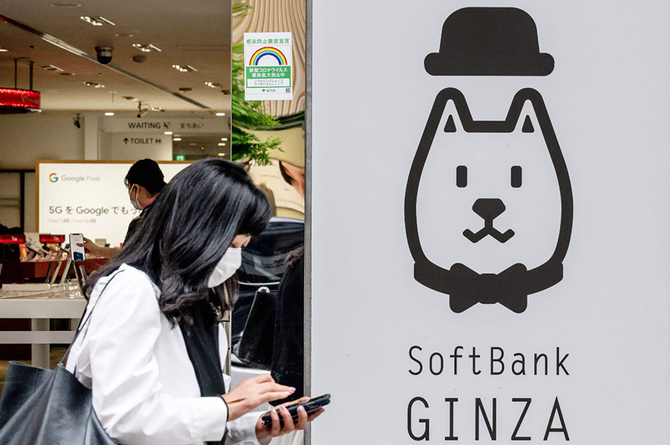
A woman walks past a logo of the SoftBank Group in Tokyo on Wednesday. (AFP)
Short Url
Updated 13 May 2021
Follow

SoftBank joins top earners with $37bn Vision Fund profit

  • SoftBank has hiked its committed capital in the second fund to $30 billion from $10 billion

TOKYO: SoftBank Group Corp. on Wednesday reported a record fourth quarter 4.03 trillion yen ($36.99 billion) Vision Fund unit profit from an investment gain on Coupang, putting it among the world’s biggest earning firms a year after an unprecedented loss.

Group net profit was 4.99 trillion yen ($45.88 billion) in the year ended March, beating the $42.5 billion made by Warren Buffett’s Berkshire Hathaway Inc. in its last business year.

It also compares with a 962 billion yen loss a year earlier after teetering tech bets depressed the value of Softbank’s portfolio.

“It’s clearly validation of Masa’s thesis,” Navneet Govil, Vision Fund’s chief financial officer, told Reuters in an interview, referring to company founder and CEO Masayoshi Son.

Market enthusiasm for tech stocks drove the public listing of SoftBank-backed e-commerce firm Coupang and used-car trading platform Auto1 Group and the rising share price of ride-hailing firm Uber during the quarter.

To sustain Softbank’s position among the global corporate elite, Son will have to replicate that fourth quarter performance with other yet-to-list companies in the Vision fund portfolio. Son has likened that to laying golden eggs.

Candidates including ride-hailing firm Didi, TikTok owner Bytedance and truck service platform Full Truck Alliance have strong revenue growth, healthy market share and a clear path to profitability, according to Govil.

These companies are “sizeable investments with significant value to be unlocked,” he said.

Much of Vision Fund’s gain, however, is on paper with the value of the portfolio locked up in the stock market amid concern over frothy valuations and a boom in special purpose acquisition vehicles (SPACs), which has drawn regulatory scrutiny.

The total fair value of the first $100 billion Vision Fund and the smaller second fund was $154 billion at the end of March, with SoftBank distributing $22.3 billion to limited partners.

SoftBank has hiked its committed capital in the second fund to $30 billion from $10 billion, reflecting the breadth of investment opportunities, Govil said.

Two of SoftBank’s highest profile bets, space sharing firm WeWork and ride-hailing firm Grab, have outlined plans to list via SPAC mergers, with Vision Fund reportedly in talks to use its own such vehicle to list portfolio company Mapbox. The Grab deal offers further upside for the Vision Fund should the transaction go through, Govil said.

The group’s trading arm, SB Northstar, is expanding deal making this week leading a $1 billion investment in acquisitive e-commerce firm THG.

SB Northstar and the broader group recorded a 233 billion yen loss on investments in listed stocks and derivatives as efforts to work cash reserves outside the Vision Fund sputter.

SoftBank has completed a 2.5 trillion yen buyback program launched last year, which pushed the stock price to two-decade highs in March. The end of the buyback pulls support at a time when shares are sliding in line with weakness in US tech stocks.


AI will never replace human creativity, says SRMG CEO 

Updated 30 January 2026
Follow

AI will never replace human creativity, says SRMG CEO 

  • Speaking to Maya Hojeij, senior business anchor at Asharq with Bloomberg, Jomana R. Alrashid expressed pride in SRMG platforms that had absorbed and adopted AI

RIYADH: Jomana R. Alrashid, CEO of Saudi Research and Media Group, highlighted how AI cannot replace human creativity during a session at The Family Office’s “Investing Is a Sea” summit at Shura Island on Friday. 

“You can never replace human creativity. Journalism at the end of the day, and content creation, is all about storytelling, and that’s a creative role that AI does not have the power to do just yet,” Alrashid told the investment summit. 

“We will never eliminate that human role which comes in to actually tell that story, do the actual investigative reporting around it, make sure to be able to also tell you what’s news or what’s factual from what’s wrong ... what’s a misinformation from bias, and that’s the bigger role that the editorial player does in the newsroom.”

Speaking on the topic of AI, moderated by Maya Hojeij, senior business anchor at Asharq with Bloomberg, the CEO expressed her pride in SRMG platforms that had absorbed and adopted AI in a way that was “transformative.”

“We are now translating all of our content leveraging AI. We are also now being able to create documentaries leveraging AI. We now have AI-facilitated fact-checking, AI facilities clipping, transcribing. This is what we believe is the future.”

Alrashid was asked what the journalist of the future would look like. “He’s a journalist and an engineer. He’s someone who needs to understand data. And I think this is another topic that is extremely important, understanding the data that you’re working with,” she said.

“This is something that AI has facilitated as well. I must say that over the past 20 years in the region, especially when it comes to media companies, we did not understand the importance of data.”


The CEO highlighted that previously, media would rely on polling, surveys or viewership numbers, but now more detailed information about what viewers wanted was available. 

During the fireside session, Alrashid was asked how the international community viewed the Middle Eastern media. Alrashid said that over the past decades it had played a critical role in informing wider audiences about issues that were extremely complex — politically, culturally and economically — and continued to play that role. 

“Right now it has a bigger role to play, given the role again of social media, citizen journalists, content creators. But I also do believe that it has been facilitated by the power that AI has. Now immediately, you can ensure that that kind of content that is being created by credible, tier-A journalists, world-class journalists, can travel beyond its borders, can travel instantly to target different geographies, different people, different countries, in different languages, in different formats.”

She said that there was a big opportunity for Arab media not to be limited to simply Arab consumption, but to finally transcend borders and be available in different languages and to cater to their audiences. 


The CEO expressed optimism about the future, emphasizing the importance of having a clear vision, a strong strategy, and full team alignment. 

Traditional advertising models, once centered on television and print, were rapidly changing, with social media platforms now dominating advertising revenue.

“It’s drastically changing. Ultimately in the past, we used to compete with one another over viewership. But now we’re also competing with the likes of social media platforms; 80 percent of the advertising revenue in the Middle East goes to the social media platforms, but that means that there’s 80 percent interest opportunities.” 

She said that the challenge was to create the right content on these platforms that engaged the target audiences and enabled commercial partnerships. “I don’t think this is a secret, but brands do not like to advertise with news channels. Ultimately, it’s always related with either conflict or war, which is a deterrent to advertisers. 

“And that’s why we’ve entered new verticals such as sports. And that’s why we also double down on our lifestyle vertical. Ultimately, we have the largest market share when it comes to lifestyle ... And we’ve launched new platforms such as Billboard Arabia that gives us an entry into music.” 

Alrashid said this was why the group was in a strong position to counter the decline in advertising revenues across different platforms, and by introducing new products.

“Another very important IP that we’ve created is events attached to the brands that have been operating in the region for 30-plus years. Any IP or any title right now that doesn’t have an event attached to it is missing out on a very big commercial opportunity that allows us to sit in a room, exchange ideas, talk to one another, get to know one another behind the screen.” 

The CEO said that disruption was now constant and often self-driving, adding that the future of the industry was often in storytelling and the ability to innovate by creating persuasive content that connected directly with the audience. 

“But the next disruption is going to continue to come from AI. And how quickly this tool and this very powerful technology evolves. And whether we are in a position to cope with it, adapt to it, and absorb it fully or not.”