Proud to plant Pakistan's flag atop Mount Everest — Shehroze Kashif

Kashif raises Pakistan's flag atop Mount Everest in Nepal on May 11, 2021. (Photo courtesy: Sheroze Kashif)
Short Url
Updated 13 May 2021
Follow

Proud to plant Pakistan's flag atop Mount Everest — Shehroze Kashif

  • Shehroze Kashif, 19, on Tuesday became the youngest Pakistani to climb the world’s highest peak
  • Kashif started climbing difficult mountainous terrains when he was just 11 years old

KHAPLU, GHANCHE: Shehroze Kashif, the youngest Pakistani to summit Mount Everest, says it was his duty to plant his country’s green flag at the top of the world.

The 19-year-old from Lahore reached the peak of the world’s highest mountain located in Nepal on Tuesday, as a part of Seven Summit Treks Everest Expedition 2021.

“It’s our duty to fly our flag wherever we can, whether it’s a mountain or other place,” Kashif told Arab News over the phone from Everest base camp on Wednesday. “Wherever you can, fly your green flag high.”
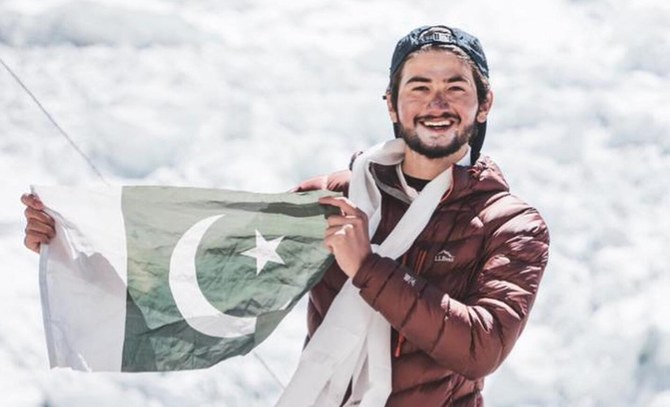


In this undated photo, Shehroze Kashif, a 19-year-old climber from Lahore, is seen holding a flag of Pakistan. (Photo courtesy: Alpine Adventure Guides)

With members of his expedition, the young climber known as “The Broad Boy” after summiting 8,047-meter Broad Peak in the Karakoram two years ago, Kashif climbed Mount Everest (8,849 meters) in four days.

Having already scaled a number of tall and difficult peaks, Kashif started climbing difficult mountainous terrains when he was just 11 years old.

In his first video message after the Everest summit, he said: “Alhamdulillah, Pakistan is on Everest. Without the support from Pakistan, this project was not possible. Thanks all of you for your support. I am coming soon to Pakistan.”

He thanked his family, friends and everyone who helped him for “the love, prayers and support” he had received.

Kashif’s achievement was welcomed by Pakistanis, including President Arif Alvi who took to Twitter to congratulate him on becoming the youngest Pakistani to scale the world’s highest peak.

“We are proud of you. I remember your passionate intention to do so when you visited me in Presidency in Feb. I wish you good luck in the future, now that you have Mt Everest in the bag,” the president said.

Previously, Samina Baig was the youngest Pakistani who summited the world’s tallest peak. 

A high-altitude climber, Baig became the first Pakistani woman to climb Everest in 2013 when she was only 21 years old.


Pakistan receives $1.2 billion from IMF under EFF, RSF loan programs— central bank

Updated 9 sec ago
Follow

Pakistan receives $1.2 billion from IMF under EFF, RSF loan programs— central bank

  • IMF Executive Board approved Pakistan’s second review under EFF, first review under RSF loan programs this week 
  • Disbursements from IMF have been crucial for cash-strapped Pakistan as it tries to recover from economic crisis 

ISLAMABAD: Pakistan’s central bank announced on Thursday that it has received $1.2 billion under the International Monetary Fund’s (IMF) External Fund Facility and Resilience and Sustainability Facility (RSF) loan programs. 

The IMF approved a $7 billion bailout package for Pakistan under its EFF program in September 2024 while in May 2025, it approved a separate $1.4 billion loan to Pakistan under its climate resilience fund. The RSF will support Pakistan’s efforts in building economic resilience to climate vulnerabilities and natural disasters. 

The global lender approved Pakistan’s second review under its $7 billion EFF program and first review under the RSF loan on Tuesday. As per the State Bank of Pakistan (SBP), the central bank received a combined sum of $1.2 billion under the EFF and RSF on Dec. 10. 

“The amount would be reflected in SBP’s foreign exchange reserves for the week ending on Dec. 12, 2025,” the SBP said in a statement. 

IMF bailouts have been crucial for cash-strapped Pakistan, which has been struggling with a prolonged economic crisis that has exhausted its financial reserves and weakened its currency. Pakistan came to the brink of a sovereign default in 2023 before a last-gasp IMF bailout package helped it avert the crisis. 

Pakistan has had to take tough decisions to comply with the IMF’s loan requirements, which include scrapping subsidies from food and fuel items to trigger inflation. Since then, Pakistan has attempted to regain stability by sharply reducing inflation and recording a current account surplus. 

The disbursement, however, comes at an important time for the South Asian country as it mitigates losses from a deadly monsoon season that killed over 1,000 people since late June and caused at least $2.9 billion in damages to agriculture and infrastructure.