

Bare palms this Eid as pandemic dampens Pakistan’s henna obsession

Pakistani women offer special prayers on the occasion of Eid al-Fitr that marks the end of the holy month of Ramadan at the historic Badshahi Mosque in Lahore on May 13, 2021. (AFP photo)
Short Url
Updated 13 May 2021
Follow

Bare palms this Eid as pandemic dampens Pakistan’s henna obsession

  • Mehndi applied to hands has long been a traditional celebration marking Eid and weddings across cultures
  • Apart from the business side, the joy of socializing during henna application has been lost

RAWALPINDI: As another Eid Al-Fitr arrives under the shadow of the pandemic, celebrations are dampened around the world. In Pakistan, the government has advised citizens to celebrate simply, and among the many festive practices compromised on, is the art of henna, or mehndi. 

Mehndi is produced from the leaves of henna plants and has played a significant role in expressions of celebration in South Asia for hundreds of years.

The night before Eid, henna artists are invited to private homes where groups of family members gather to get their palms made up. In bazaars, long queues of people wait for busy artists speedily creating designs on hundreds of women a day-- sometimes well into the early hours of the morning.

But since last year, henna artists say nothing is the same.

“The pandemic has really badly affected my work. I’m still better off than many others, but because the majority of my work was traveling for bridal bookings, I took a hit,” Sara Vazir, a henna artist, told Arab News.

Vazir, 33, has been working with henna since she was 11 and has built an international clientele for her business, ‘Sara’s Henna.’


Sara Vazir shares her henna designs with over 80,000 followers on Instagram, on December 13, 2020. (Photo courtesy: Sara's Henna)

“As for Eid, that [business] has completely stopped since the pandemic began ... a year and a half now. I have two small kids and I do not want to take the risk; I don’t want to go to people’s houses or call them over,” she said.

Vazir’s designs are inspired by mehndi from around the world. 

Moroccan style henna art has fast become one of the most popular, with geometric designs featuring dot work and diamond shapes that borrow from the Afro-Arab country’s architectural styles. 
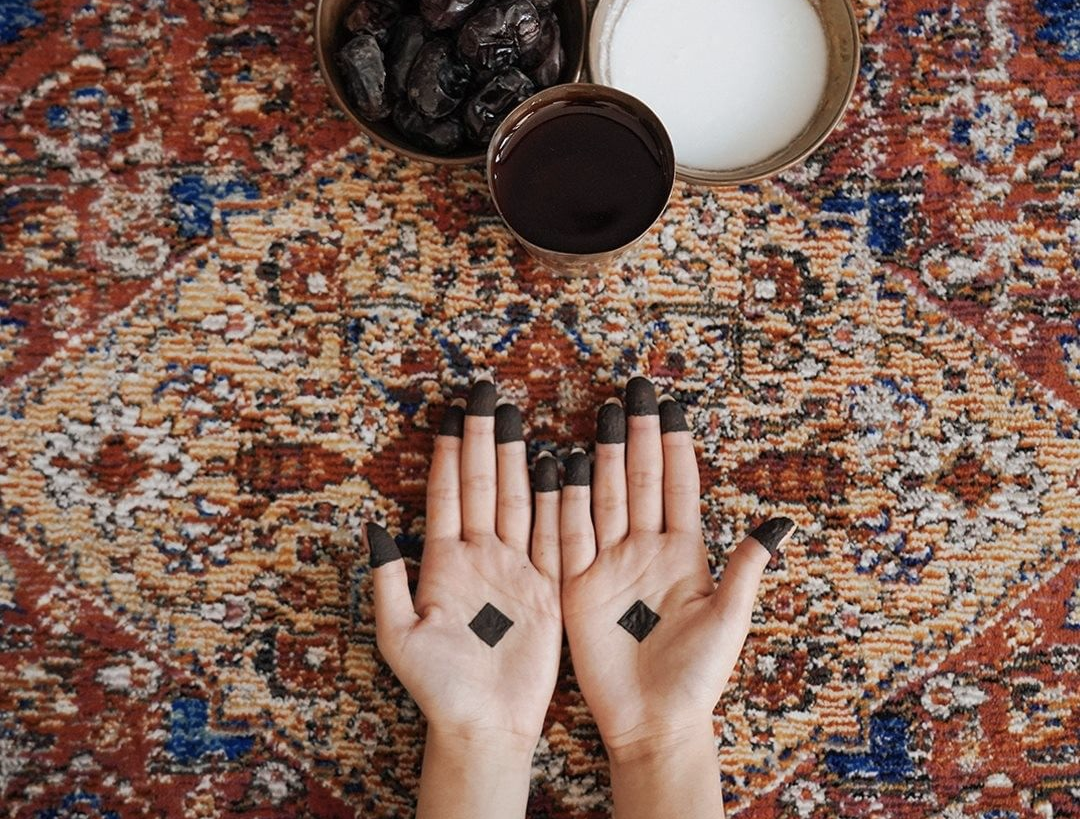


Pakistani fashion brand Ethnic borrows Moroccan henna designs for their Ramadan 2021 collection. (Photo courtesy: Ethnic)

Even Islamic imagery like domes and symmetrical arches are common in popular henna design. In recent years, simpler designs have become trendy. 

Some brands like Dastaangoi and Kolachi mehndi in Pakistan have encouraged people to DIY their mehndi at home, and have released mehndi design kits featuring designs rooted in different henna traditions.
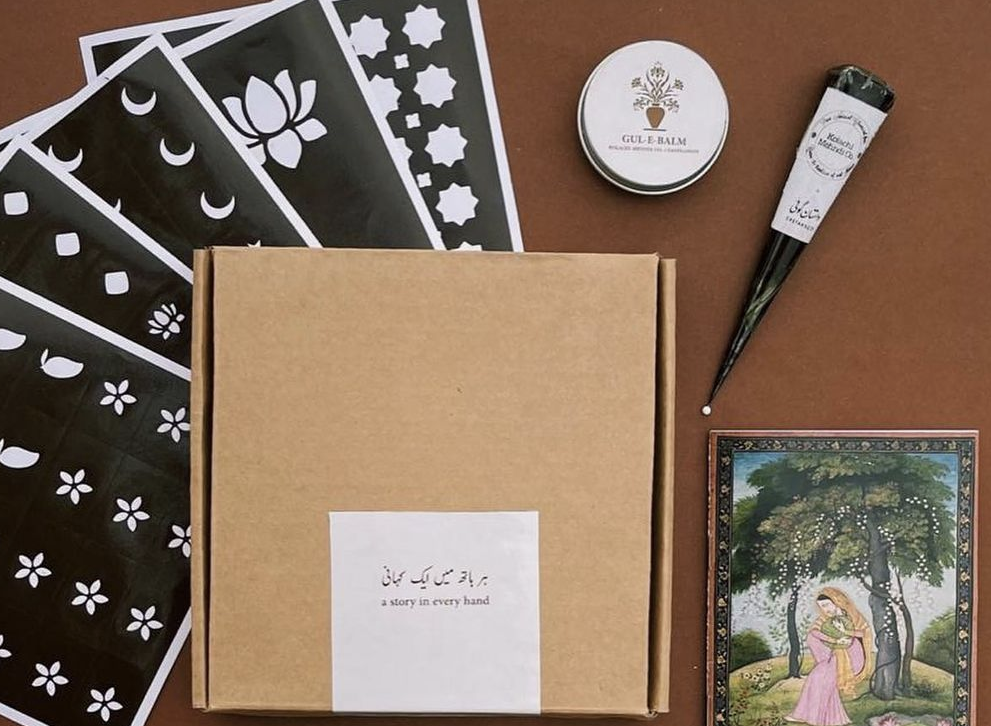


Storytelling platform Dastaangoi and organic henna brand Kolachi Mehndi collaborate for an at-home Eid mehndi kit featuring style inspirations across cultures. Photo shared on May 4, 2021. (Photo courtesy: Kolachi Mehndi)

But apart from the business of henna design, it’s the socializing aspect-- the part that creates happy memories-- that has been hurt.

“When I work on clients now, it’s not the same fun of a group getting together and sharing in something joyful because we have to be careful,” Karachi-based henna artist Shahtaj A. Khan told Arab News.

“It’s sad that this traditional happy moment is disappearing.”

Some mehndi artists like Khan are continuing to see clients under strict SOP’s, wearing masks, shields and working outside in the open.


A girl gets her hand decorated with henna paste at a marketplace during the holy month of Ramadan ahead of Eid Al-Fitr in Karachi on May 8, 2021. (AFP)

During weddings in Pakistan and India, the hands of the bride and her closest women friends and family are filled with intricate details bordered with thick lines, motifs of flora, peacocks, paisleys, and checkered patterns. There is an entire wedding occasion dedicated to the ritual of this application, called simply, the ‘mehndi.’
Umme Kulsoom Huzaifa Lathi, who has decorated hands around the nation including for Bakhtawar Bhutto Zardari on her wedding, told Arab News that these days, being careful was paramount.
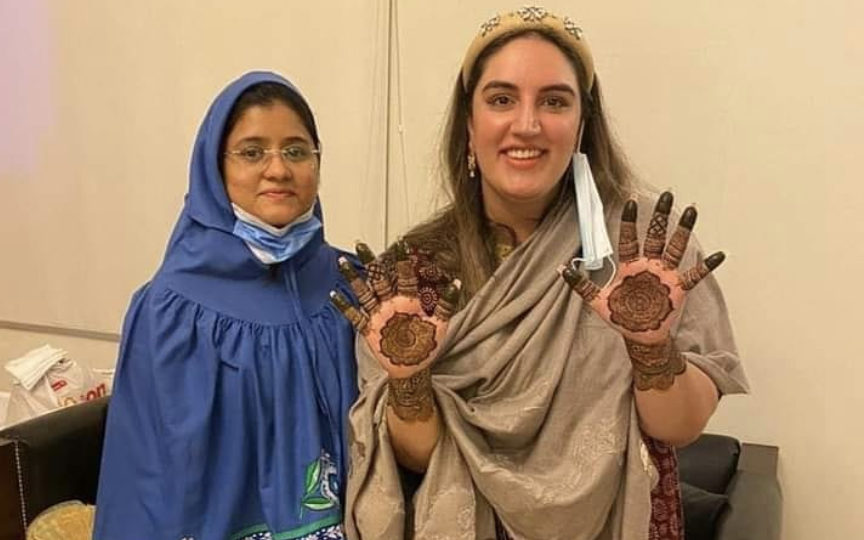


Pakistani henna artist Umme Kulsoom Huzaifa Lathi shares a photo with Bakhtawar Bhutto Zardari whose hands she has decorated for during a mehndi bridal session on January 29, 2021. (Photo courtesy: Kulsooms Henna)

“Since last Eid, business has picked up, but everything is done extremely carefully,” Lathi told Arab News over the phone from Karachi.

“We follow all the guidelines because we want things to get back to normal... and hopefully artists like me can see their businesses get back to normal too.”


Pakistan launches privatization process for five power distributors under IMF reforms

Updated 10 sec ago
Follow

Pakistan launches privatization process for five power distributors under IMF reforms

  • Power-sector losses have pushed circular debt above $9 billion, official documents show
  • Move is tied to IMF and World Bank conditions aimed at cutting subsidies and fiscal risk

KARACHI: Pakistan has appointed financial advisers and launched sell-side due diligence for the privatization of five electricity distribution companies, marking a long-awaited step in power-sector reforms tied to International Monetary Fund (IMF) and World Bank programs, according to official documents shared with media on Monday.

The five companies, namely Islamabad Electric Supply Company (IESCO), Faisalabad Electric Supply Company (FESCO), Gujranwala Electric Power Company (GEPCO), Hyderabad Electric Supply Company (HESCO) and Sukkur Electric Power Company (SEPCO), supply electricity to tens of millions of customers and have long been a major source of financial losses for the state.

Pakistan’s power sector has accumulated more than Rs2.6 trillion (about $9.3 billion) in circular debt as of mid-2025, driven largely by distribution losses, electricity theft and weak bill recovery, according to official government data cited in the documents. The shortfall has repeatedly forced the government to provide subsidies, adding pressure to public finances in an economy under IMF supervision.

“The objective is to reduce losses, improve efficiency and limit the government’s fiscal exposure by transferring electricity distribution operations to the private sector,” the documents said, adding that sell-side due diligence for five distribution companies is under way as a prerequisite for investor engagement.

Two utilities, the Quetta Electric Supply Company and Tribal Areas Electric Supply Company, are excluded from the current privatization phase due to security and structural constraints, the documents said.

Power-sector reform is a central pillar of Pakistan’s IMF bailout program, under which Islamabad has committed to restructuring state-owned enterprises, improving governance and reducing budgetary support. The World Bank has also linked future energy-sector financing to progress on structural reforms.

Electricity distribution companies in Pakistan routinely report losses exceeding 20 percent of supplied power, far above international benchmarks, according to official figures. These inefficiencies have been a persistent obstacle to economic growth, investment and reliable power supply.

Previous attempts to privatize power distributors have stalled amid political resistance, labor union opposition and concerns over tariff increases. While officials have not announced a timeline for completing transactions, the launch of due diligence marks the most concrete step taken in years. International lenders and investors will now be closely watching whether Pakistan can translate this phase into completed sales, a key test of its ability to deliver on IMF-backed reforms.

In a related development in Pakistan’s privatization agenda, the government last month concluded the long-delayed sale of a 75 percent stake in national flag carrier Pakistan International Airlines (PIA) in a publicly televised auction. A consortium led by the Arif Habib Group emerged as the highest bidder with a Rs135 billion ($482 million) offer for the controlling stake, in a transaction officials have said will end decades of state-funded bailouts and inject fresh capital into the loss-making airline.