Pakistan’s army chief visits Afghanistan, discusses peace process with President Ghani

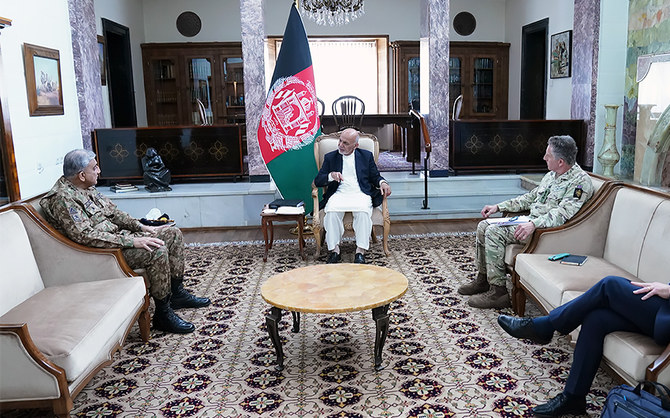
Pakistan's Army Chief General Qamar Javed Bajwa, left, meets Afghan President Ashraf Ghani in Kabul, Afghanistan, on May 10, 2021. (Picture courtesy: @ARG_AFG/Twitter)
Short Url
Updated 11 May 2021
Follow

Pakistan’s army chief visits Afghanistan, discusses peace process with President Ghani

  • President Ghani thanked Gen Bajwa for a meaningful discussion and “appreciated Pakistan’s sincere & positive role in Afghan Peace Process”
  • Pakistan’s foreign office on Monday welcomed a three-day cease-fire during the upcoming Eid Al-Fitr holiday announced by the Afghan Taliban

ISLAMABAD: Pakistan’s army chief General Qamar Javed Bajwa visited Kabul on Monday where he held meetings with President Ashraf Ghani and Chairman of the Afghan High Council for National Reconciliation Dr. Abdullah Abdullah to discuss intra-Afghan peace talks, said the military’s media wing, ISPR, in a statement.
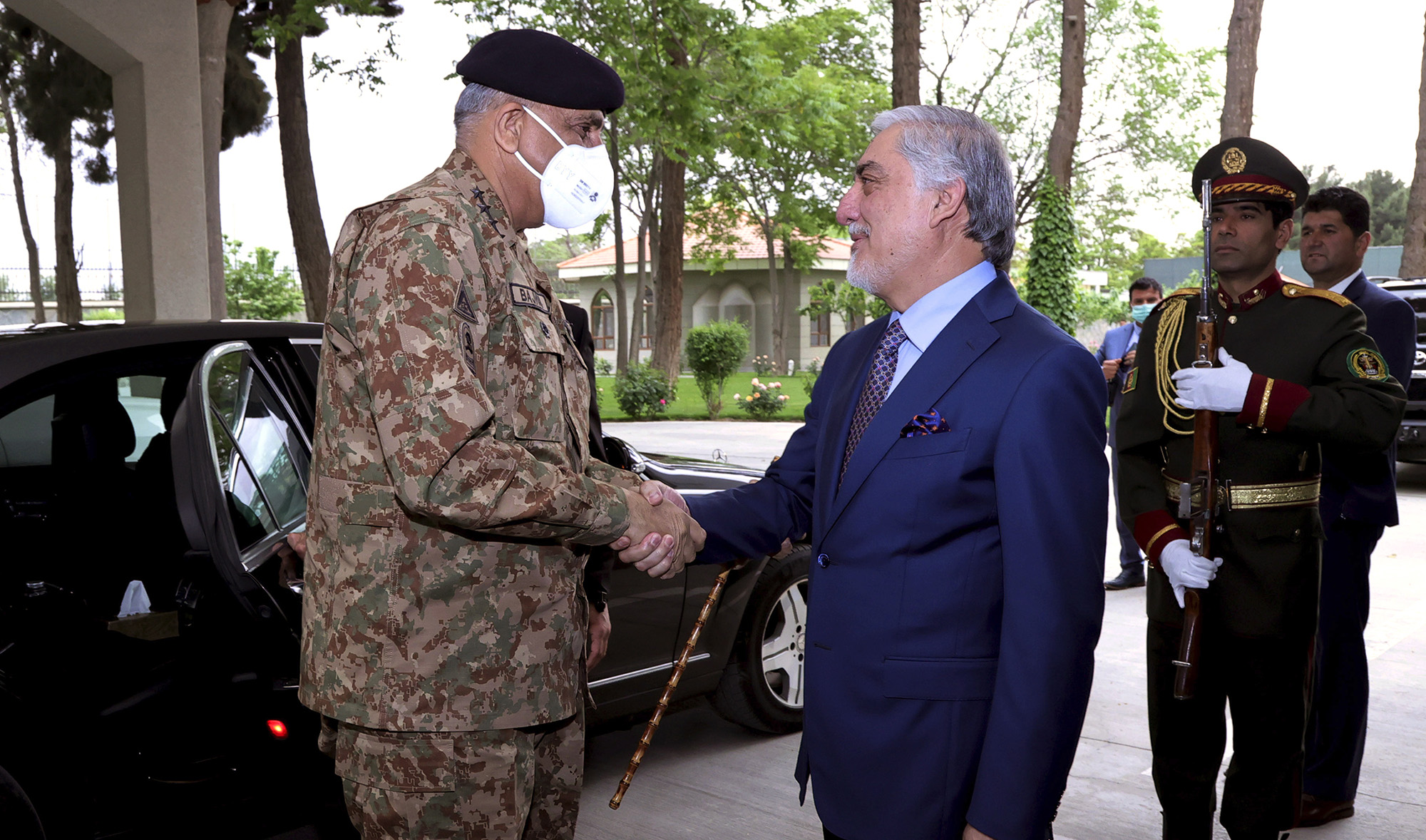


Pakistan's army chief Gen. Qamar Javed Bajwa, left, shakes hands with Abdullah Abdullah, Chairman of the High Council for National Reconciliation, on his arrival in Kabul, Afghanistan, on May 10, 2021. (Sapidar Palace via AP)

Gen Bajwa reiterated that a peaceful Afghanistan means a peaceful region in general and a peaceful Pakistan in particular. “We will always support ‘Afghan led-Afghan Owned’ Peace Process based on mutual consensus of all stakeholders,” he was quoted as saying by the ISPR.

Military statement added that Afghan President Ghani thanked Gen Bajwa for a meaningful discussion and “appreciated Pakistan’s sincere & positive role in Afghan Peace Process.”

Bajwa undertook his visit to Afghanistan at a time when it is witnessing increased militant violence against its security forces and civilian population, making regional actors urge the Taliban insurgents to abandon violence and create a more conducive environment for peace talks with the administration in Kabul.

The United States has already started pulling out its troops from the war-battered country and is likely to complete the process by the 20th anniversary of September 11 this year.

Bajwa also met Britain’s Chief of Defense Staff General Nicholas Patrick Carter in Kabul, who was also present at his meeting with the Afghan president.

“During the meeting, matters of mutual interest, regional security situation, particularly current developments in Afghan peace process and measures to further enhance bilateral and defense cooperation, were discussed,” the ISPR said.

The statement added that General Carter “appreciated Pakistan’s sincere efforts for peace and stability in the region, especially the Afghan peace process.”

Pakistan also welcomed the Taliban announcement on Monday to declare a three-day cease-fire in Afghanistan during this week’s Eid Al-Fitr holiday.

Eid Al-Fitr marks the end of the Muslim fasting month of Ramadan, and the holiday begins after the crescent is sighted for the next month on Islamic lunar calendar.

“We welcome the three-day cease-fire announcement for Eid-ul-Fitr by Taliban,” Pakistan’s foreign office said in a tweet.

It added: “We fully support all efforts that lead to reduction in violence and contribute to achieving durable stability & lasting peace in Afghanistan.”


The cease-fire announcement from the Taliban came only two days after a bomb attack on a girls’ schools in Afghanistan on Saturday that killed about 60 people, mostly young schoolgirls.

The Taliban condemned the deadly bomb blast outside the school and denied any responsibility.


Planning minister says Pakistan to set up advanced technology centers to support economic growth

Updated 13 sec ago
Follow

Planning minister says Pakistan to set up advanced technology centers to support economic growth

  • Ahsan Iqbal says planned centers to focus on artificial intelligence, quantum computing and nanotechnology
  • He also cites satellite technology as key tool for climate monitoring, early warning and disaster management

ISLAMABAD: Pakistan plans to set up technology Centers of Excellence, including facilities focused on quantum computing and nanotechnology, as it seeks to benefit from rapid advances in artificial intelligence and emerging technologies, state media reported on Friday.

The announcement was made by Planning and Development Minister Ahsan Iqbal, who said the government aims to position Pakistan to compete in future technologies that are expected to drive economic growth and reshape global industries.

Quantum computing, which uses the principles of quantum mechanics to process information far more quickly than conventional computers, has applications ranging from complex data analysis and cryptography to climate modeling and materials science. Nanotechnology focuses on engineering materials at the molecular level and is widely used in energy storage, medicine and electronics.

Addressing a ceremony in Islamabad, Iqbal said countries that master artificial intelligence, robotics, quantum computing and space technologies would lead the global economy in the coming decades.

“During the address, the minister said Pakistan’s efforts to align itself with rapid advancements in artificial intelligence, robotics, space innovation and emerging technologies reflect the country’s ambition to participate confidently in shaping the future,” Radio Pakistan reported.

“Ahsan Iqbal further announced that the government plans to establish three Centers of Excellence, including a National Center for Quantum Computing and a National Center for Nanotechnology, aimed at upgrading the national economy,” it added.

He informed the ceremony that measures were underway to develop a new Silicon Valley in Pakistan “to promote cross-fertilization of ideas and innovation by bringing talent, research and industry together under one roof.”

The minister also highlighted the role of technology in tackling climate challenges, noting that satellite systems are increasingly used worldwide for disaster management, early warning systems and climate monitoring.

Pakistan, one of the world’s most climate-vulnerable countries, can benefit from satellite technology to track weather patterns, manage floods and improve disaster preparedness, he said, adding that more than 9,000 satellites currently orbit the Earth and are transforming how economies and governments operate.

Iqbal said the planned centers would support Pakistan’s broader “Uraan Pakistan” vision, which focuses on exports, digital development, energy and infrastructure, environmental resilience and social equity, Radio Pakistan reported.