
JERUSALEM: Saudi Arabia on Saturday denounced Israeli plans to evict Palestinian families from their homes in Jerusalem amid soaring violence in the city.
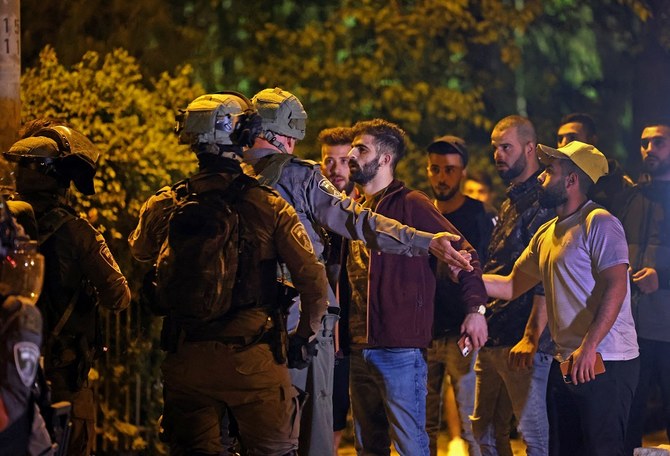
Israel reinforced its security operation on Saturday after clashes on Friday night, when more than 200 Palestinians were injured.
Riot police fired rubber bullets, tear gas and stun grenades at Palestinians inside Al-Aqsa Mosque, where throngs of worshippers, including women and children, were praying on the last Friday of Ramadan.
The clashes at Islam’s third-holiest site and around occupied East Jerusalem came amid mounting anger over the planned evictions.
“Saudi Arabia rejects Israel’s plans and measures to evict dozens of Palestinians from their homes in Jerusalem and impose Israeli sovereignty over them,” the Saudi Foreign Ministry said.
The UAE, which normalized relations with Israel last year, “strongly condemned” the planned evictions. The Minister of State for Foreign Affairs, Khalifa Al-Marar, urged Israeli authorities to “assume their responsibilities — in line with international law — to provide necessary protection to Palestinian civilians’ right to practice their religion, and to prevent practices that violate the sanctity of the holy Al-Aqsa Mosque.”
Oman also said it rejected the policies and procedures for displacing Palestinian people from their homes in the city of Jerusalem, and the sultanate reaffirmed “its steadfast position in supporting the legitimate rights to establish an independent Palestinian state on the borders of 1967, with East Jerusalem as its capital.”
As tension mounted on Saturday, Israeli police set up roadblocks near the village of Abu Ghish on the main highway to Jerusalem to stop busloads of Palestinians from reaching Al-Aqsa. Scuffles broke out and police fired stun grenades.
When the Palestinians left their buses and began to walk the remaining 20 km to Al-Aqsa, local residents came to pick them up in private cars.
The late-night clashes in Jerusalem followed days of tension in the Sheikh Jarrah neighborhood, where Israelis are trying to evict an entire Palestinian community and hand over their homes to ultra-extreme Jewish settlers.
The Waqf Council, Jordan, the US, EU, and European and Arab countries all issued statements denouncing the violence in the city. The US called on all parties to avoid actions that could damage final status talks between Israel and Palestinians, including settlements. UN Security Council Resolution 2334 considers all settlements illegal.
On Sunday, Jordan urged Israel to stop whatthe "barbaric" attacks on worshippers at the mosque.
"What the Israeli police and special forces are doing, from violations against the mosque to attacks on worshippers, is barbaric (behaviour) that is rejected and condemned," the government said in a statement.
Wasfi Kailani, executive director of the Hashemite Fund for the reconstruction of Al-Aqsa Mosque, told Arab News there was no excuse for the Israeli action.
“What happened on Friday night is inexcusable. Violating the mosque’s sanctity during the last 10 holy days of Ramadan is illegal and a clear violation of the right to worship. Its status quo must be protected.”
Kailani, a member of the Jerusalem Waqf Council, said Israeli forces not only violated the peace of worshippers but also destroyed mosque property, including its clinic and gates.
Hijazi Risheq, head of the Jerusalem Merchants Committee, told Arab News that attacks by Israeli forces were meant to intimidate Palestinians following threats by Jewish extremists of a large-scale infiltration into Al-Aqsa on Monday, which they call “Jerusalem Day.”
“However, the people of Jerusalem have broken the barrier of fear and are no longer afraid of Israeli soldiers or Israeli prisons,” he said. Risheq called on Arab and Islamic countries to help Palestinians defend the mosque.