BEIRUT: Even after she was taken off an investigation into alleged financial crimes by a money transfer company, the defiant Lebanese prosecutor charged ahead.
Ghada Aoun showed up at the company’s offices outside of Beirut with a group of supporters and a metal worker, who broke open the locked gate.
She obtained data from Mecattaf Holding Company that she contends will reveal the identities of people who sneaked billions of dollars out of Lebanon amid the financial meltdown that has hit the country.
The move was part of a public feud between Aoun and Lebanon’s state prosecutor Ghassan Oueidat, who had dismissed her from the case, saying she’d overstepped with two earlier raids.
Their feud has turned into scuffles between their supporters in the street.
Aoun, an investigating judge for the Mount Lebanon district, presents herself as a crusader against corruption and accuses higher-ups of trying to stop her.
But to her critics, she’s a tool of her backer, Lebanon’s president, who they say uses her to punish his political opponents and protect his allies.
That is the problem in Lebanon: The judiciary is so deeply politicized it paralyzes the wheels of justice, mirroring how factional rivalries have paralyzed politics.
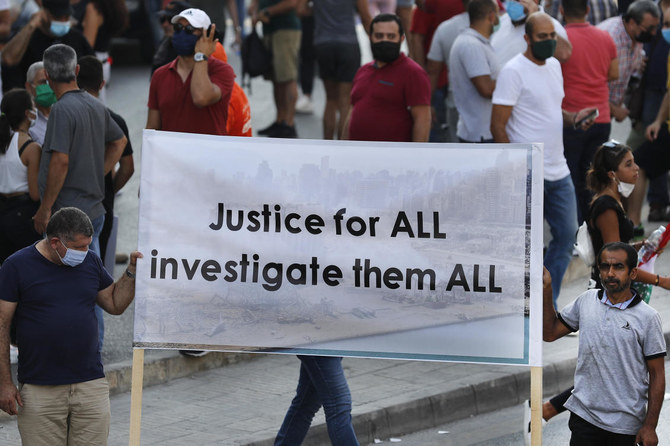
Political interference in the judiciary has for years thwarted investigations into corruption, violence and assassinations. But mistrust of the judiciary is thrown into even starker relief now, when Lebanese are crying out for politicians to be held accountable for the disastrous crises in their country — not only the financial collapse but also last August’s massive explosion in Beirut’s port that killed scores and wrecked much of the capital. The explosion has been blamed on incompetence and neglect.
Lebanon’s political posts are split up in a power-sharing system among sectarian-based factions. Judicial appointments are subject to the same sectarian allotment and horse-trading.
Ghada Aoun is a Maronite Christian, like the country’s president, Michel Aoun, and her supporters are mainly members of the president’s Free Patriotic Movement. The two are not related. The state prosecutor, Oueidat, is a Sunni Muslim, like the prime minister-designate, Saad Hariri. The country’s top financial prosecutor is a Shiite Muslim, chosen by the country’s top Shiite factions, Amal and Hezbollah. Positions all through the judicial hierarchy are similarly divvied up.
“Those who hold on to power have set up a judiciary that is loyal to them in order to fight their opponents and protect their interests,” retired state prosecutor Hatem Madi told The Associated Press.
President Aoun and Prime Minister-designate Hariri have been locked in a power struggle that has prevented the formation of a Cabinet for more than six months. As a result, there is no leadership to carry out reforms to rescue the country even as the currency collapses in value.
Lebanese watched in fury as their own savings and salaries plummet in value and prices skyrocket. The central bank is struggling to gather enough hard currency to ensure fuel for electricity or other key imports, much less maintain its longtime peg of the currency to the dollar.
Even more galling for the public, the wealthy and politically connected transferred billions of dollars to safety outside Lebanon even after banks imposed informal capital controls at the beginning of the crisis. Most people have been unable to access their dollars in bank accounts since late 2019.
Ghada Aoun, the judge, was probing Mecattaf Holding on suspicion it helped in that flight of capital. Mecattaf, one of Lebanon’s largest money and gold-trading companies, denied any links to suspicious transfers, saying all business it does is legal.
Skeptics note that Mecattaf’s owner, Michel Mecattaf, is the publisher of Nidaa Al-Watan, a daily newspaper that is harshly critical of President Aoun and his main ally, the Lebanese militant group Hezbollah.
Ghada Aoun has also pursued cases against Central Bank Governor Riad Salameh and former Prime Minister Najib Mikati, both of them opponents of the president.
In tweets, Aoun said she was being sidelined “because I dared to open a major file and tried to establish the truth with evidence.” She accuses her opponents of using “false accusations” against her to “politicize a case of justice, a case where an oppressed people wants accountability.”
After her previous raids, Ouiedat ordered her taken off financial cases. Then on April 20, both he and Aoun appeared at a session of Lebanon’s top judicial body, where they upheld the order. Outside, supporters of the president and the prime minister got into scuffles and nearly into fist-fights before the army separated them. The next day, she carried out her third raid on the company.
Sami Kara, a Hariri supporter, said Aoun ruined her long reputation by breaking into the company. “She was used for political purposes and now they threw her away,” said the 61-year-old shop owner.
Lebanese are also closely watching the investigation into the Aug. 4 explosion of nearly 3,000 tons of ammonium nitrates poorly stored at Beirut’s port. The explosion killed 211, wounded more than 6,000 and devastated nearby neighborhoods.
The first investigating judge accused two former Cabinet ministers of negligence, but was then removed from the case after the former ministers raised legal challenges against him. Many worry his replacement, Judge Tarek Bitar, will be prevented by politicians from holding anyone accountable for the blast.
Judges know that if they want senior posts, they must be loyal to a political leader, said Bushra Al-Khalil, a prominent Lebanese lawyer.
Knowing this, some people go straight to politicians and ask for their help in cases, rather than go through judicial authorities, she said. Others hire a lawyer with strong political connections to intimidate judges.
Madi said the long-term solution is for the judiciary to be given independence under the constitution. Currently, it comes under the authority of the government.
Lebanon “is proving incapable of fighting corruption,” said outgoing Justice Minister Marie-Claude Najm, pointing to the divisions demonstrated in the feud between Aoun and Ouiedat.
“After all that has happened,” she said, “how can people feel they respect and trust the judiciary?”


![]()

As Lebanese cry for justice, politics paralyzes the system
Short Url
https://arab.news/jcc84
As Lebanese cry for justice, politics paralyzes the system
- Judge Ghada Aoun presents herself as a crusader against corruption and accuses higher-ups of trying to stop her
- Political interference in the judiciary has for years thwarted investigations into corruption, violence and assassinations

Latest updates


© 2026 SAUDI RESEARCH & PUBLISHING COMPANY, All Rights Reserved And subject to Terms of Use Agreement.