

Egypt steps up response to second filling of GERD

1 / 2
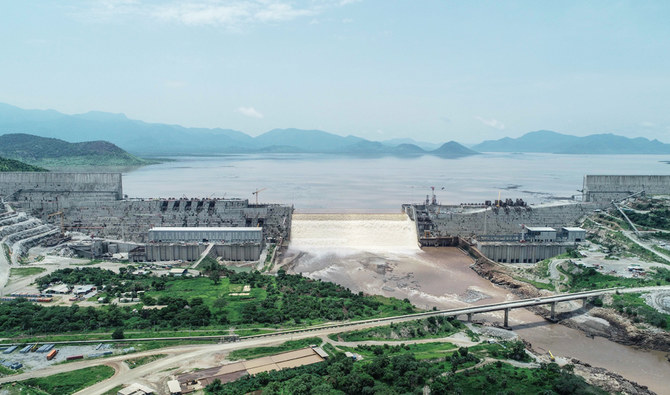
Workers perform measurements at the Grand Ethiopian Renaissance Dam in Ethiopia. Egypt, Sudan and Ethiopia are deadlocked in the dam dispute. (File/AFP)
2 / 2
This handout picture taken on July 20, 2020, and released by Adwa Pictures on July 27, 2020, shows an aerial view Grand Ethiopian Renaissance Dam on the Blue Nile River in Guba, northwest Ethiopia. (AFP)
Short Url
Updated 05 May 2021
Follow

Egypt steps up response to second filling of GERD

  • Ghanem said that the fourth plan is to encourage farmers to use modern irrigation methods in desert areas

CAIRO: Egypt has outlined four plans to mitigate the effects of the second filling of the Grand Ethiopian Renaissance Dam (GERD) on the country’s irrigation system.

Mohammed Ghanem, spokesperson for the Ministry of Water Resources and Irrigation, said that the ministry wants to ensure a strong water system under all possible scenarios.

“We have four major plans to mitigate the effects of any potential crisis,” he said in a statement.

Ghanem said that the ministry has begun upgrading and lining over 8,200 km of irrigation canals at an overall cost of EGP18 billion ($1.1 billion) to reduce water waste.

The second plan is the maintenance and construction of 92 water pumping and lifting stations, which operate with high efficiency, especially during peak demand.

The spokesperson said that the third plan is to inaugurate the Al-Mahsama wastewater treatment plant in Ismailia to drain 1 million cubic meters daily, and the Bahr Al-Baqar wastewater treatment plant, which treats 5 million cubic meters daily.

Bahr Al-Baqar is the largest treatment plant in the world. The inauguration of a  Hammam wastewater treatment plant to serve new delta projects is also part of the third plan.

Ghanem said that the fourth plan is to encourage farmers to use modern irrigation methods in desert areas.

Agriculture consumes the largest proportion of the Nile water, he said.

The spokesman said that Cairo opposes the second filling of the dam, which will negatively affect both Egypt and Sudan.

Ghanem said Ethiopia did not generate energy last year, and will probably not generate energy this year, but seeks to impose a “fait accompli policy,” which is rejected by Cairo.


Two Tunisia columnists handed over three years in prison

Updated 23 January 2026
Follow

Two Tunisia columnists handed over three years in prison

  • Mourad Zeghidi and Borhen Bsaies have already been in detention for almost two years
  • They were due to be released in January 2025 but have remained in custody on charges of money laundering

TUNIS: Two prominent Tunisian columnists were sentenced on Thursday to three and a half years in prison each for money laundering and tax evasion, according to a relative and local media.
The two men, Mourad Zeghidi and Borhen Bsaies, have already been in detention for almost two years for statements considered critical of President Kais Saied’s government, made on radio, television programs and social media.
They were due to be released in January 2025 but have remained in custody on charges of money laundering and tax evasion.
“Three and a half years for Mourad and Borhen,” Zeghidi’s sister, Meriem Zeghidi Adda, wrote on Facebook on Thursday.
Since Saied’s power grab, which granted him sweeping powers on July 25, 2021, local and international NGOs have denounced a regression of rights and freedoms in Tunisia.
Dozens of opposition figures and civil society activists are being prosecuted under a presidential decree officially aimed at combatting “fake news” but subject to a very broad interpretation denounced by human rights defenders.
Others, including opposition leaders, have been sentenced to heavy prison terms in a mega-trial of “conspiracy against state security.”
In 2025, Tunisia fell 11 places in media watchdog Reporters Without Borders’ (RSF) World Press Freedom Index, dropping from 118th to 129th out of 180 countries.