

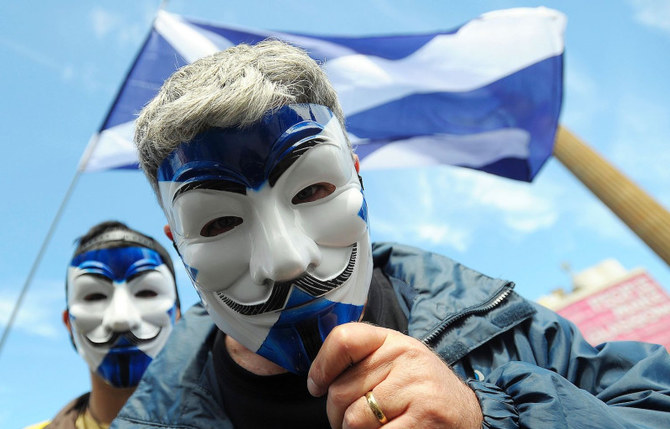

LONDON: Iran is peddling misinformation in an attempt to swing Scotland’s parliamentary elections in favor of pro-independence parties to destabilize the UK, a report has warned.
A study from the UK-based Henry Jackson Society (HJS) think tank found that operatives linked to Iran were creating fake accounts, groups and pages on Facebook and Twitter to target voters.
They posed as pro-independence Scots and distributed separatist material, memes, graphics, and cartoons to their legitimate connections.
The activity was, according to the HJS, an attempt by the Iranian regime to “attack the constitutional integrity of the United Kingdom.”
It found that operatives established fake websites with targeted domain names in an effort to trick internet users, a tactic that was part of a wider disinformation strategy designed to sow chaos, division and weaken Iran’s adversaries.
“Iran has shown itself to be a country which engages in Russian-style disinformation campaigns, repeatedly establishing fake websites and internet accounts in an effort to disrupt the political systems of liberal democracies,” the report said. “Judged within this context, Iran is almost certainly looking to disrupt our current elections, most likely those under way for the Scottish assembly.”
The study also said the campaigns were being generated by agents acting on the regime’s behalf so that its leaders could deny responsibility and avoid repercussions.
The aim was to “cause harm to adversaries with clear military superiority, and at the same time, maintain a margin of denial that will prevent international censure or even sanctions and a counterattack.”
Amin Sabeti, an Iranian cyber operations expert and executive director of Digital Impact Lab, said the report’s findings were part of an “established pattern of behavior.”
“They are opposed to Western democracy and Western values — this disinformation is not a surprise,” he told Arab News.
Sabeti said that Iran’s lower technical cyber operations capacity meant they had to employ other, more accessible means to meddle in the affairs of foreign countries.
“This kind of campaign is cheap, easy to implement, and doesn’t require a sophisticated hacker. It’s not a high-skill operation, and so has a low cost.”
In March, Facebook said it had removed hundreds of fake accounts linked to the Islamic Republic of Iran Broadcasting state media group that had shared content in an attempt to go viral, including content that mocked the Scottish Conservatives.
“Whenever any kind of cyber operations is cheap, the Iranian regime — especially the IRGC (Islamic Revolutionary Guard Corps) — they are in,” added Sabeti. “If they can change anything, destabilize anything, or disrupt the establishment in the UK they are going to do it.”


