TAQA completes $1.5bn bond sale

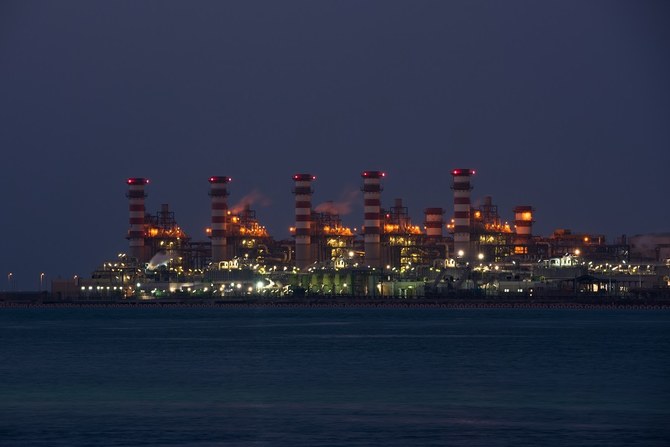
The company is also known as Abu Dhabi National Energy Company. (Shutterstock)
Short Url
Updated 02 May 2021
Follow

TAQA completes $1.5bn bond sale

  • The seven-year notes, sized at $750 million and maturing April 2028, were issued at a coupon rate of 2 percent
  • The 30-year notes, also sized at $750 million and maturing April 2051, were issued at a coupon rate of 3.4 percent

DUBAI: Abu Dhabi energy giant TAQA said it completed a $1.5 billion bond sale that will help repay outstanding debt.
The company also known as Abu Dhabi National Energy Company, said the placement comprised seven-year and 30-year dual-tranche senior unsecured notes, in a stock exchange filing on Sunday.
The seven-year notes, sized at $750 million and maturing April 2028, were issued at a coupon rate of 2 percent. The 30-year notes, also sized at $750 million and maturing April 2051, were issued at a coupon rate of 3.4 percent, it said.
“The strong demand from global credit markets and investors from around the world is a strong vote of confidence in TAQA’s strengthened financial profile as well as the company’s strategy to become a low carbon power and water champion in the UAE and beyond,” said Jasim Husain Thabet, TAQA’s group CEO.
The 30-year tranche was TAQA’s first Formosa issuance dual-listed in Taipei and London to tap into Taiwanese demand.
The order book was four times oversubscribed with strong demand from Asian investors setting the stage for further orders from MENA, Europe and the US, it said.
The issuance was arranged and offered through a syndicate of joint lead managers and bookrunners comprising Bank of China, Citi, First Abu Dhabi Bank, HSBC, Mashreq, Mizuho Securities and MUFG.
In addition to the bond issuance, TAQA offered to buy back all the $1.5 billion of outstanding corporate bonds maturing in 2021 and up to $250 million of the bonds maturing in January 2023.


Asian economies weigh impact of fresh Trump tariff moves, confusion

Updated 8 sec ago
Follow

Asian economies weigh impact of fresh Trump tariff moves, confusion

LONDON: US trading partners in Asia weighed fresh uncertainties this weekend after President Donald Trump announced a new tariff on imports, hours after the Supreme Court struck down many of the sweeping levies he used to launch a global trade war.

The court’s ruling invalidated a number of tariffs that the Trump administration had imposed on Asian export powerhouses from China and South Korea to Japan and Taiwan, the world’s largest chipmaker and a key player in tech supply chains.

Within hours, Trump said he would impose a new 10 percent duty on US imports from all countries starting on Feb. 24, which he raised to 15 percent on Feb. 21. The levies, under a different law, are set for 150 days, prompting analysts to warn that more measures could follow, threatening further confusion for businesses and investors.

Hong Kong says tariff  ‘fiasco’ plays to city’s strengths

Before the ruling, Trump’s tariff push had strained Washington’s diplomatic relations across Asia, particularly for export-reliant economies integrated into US-bound supply chains.

In Japan, a government spokesman said on Feb. 21 that Tokyo “will carefully examine the content of this ruling and the Trump administration’s response to it, and respond appropriately.”

On Feb. 22, Itsunori Onodera, an executive of Prime Minister Sanae Takaichi’s Liberal Democratic Party and a former defense minister, called Trump’s new tariffs “outrageous.”

“As an ally, I’m worried this will only accelerate countries distancing themselves from the US,” Onodera, the LDP tax policy chief, who is not in government, told a talk program on Fuji Television.

China, which is preparing to host Trump in late March, has not responded to the latest tariff moves, as the country is currently on an extended holiday. But a senior financial official in China-ruled Hong Kong described the US situation as a “fiasco.”

Christopher Hui, Hong Kong’s secretary for financial services and the treasury, said Trump’s new levy served to underscore Hong Kong’s “unique trade advantages.”

“This shows the stability of Hong Kong’s policies and our certainty ... it shows global investors the importance of predictability,” Hui told a media briefing on Feb. 21 when asked how the new tariffs would affect the city’s economy.

Hong Kong operates as a separate customs territory from mainland China, a status that has shielded it from direct exposure to US tariffs targeting Chinese goods.

While Washington has imposed duties on mainland exports, Hong Kong-made products have generally faced lower tariff rates, allowing the city to maintain trade flows even as Sino-US tensions escalated.

More confusion after ruling, analysts say

As Trump’s levies escalated through 2025 and early 2026, corporate disclosures tracked by Reuters showed firms across the Asia‑Pacific region reporting financial hits, supply shifts, and withdrawals.

Feb. 20th’s ruling concerns only the tariffs launched by Trump on the basis of the International Emergency Economic Powers Act, or IEEPA, intended for national emergencies.

Trade policy monitor Global Trade Alert estimated that by itself, the ruling cuts the trade-weighted average US tariff almost in half from 15.4 percent to 8.3 percent.

For those countries with higher US tariff levels, the change is more dramatic. For China, Brazil and India, it will mean double-digit percentage-point cuts, although to still-high levels.

In Taiwan, the government said it was monitoring the situation closely, noting that the US government had yet to determine how to fully implement its trade deals with many countries.

“While the initial impact on Taiwan appears limited, the government will closely monitor developments and maintain close communication with the US to understand specific implementation details and respond appropriately,” a cabinet statement said.

Taiwan has signed two recent deals with the US, including a memorandum of understanding last month that committed Taiwan to invest $250 billion, and a deal was signed this month to lower what Trump calls “reciprocal” tariffs.

Even before Trump raised his new levy to 15 percent, analysts said the court ruling might offer little relief for the global economy. They warned of looming confusion as trading nations brace for moves by Trump to find other means of using levies to circumvent the ruling.

Thailand’s Trade Policy and Strategy Office head Nantapong Chiralerspong said the ruling might even benefit the country’s exports as uncertainty drove a fresh round of “front-loading,” where shippers race to move goods to the US, fearing even higher tariffs.