

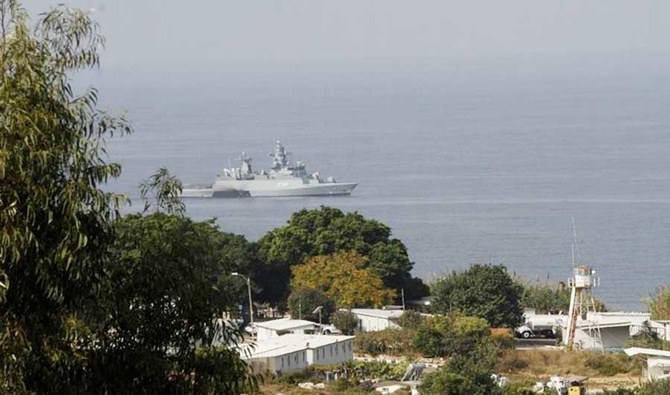

BEIRUT: Lebanon and Israel will resume technical negotiations on demarcating their maritime border, under US auspices, at the UN headquarters in Ras Al-Naqoura in southern Lebanon over the weekend.
The two sides engaged in four rounds of negotiations from Oct. 14 to Nov. 11, but talks stopped due to Lebanon’s adherence to its demand to expand the disputed area with Israel to reach 2,290 square km instead of 860 square km. This disputed area is located in the potentially gas-rich region.
The US State Department announced that the American delegation mediating the negotiations was heading to Beirut on May 3 to resume talks. These negotiations are the first between the two sides under the new US administration.
Lebanon and Israel are officially still at war, and there is no demarcation of land or sea borders between them. The State Department renewed “its commitment to mediate between Lebanon and Israel to facilitate the maritime talks.” John Deruscher is expected to be the US mediator.
Lebanon showed some confusion on the issue of demarcating its maritime border, as it drew a border from Ras Al-Naqoura to Line 23 and brought it to the notice of the UN in 2011. However, Lebanon later said this was based on wrong estimates, and the correct one was Line 29.
Lebanon demanded during the negotiation sessions an additional area of 1,430 square km that includes part of the Israeli Karish gas field in which the Greek Energean PLC operates.
However, the Lebanese request to amend the maritime border has not yet been sent to the UN because Decree No. 6433 related to border demarcation, which extends the border to Line 29, was not amended because President Michel Aoun did not sign it.
Aoun called for a Cabinet session to approve the amendment before referring it to Parliament, but caretaker Prime Minister Hassan Diab is refraining from holding a session of the caretaker administration because the matter is outside the powers of his government.
Israel accused Lebanon of changing its stance on the demarcation of the maritime borders, and Israeli Energy Minister Yuval Steinitz warned against “obstructing the offshore gas and oil exploration projects.”
Michel Najjar, minister of public works and transport in the caretaker government, said the border amendment was based on “regulations of coordinates of geographical points shown on the international maritime map issued by the British Admiralty.”
BACKGROUND
Lebanon and Israel are officially still at war, and there is no demarcation of land or sea borders between them.
The Lebanese Army Command, which demarcated the maritime border, said the negotiating delegation continued to perform its task in the indirect technical negotiations based on the study prepared by the Army Command and based on “scientific and legal bases in accordance with the evidence and studies prepared by the Hydrographic Office in the Army Command.”
Remarkably, a week ago, the leader of the Free Patriotic Movement (FPM), MP Gebran Bassil, proposed in a speech, “a new agreement based on a line that extends between the Hof Line, which gives Lebanon about 500 square km and Israel about 360 square km out of the entire area of 860 square km, and the Lebanese Line 29.”
Basil said at the time that “It is not wise to stay on Line 23 as long as the enemy did not give it to us. Therefore, Line 29 should be placed on the table.”
Bassil’s proposal sparked reactions from political figures who considered his proposal to be “non-sovereign and one that has political bargaining backgrounds with the American side, which imposes sanctions on him.”
Christina Abi Haidar, an oil and gas legal expert, said the most dangerous aspect of Bassil’s proposal was that he called for the formation of a new Lebanese delegation. “This proposal gives a wrong impression on the Lebanese delegation to the UN and the Israeli side, and this is not permissible at all.”
The Lebanese Army Command quickly denied information published in the media that the army “introduced a new amendment to its proposal as a compromise solution giving Lebanon about 1,300 instead of 2,290 square km by adopting a new borderline called the Qana Line.”
The Army Command stressed its and the negotiating delegation’s commitment and “adherence to the announced proposal, which is Line 29, which is scientifically proven and with evidence.”
Abi Haidar told Arab News: “The next negotiation is not yet clear. President Aoun’s refusal to sign the decree to amend the maritime border means that the matter is behind us, and we will go to negotiations with a weak position.”
Abi Haidar added: “If Lebanon agreed to amend the decree and we took it to the UN, we would have obtained part of the Karish field. Now, Aoun’s move is like telling the American and Israeli side: We are compromising. Perhaps it was this very step that prompted the resumption of negotiations between Lebanon and Israel.”


