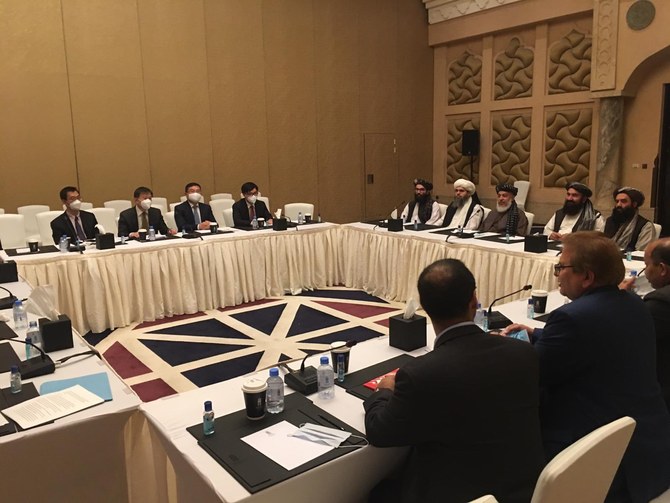
ISLAMABAD: Pakistan’s ambassador to Afghanistan Mansoor Ahmad Khan told Arab News on Friday that senior American, Chinese, Russian and Pakistani officials had opened consultations in Doha to “explore a way forward in the Afghan peace process.”
Khan is part of the Pakistani delegation attending the meeting of the “Extended Troika on the Peaceful Settlement in Afghanistan” that is held at a time when there has been no substantial progress in intra-Afghan negotiations that began last year in September.
Pakistan’s Special Representative for Afghanistan Mohammad Sadiq is leading his country’s delegation.
“All these meetings and initiatives are to held to achieve the goal [of peaceful settlement] and reflect Pakistan’s commitment for lasting peace and stability in Afghanistan,” Khan told Arab News from Doha.
“Pakistan believes there is no military solution to the Afghan conflict and a peaceful resolution of all hostilities requires serious negotiations among all Afghan stakeholders for an inclusive, broad-based and comprehensive political settlement in Afghanistan,” he added.
Taliban spokesman Mohammad Naeem said in a Twitter post that the Taliban political representatives met special envoys from the US, China, Russia and Pakistan on Friday.
He said that the meeting discussed the release of remaining Taliban prisoners and removing names of the insurgent group’s leadership from the United Nation’s blacklist and the US rewards list.
Naeem added that all sides agreed to initiate practical work to end sanctions on the Taliban leaders.
Earlier, a Pakistani official, who did not want to be named, said that members of the extended troika would try to convince the Taliban to be at the Istanbul Conference that is expected to be held after Eid Al-Fitr.
The Taliban refused to participate in the Istanbul meeting that was postponed twice this month.
Previously, Naeem said in a Tweet post that the Taliban would not participate in an international conference focusing on the Afghan situation unless all foreign forces left Afghanistan.
The last troika plus meeting was held in Moscow in March that was also attended by the Taliban and Afghan government delegation as well as a Qatari envoy and Afghan political leaders.
The Taliban had rejected a joint statement that came out of the Moscow meeting as interference in Afghanistan’s internal affairs since it opposed the restoration of Taliban’s Islamic Emirate.
Pakistani team in talks with the Taliban
In another development, a Pakistani official told Arab News on condition of anonymity that a Pakistani delegation had gone to Qatar on Wednesday to meet the Taliban political envoys and “convince them to show flexibility in intra-Afghan talks and reduce violence.”
The Taliban last month floated a proposal for a three-month reduction in violence to create a conducive environment for talks, though the initiative could not go too far after United States President Joe Biden announced a delayed troop withdrawal that would finish by September 11.
The United States and the Taliban signed an agreement in late February 2020, calling for a full withdrawal of foreign forces from Afghanistan by May 2021.
Pakistan said on Thursday it had always maintained that it could not control the Taliban.
“We will continue encouraging them to remain engaged in the peace process leading to an inclusive, broad-based and comprehensive political settlement in Afghanistan,” foreign office spokesman Zahid Hafeez Chaudhri said at his weekly news briefing.
US Special Representative for Afghanistan Reconciliation Zalmay Khalilzad is also in Doha to attend the meeting.
Taliban spokesman Suhail Shaheen confirmed in a Twitter post that Khalilzad interacted with the political representatives of the insurgent group on Thursday and discussed the latest situation in Afghanistan.


![]()

United States, Russia, China and Pakistan discuss fragile Afghan peace process in Doha
Short Url
https://arab.news/9ce3k
United States, Russia, China and Pakistan discuss fragile Afghan peace process in Doha
- The special representatives of the four countries met with the Taliban political representatives to find a way forward in peace talks
- The Taliban distanced themselves from international peace efforts after President Joe Biden announced delayed troop withdrawal
Latest updates


© 2026 SAUDI RESEARCH & PUBLISHING COMPANY, All Rights Reserved And subject to Terms of Use Agreement.