

Pakistan considering importing oxygen from China, Iran if need arises — information minister 

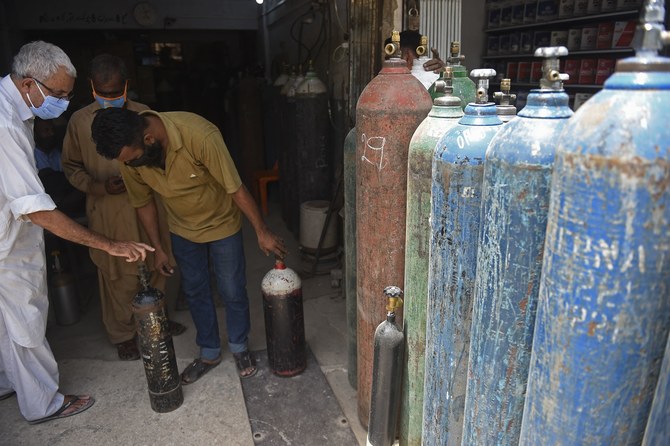
A shopkeeper (R) deals with a customer before refilling medical oxygen cylinders for Covid-19 coronavirus patients at his shop in Karachi on April 26, 2021. (AFP)
Short Url
Updated 27 April 2021
Follow

Pakistan considering importing oxygen from China, Iran if need arises — information minister 

  • Pakistan currently producing 792 metric tons of oxygen to meet needs of COVID-19 patients, Chaudhry Fawad Hussain says
  • Hospitals in Sindh and Islamabad suspend elective surgeries to divert available oxygen to coronavirus patients

ISLAMABAD: Pakistan’s federal information minister Chaudhry Fawad Hussain said on Tuesday the government would consider importing oxygen from China and Iran if a growing number of coronavirus cases caused shortages of oxygen in the country.

The minister was briefing the media about decisions taken in a federal cabinet meeting on Tuesday afternoon.

“The government, Fawad said, was also considering import of oxygen from China and Iran if the need arose,” state news agency APP reported. “Currently Pakistan was producing 792 metric tons of oxygen to meet the requirement of COVID-19 patients.”

“The situation in Pakistan would have [been] different had it not increased 7,000 ventilator beds and doubled the production of oxygen during the last one year,” the minister said, adding that the cabinet had also decided that oxygen meant for the industrial sector would be diverted to the health sector “if the situation worsened.”

Meanwhile, Pakistan’s southern Sindh province has decided to ban elective surgeries to divert oxygen to coronavirus patients:

Authorities in the capital city, Islamabad, also suspend all scheduled routine surgeries at public hospitals to divert available oxygen supplies to those suffering from COVID-19, Geo News reported. 

About 5,075 coronavirus patients are in critical care in Pakistan currently, the highest number since the pandemic began in Pakistan in February last year.


Pakistan, Qatar resolve to boost strategic, economic cooperation at Doha talks

Updated 8 sec ago
Follow

Pakistan, Qatar resolve to boost strategic, economic cooperation at Doha talks

  • Both countries urge dialogue on Afghanistan amid renewed border tensions between Islamabad and Kabul
  • Discussions focus on bilateral trade and investment, energy, defense, manpower and labor and culture

ISLAMABAD: Pakistan and Qatar on Tuesday agreed to deepen their strategic and economic cooperation during high-level talks between Prime Minister Shehbaz Sharif and his Qatari counterpart Sheikh Mohammed bin Abdulrahman bin Jassim Al Thani, Sharif’s office said.

Sharif visited Qatar along with a high-level delegation on the invitation of Qatari emir Sheikh Tamim bin Hamad Al Thani. The Pakistan premier also held meetings with Qatar’s trade and defense minister to discuss cooperation in various domains.

The visit came at a time when Pakistan is seeking closer economic engagement with Gulf partners amid its broader push to stabilize the economy and attract investment, while maintaining security and defense cooperation with key regional states.

During their meeting in Doha, PM Sharif and Qatar’s Sheikh Mohammed discussed bilateral relations and exchanged views on regional and international developments, according to the Pakistan prime minister’s office.

“They reaffirmed the strong brotherly relations between Pakistan and Qatar and expressed satisfaction at the growing momentum in political, economic and institutional ties,” Sharif’s office said.

“Discussions focused on enhancing cooperation in the fields of trade and investment, energy, defense, manpower and labor and culture, with both sides stressing the importance of their task force to accelerate cooperation in all these areas.”

Pakistan and Qatar maintain strong trade and investment ties. In 2022, the office of Qatar’s emir said the Qatar Investment Authority planned to invest $3 billion in Pakistan, targeting sectors including transport, aviation, education, health, media, technology and labor.

Nearly 300,000 Pakistanis live and work in Qatar, according to Pakistan’s foreign office, with many employed in health, education, engineering and public services, as well as construction and transport. The two countries engage through forums such as the Bilateral Political Consultations and the Joint Ministerial Commission.

Sharif and his Qatari counterpart also discussed regional issues, including developments in Gaza and broader Gulf security. PM Sharif appreciated Qatar’s constructive diplomatic efforts to promote dialogue and de-escalate tensions in the region, according to Sharif’s office.

The meeting reaffirmed the shared commitment to further strengthen the strategic partnership between Pakistan and Qatar and to remain in touch on current bilateral, regional and international issues.

DIALOGUE WITH AFGHANISTAN

Earlier, Sharif and Qatar’s Deputy PM Sheikh Saoud Al-Thani discussed the situation in Afghanistan and called for dialogue to support regional stability.

The meeting took place amid renewed tensions after Islamabad carried out airstrikes last week on what it described as Tehreek-e-Taliban Pakistan (TTP) targets inside Afghanistan. Kabul said the strikes killed civilians and vowed to respond to what it called a violation of its sovereignty.

“Regional developments were also discussed, in particular the situation in Iran and Afghanistan,” Sharif’s office said in a statement. “Both sides emphasized the importance of dialogue, de-escalation and collective efforts to promote peace and stability in the region.”

This was the second time in less than six months that Pakistan conducted airstrikes in Afghanistan. The last strikes triggered heavy, weeklong clashes between the neighbors along their border before Qatar and Turkiye mediated a ceasefire between them in Oct. last year.

Separately, Sharif held meetings with Qatar’s State Minister for Trade Dr. Ahmed bin Mohammed Al-Sayed and a delegation of the Qatar Businessmen Association (QBA), highlighting Pakistan’s investment-friendly reforms.

He invited QBA members to explore opportunities in infrastructure, logistics, energy, agriculture, technology and export-oriented manufacturing, his office said.