ISLAMABAD: The people of Afghanistan expect Pakistan to take “serious steps” to ensure a cease-fire in their country, the Afghan president’s special envoy for Pakistan, Umer Daudzai, told Arab News on Monday after holding wide-ranging talks with his Pakistani counterpart Mohammad Sadiq in Kabul.
The Taliban have rejected calls for a cease-fire and insist the issue will only be discussed in intra-Afghan negotiations that have hit a stalemate for months.
Sadiq wrapped up a two-day visit to Kabul on Monday in which he led a Pakistani team in talks with Daudzai, Afghan national security adviser Hamdullah Mohib and acting Afghan foreign minister Mirwais Nab. The special Afghan envoy said the Pakistani delegation included representatives from the army, the ISI spy agency and officials from the ministries of commerce and foreign affairs.
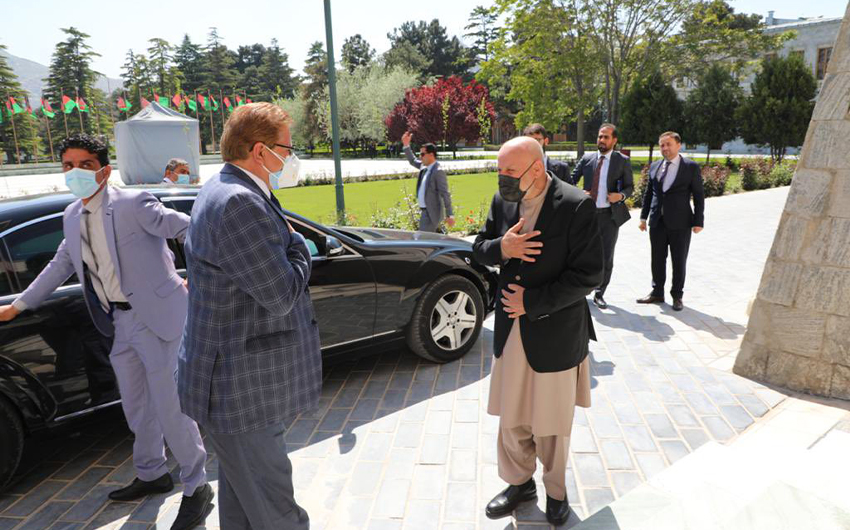
Afghan president’s special envoy for Pakistan, Mohammed Umer Daudzai (right) welcomes his Pakistani counterpart, Mohammad Sadiq (second left) at Presidential Palace in Kabul on April 25, 2021. (Umer Daudzai/Twitter)
Daudzai had visited Islamabad in February to discuss Pakistan’s role in the peace process and reduction of violence in Afghanistan.
“Cease-fire was one of my key demands during my visit to Pakistan in February,” Daudzai said. “Later, Pakistan also demanded a cease-fire during the recent meetings [of regional and international stakeholders] in Moscow, Tajikistan and Istanbul.”
“The other issue [discussed with Sadiq] was to encourage the Taliban to return to the negotiating table for constructive talks,” he said. “Pakistan had earlier promised its help for this purpose and the delegation reiterated its commitment.”
Daudzai said the basic purpose of the Pakistani delegation’s visit was to improve bilateral relations in different sectors and increase trust.
He added that problems in a revised transit trade agreement also came under discussion and would be resolved “within a week,” after which a new Afghanistan-Pakistan Transit Trade Agreement (APTTA) would be ready for signing.
The 2010 APTTA expired in February, and the two countries could not sign a revised agreement due to differences, thus deciding to extend the old agreement for three months, which will expire in May.
Afghanistan wants a new arrangement based on the provisions of the World Trade Organization (WTO) since the two sides are signatories to its provisions. Pakistan argues that transit trade is a bilateral accord and should be decided between the two nations.
Pakistan’s ambassador in Kabul, Mansoor Khan, told Arab News officials in the two countries had also agreed to step up efforts for the Istanbul conference, previously scheduled to start on April 24 but postponed over the Taliban’s refusal to participate.
The Taliban have said they will not participate in any international conference which makes decisions about Afghanistan unless all foreign troops leave the war-battered country.
Khan said Pakistan had also emphasized the need to activate the Afghanistan-Pakistan Action Plan for Peace and Solidarity (APAPPS) and hold its next meeting after Eid Al-Fitr in mid-May.