



DUBAI: In an online universe awash with websites publishing free but inaccurate information, and social media sites offering megaphones to unfiltered opinion, it is no surprise that trusted news media around the globe are facing one of their toughest choices to date — whether to erect a paywall.
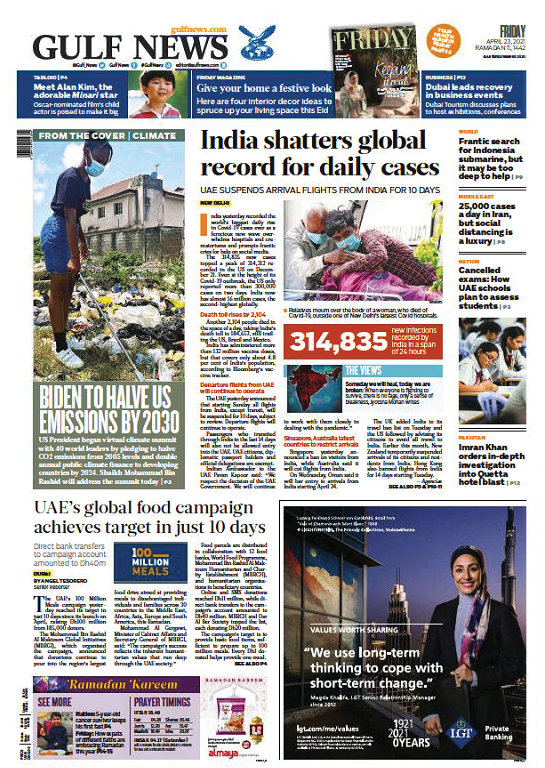
Gulf News, the leading UAE English-language daily, is the first to adopt a paywall strategy, asking users to subscribe to one of three currently discounted packages that will allow access to content.
“People think that when you go behind the wall, you’re preventing readers from reading. No, in fact, you’re opening a gateway for them for trusted journalism,” Gulf News’ CEO, Editor-in-Chief and Executive Director of Publications, Abdul Hamid Ahmad, exclusively told Arab News.
“That’s important, you know, and in today’s world, you don’t know how many websites there are, how many on social media, how many of this false, fake news. We are here to give the good journalism, the trusted journalism,” he said.
Indeed, at a time when many international news outlets have been lowering their paywalls to allow users access to crucial COVID-19-related news, the question must be asked: Why now?
“Our whole point was that we have high traffic, and we want the engagement with our readers. We have a very strong, loyal readership and, therefore, when we went into the paywall model, we’ve given everybody an opportunity to come through gulfnews.com to get COVID news,” Meher Murshed, Gulf News executive editor of digital, told Arab News.

Meher Murshed, Gulf News executive editor of digital
“If you come through the site, it gives you the flexibility of scanning the entire site without coming upon a wall. You can read the full site, you know, and get your news, and then move on if you wish.”
The UAE daily competes with media outlets such as The National, Khaleej Times and a host of other publications that currently do not require a paid subscription, and the editors believe that their unique readers will not migrate from the platform to others due to the paywall.
“That’s our strength — the audience that we have is an engaged audience, it’s a local audience and expatriates who want news on the home country and the opinion,” Murshed said.
Currently, the news industry relies heavily on advertising revenue to remain afloat, and while Gulf News averages 230 million page views with 15 million unique visitors monthly, subscriptions will not become the paper’s main source of funding.
INNUMBERS
15 million monthly users
230 million monthly page views
Over 5.4 million engaged social audience
He added: “It’s not that we blocked anyone out, or anything like that. In fact, if anything, the engagement level has gone up, even during these times.”
However, both Ahmad and Murshed believe that this will fine tune the types of ads with which readers interact.
“You have to respect the reader — you have to give them a good experience when they read and not bombard them with too many ads and disrupt their reading,” Ahmad said.
“If you respect the reader, the advertiser will respect you and will come to you.”
Murshed echoed Ahmad’s comments, saying: “I think the advertising and the readers go hand in hand. They always have and always will. I don’t think you can choose one or the other.”
The paywall decision required a lot of research, Ahmad and Murshed said, before deciding on a unique model to offer readers an engaging experience — subscriber or not.
“It’s not a model that you see anywhere in the world, because we have a unique audience, and I think we are catering to them,” Murshed said.
While a dip in readership is expected, as is the case when any paywall is set up, the editors are unfazed by the challenge and, if anything, are confident even more readers will sign up.
“It’s a milestone for us, certainly, and at every milestone you have to face certain challenges. Now the challenge for us is really to keep the content as good as it is — it matters to the reader. When the reader feels that you have the content that others don’t have, they’ll come to you,” Ahmad said.
“So, if you keep providing the reader with good content, they will come to you, and stay with you and trust you,” he added, “But when you say good content, it also has to be verified, fact-checked and credible. It also has to be told in a way that is attractive.”
Established over four decades ago, Gulf News has now expanded, with sections on personal finance, parenting and food that cater to a wide UAE readership.
“For 42 years, we’ve been providing content, very strong content, reliable, and we are continuing to do so. Gulf News has been looking to strengthen and innovate all along the way,” Murshed said.
“So, I think, you know, we will give the audience what we do best — what they want, what they’re looking for, and we will strengthen it further and evolve. That’s our journey,” he added.


