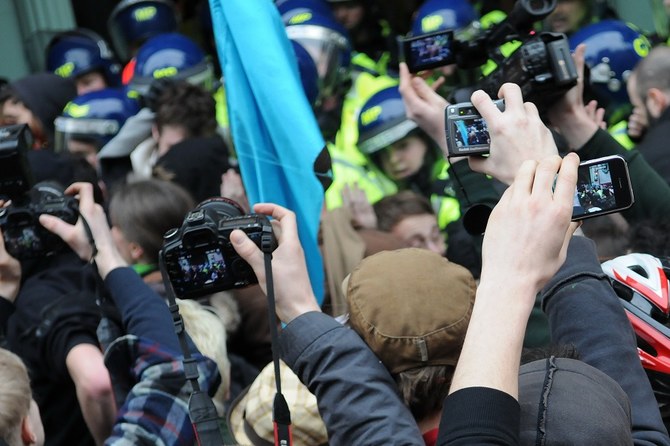

DUBAI: Every picture tells a story and with the rise of digital media the camera may be a journalist’s only tool to accurately convey information while playing a role in promoting tolerance among the masses.
Sharing this view was a panel of journalists and media professionals speaking at the World Tolerance Summit being held at the Madinat Jumeirah resort in Dubai between Nov. 13 and 14.
Exploring tolerance practices from around the world under the theme “Tolerance in Multiculturalism: Achieving the Social, Economic and Humane Benefits of a Tolerant World,” the summit’s second edition was expected to gather 3,000 participants from more than 100 countries, including top-level officials, peace experts, diplomats and youth.
Mohammed Fahad Al-Harthi, editor-in-chief of Sayidaty, Arrajol, and Al-Jamila magazines, kicked off the first day of the conference by calling on media outlets to enhance their approach to the delivery of news through frequent on-the-ground reporting and visual material.
In an era of citizen journalism and social media influencers, news media outlets have often been blamed for playing a key role in spreading false information and reporting fake news.
To combat this perception, Al-Harthi said print and digital media must elevate their standards by incorporating fact-checking tools into their day-to-day reporting.
“We must also identify the people affected in news stories in order to impact readers and bring them back to values such as tolerance. If there is no camera, there is no news,” he added.
Al-Harthi noted the importance of adopting platforms such as social media that allow news outlets to engage with their audience, creating a channel to exchange views and feedback. He pointed to Sayidaty magazine’s 2013 “White Campaign” against child brides as an example of positive use of social media to encourage the “voiceless” to tell their stories.
The campaign reached more than 42 million people in the Arab world, gaining the support of members of the Saudi royal family, government officials, journalists and NGOs from throughout the region.
Running for a period of three months, it focused on countries known to previously tolerate child marriages such as Saudi Arabia, Egypt and Yemen, with the goal of pressurizing governments to increase the minimum age for marriage and criminalize sexual abuse.
“This was one of the most successful campaigns carried out by the media as we were able to stop five marriages involving children in three countries,” said Al-Harthi.
Commenting on the power of images and video in news reporting, Anelise Borges, Paris-based correspondent for Euronews France, described social media as a “double-edged sword.”
She said: “The entire world is struggling to find a balance between freedom of speech and responsibility and accountability.”
Borges talked about her 10-day experience onboard the Aquarius, a vessel operated by Medecins Sans Frontieres (MSF) and SOS Mediterranee, capturing human stories of men, women and children who risked everything to reach Europe in search of a better life.
Sailing across the Mediterranean, Borges witnessed the rescue of two rubber boats overcrowded with refugees who had travelled long distances to escape the violence of war.
“We had seen these migrants as victims, poor people, and masses without names or faces. I wanted to go there and see who we are talking about and let them speak for themselves,” said Borges.
With the issue of migrants and refugees considered a major crisis in Europe, Borges pointed out that it was their voices that were “missing in the conversation” among governments today.
Through raw images and videos documenting distressing stories of struggle, Borges said she was able to explain to viewers and decision-makers the impact their choices and decisions were having on migrants.
“Our job as journalists is to tell a story, which only works through engagement and conversation with the people involved,” she said, stressing the importance of empathy. “It is not us versus them anymore.”
Sharing the same views, panelist Mohammed Khairy, a director and producer with Saint Films in Egypt, discussed his efforts to raise awareness about Christian Egyptians through his film “Jesus was here.”
Traveling around the country to identify different sects of Christians, he documented individual stories, reflecting their struggles from a “cinematic perspective.”
In his documentary, he sheds light on the history of Christianity in Egypt, with hopes to influence intolerant views in the society of the “so-called minority” group.
“As a film director, you put a lot of effort into research and fact-checking and verifying information whether it’s from a book, a person, or a verified source,” said Khairy, commenting on the challenges facing journalists in the news industry. “At times, the process in film can take up to a year to finalize,” he added.