

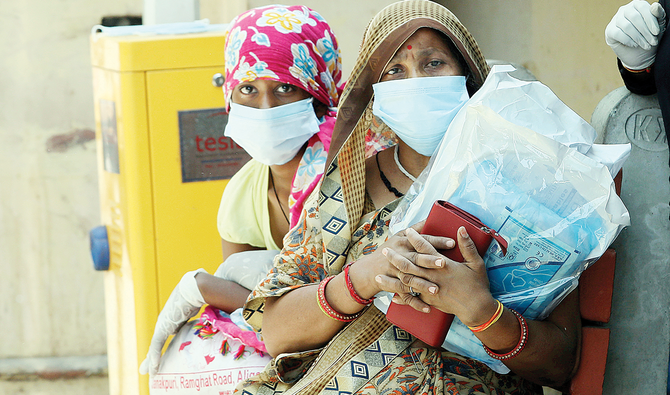

NEW DELHI: India’s government on Monday announced a week-long lockdown in the national capital, New Delhi, after its health system reached “breaking point” due to a scarcity of hospital beds and oxygen tanks for coronavirus patients.
On Monday, India witnessed an unprecedented spike in coronavirus infections, with 273,810 cases reported in a single day.
At least 1,620 people were killed by the virus, creating another record on Monday and bringing the country’s death toll to 178,769.
New Delhi recorded 26,000 coronavirus cases on Monday, a record jump since April 1, when daily case numbers hovered around the 1,000 mark. The city also recorded 161 coronavirus-related deaths in the past 24 hours.
New Delhi Chief Minister Arvind Kejriwal described the situation as “pretty critical,” adding that imposing the lockdown was “the only option left to avoid a bigger disaster.”
He said in a televised address: “Delhi’s health system is at a breaking point. I will not say it has collapsed, but the situation is pretty critical.”
Kejriwal added that the decision to impose a lockdown was “not an easy one to take.”
He said: “I have always been against a lockdown, but it will reduce the transmission rate and give us time to boost our infrastructure. We will use this week-long lockdown to improve our healthcare.”
Kejriwal acknowledged that Delhi was facing an acute shortage of hospital beds and oxygen supply, highlighting the issue in a letter to Indian Prime Minister Narendra Modi on Sunday while seeking help from the federal government to avert the crisis.
A majority of hospitals in Delhi reported chaotic scenes on Monday with patients desperately searching for bed space in coronavirus wards.
All of the 18,933 beds reserved for coronavirus patients were reportedly full on Monday, including 1,436 intensive care unit (ICU) beds and 2,881 ICU beds without ventilators.
However, residents are warning that existing facilities cannot accommodate the surge in infections, with several losing relatives due to a lack of oxygen supply and medical support.
“I lost my wife on Sunday because she could not get ventilator support on time,” Dr. Anwar Sadat, a Delhi resident, told Arab News.
“We never thought that such a tragedy would strike us and that our whole life would become disoriented within a matter of days. We desperately looked for beds in the hospital for her, but by the time she got ventilator support, my wife had collapsed,” Sadat said.
Besides New Delhi, the central Indian state of Madhya Pradesh (MP) also posted a grim picture, with medical infrastructure in its capital city Bhopal “overstretched” amid reports of residents suffering due to a lack of medical attention.
MP has also imposed a lockdown until April 26 in several cities, including Bhopal.
On Monday, it reported almost 12,500 coronavirus infections across the state.
However, media reports alleged that government figures do not reflect the reality on the ground in crematoriums and burial grounds.
“There was hardly any space to burn the dead bodies in the crematorium ground. We had to wait eight hours,” Santosh Mishra, who lost his uncle to coronavirus, told Arab News about the situation at the Bhadbhada crematorium in Bhopal.
Doctors, too, said they were struggling to cope with the massive influx of patients.
“The situation is grim,” Dr. Sarman Singh, director of Bhopal’s premium medical institution, the All India Institute of Medical Science, told Arab News.
“We are facing a scarcity of beds and oxygen like everywhere in the world, and the patient load is increasing,” he added.
Arab News on Sunday reported similar events in the northern Indian state of Uttar Pradesh and the western state of Gujarat, Prime Minister Narendra Modi’s home state.
Experts said they were unsure how long the spike in coronavirus infections would continue, but blamed ongoing regional election campaigns and an ongoing Hindu festival, the Kumbh Mela — where millions converge to sacred sites for a ritual dip in holy waters — for “adding to the existing trouble.”
Dorairaj Prabhakaran, general secretary of the Public Health Foundation of India, said: “It will take another two to three weeks before the cases peak in major cities.”
He said that imposing the lockdown was “one of the options to contain the virus,” adding: “Lockdown is an important option right now. At least a decentralized lockdown is a better option than a countrywide lockdown. This keeps the mobility going.”
However, Dr. Jayesh Lele, general secretary of the Indian Medical Association, blamed the “pathetic management” of the government for the crisis.
“Why is the government going ahead with the election campaigning and not stopping mass gatherings? It’s a pathetic management of affairs,” Lele told Arab News.
“The government should have done some preparation. Today, cities across India have collapsed. In rural areas, the situation is probably grimmer,” he added.


