Blinken calls Pakistan military chief as US delays troop pullout from Afghanistan

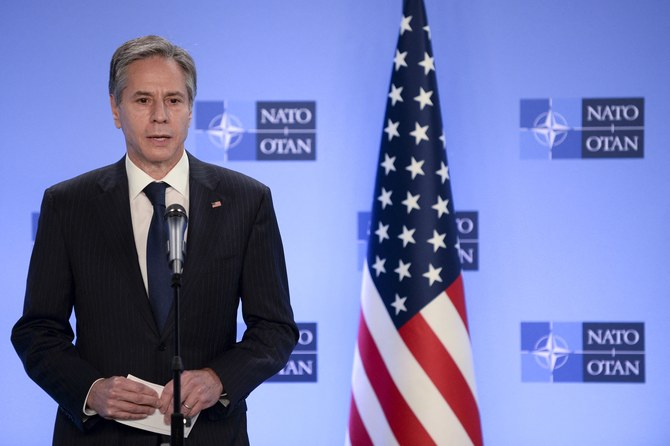
US Secretary of State Antony Blinken speaks during a press conference with transatlantic alliance NATO's chief on April 14, 2021 at NATO's headquarters in Brussels (AFP)
Short Url
Updated 14 April 2021
Follow

Blinken calls Pakistan military chief as US delays troop pullout from Afghanistan

  • Delay of US troop withdrawal prompts the Taliban to shun an upcoming Afghan peace conference
  • US president is expected to lay out the timeline for the withdrawal on Wednesday

ISLAMABAD: US Secretary of State Antony Blinken held a phone meeting with Pakistan military chief Gen. Qamar Javed Bajwa on Wednesday, following reports that Washington would not a observe a May 1 deadline to withdraw its soldiers from Afghanistan.

The call came as US officials said President Joe Biden would pull American troops from Afghanistan before this year’s 20th anniversary of the Sept. 11 attacks, delaying by some five months an agreement the former US administration of President Donald Trump signed with the Taliban in February last year.

“During the conversation matters of mutual interest, regional security situation including latest developments in Afghan Peace Process and bilateral cooperation in various fields were discussed,” the Pakistani military’s media wing said in a statement.

Bajwa reiterated Pakistan’s support for an Afghan led and Afghan-owned peace process “based on mutual consensus of all stakeholders.”

The delay in the US pullout has, however, prompted the Taliban to shun an upcoming conference on Afghanistan’s future in Istanbul this month. The group’s spokesman, Mohammad Naeem, said in a tweet on Tuesday night the Taliban would not attend the conference in Turkey until all foreign troops leave the country.

Biden is expected to lay out his vision for the way forward in Afghanistan and the timeline for the withdrawal on Wednesday.


Pakistan approves first national gemstones policy, targets $1 billion exports

Updated 09 January 2026
Follow

Pakistan approves first national gemstones policy, targets $1 billion exports

  • Government seeks to overhaul certification, mining, processing to curb smuggling and boost value-added exports
  • Move follows broader push to tap Pakistan’s vast mineral wealth and attract much-needed foreign investment

ISLAMABAD: Pakistan has granted in-principle approval to its first national policy framework for gemstones and precious stones, aiming to reform the sector, align it with international standards and lift annual exports to $1 billion within five years, the prime minister’s office said on Friday.

The decision was taken during a meeting chaired by Prime Minister Shehbaz Sharif, which reviewed reforms for the largely underdeveloped gemstones sector despite Pakistan holding significant reserves of emeralds, rubies, sapphires, peridot and topaz.

The move comes as Pakistan intensifies efforts to monetize its untapped mineral resources amid fiscal pressures and an IMF-backed reform program. Over the past two years, Islamabad has hosted international minerals conferences and signed cooperation agreements with countries including the United States, Saudi Arabia and China to improve governance, attract foreign investment and move up the value chain in mining and minerals processing.

Despite officials estimating Pakistan’s gemstone reserves at around $450 billion, formal exports remain negligible, at about $5.8 million annually, due to weak certification systems, limited domestic processing capacity, widespread smuggling and fragmented regulation across federal and provincial authorities.

“Sharif has granted in-principle approval to a national policy framework to reform Pakistan’s gemstones and precious stones sector and align it with international standards,” the PM’s office said in a statement. 

“The Ministry of Industries and Commerce, after identifying challenges during the preparation of the national policy framework, has developed a comprehensive set of priority policy measures which aim to achieve $1 billion in gemstone-related exports within five years through sectoral reforms.”

According to the statement, the policy framework includes geological mapping to accurately assess reserves, the establishment of internationally accredited laboratories and certification regimes and the creation of a dedicated authority to regulate and promote the sector. The government also plans to set up a National Warranty Office and at least two centers of excellence this year to support training, research and value-added processing.

The policy prioritizes private sector participation, particularly encouraging young entrepreneurs, and seeks to shift Pakistan away from exporting raw stones toward domestic cutting, polishing and branding. The statement said this approach could significantly increase export earnings while generating skilled jobs.

The prime minister also directed the ministry of finance to ensure timely allocation of financial resources required to implement the reforms and stressed the need to involve provincial governments, industry stakeholders and international experts to address structural bottlenecks.

“Pakistani precious stones are renowned globally for their quality, and curbing smuggling while ensuring exports through legal channels will secure billions of dollars in foreign exchange,” the prime minister said, according to the statement.