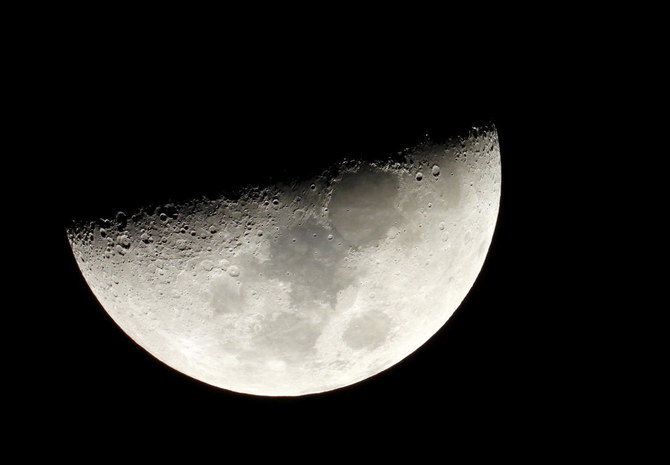
UAE partners with Japan’s iSpace to send rover to the moon in 2022

Japanese company iSpace, founded in 2010, aims to provide commercial transportation to the moon. (Reuters)
Short Url
Updated 14 April 2021
Follow

UAE partners with Japan’s iSpace to send rover to the moon in 2022

  • SpaceX rocket will deliver an iSpace lander to the moon’s orbit
  • UAE had originally intended to send it into space by 2024

DUBAI: Lunar exploration company iSpace will transport a United Arab Emirates rover to the moon in 2022, the company said on Wednesday, as the UAE pushes for rapid expansion in the space exploration business to diversify its economy.
The UAE is using its space program to develop its scientific and technological capabilities and reduce its reliance on oil.
The Gulf state’s, and the Arab world’s, first interplanetary probe entered Mars’ orbit in February. It is now sending data about the Martian atmosphere and climate.
The Rashid lunar rover will be designed entirely by Emiratis. The UAE had originally intended to send it into space by 2024.
Japanese company iSpace, founded in 2010, aims to provide commercial transportation to the moon with a wider mission to ultimately incorporate the moon into the earth’s economy.
The 2022 launch will be iSpace’s first mission of this kind and will use a Falcon 9 rocket from Elon Musk’s SpaceX, to be launched from Florida.
Dubai’s Mohammed Bin Rashid Space Center (MBRSC) will build the Rashid lunar rover. It will remain on the moon after data collection is completed, said Emirates Lunar Mission manager Hamad Al-Marzooqi.
The SpaceX rocket will deliver an iSpace lander to the moon’s orbit. The lander will propel itself to the moon’s surface and the UAE rover will then emerge from the lander and drive off to explore, said iSpace Founder and CEO Takeshi Hakamada.
The lander will also be carrying a solid-state battery designed by Japanese company NGK Spark Plug to be tested in the lunar environment.
The lunar mission is part of the Gulf state’s broader vision for a Mars settlement by 2117.
Under the agreement, iSpace said it would also provide the Emirates Lunar Mission with wired communication and power during the cruise phase and wireless communication on the moon.
The UAE launched a National Space Programme in 2017 to develop local expertise. Its population of 9.4 million, most of whom are foreign workers, lacks the scientific and industrial base of the major countries which have space programs.
Hazza Al-Mansouri became the first Emirati in space in 2019 when he flew to the International Space Station. This week the UAE selected the first Arab woman to train as an astronaut.


Egypt defies African FDI trend with inflows of $11bn in 2025: UNCTAD 

Updated 4 sec ago
Follow

Egypt defies African FDI trend with inflows of $11bn in 2025: UNCTAD 

RIYADH: Egypt emerged as Africa’s top destination for foreign direct investment in 2025, attracting an estimated $11 billion in inflows in a year marked by declining investment across the continent. 

According to UNCTAD’s latest Global Investment Trends Monitor, the North African country ranked ahead of other major African economies despite a sharp regional slowdown. 

The performance underscores Egypt’s relative resilience at a time when foreign investment into Africa has normalized following an unusually strong 2024, which UNCTAD said was inflated by a single large project. As a result, the 2025 data reflects a return to more typical investment levels across the continent. 

“Among African economies, inflows to Angola reached an estimated $3 billion, marking a return to positive values after nine consecutive years of net divestments,” the report stated. 

It added: “Egypt, with inflows of $11 billion, remained the largest FDI host country in Africa.”  

While Egypt solidified its position as Africa’s leading FDI host, other notable movements on the continent included Mozambique, where inflows surged 80 percent to $6 billion, driven by renewed activity in major liquified natural gas projects.  

Angola also saw a positive shift, recording an estimated $3 billion in FDI after nine consecutive years of net divestments. 

UNCTAD noted that Egypt’s strength extended beyond headline inflows, with the country also contributing to an increase in greenfield investment activity across Africa. While the number of greenfield projects fell globally and across most lower-income economies, Africa recorded a 5 percent increase in project numbers in 2025, supported in part by growth in Egypt and Côte d’Ivoire. 

Globally, FDI flows rose by 14 percent in 2025 to approximately $1.6 trillion, though growth was heavily concentrated in developed economies, which saw a 43 percent increase.  

In contrast, flows to developing economies declined by 2 percent, with the least developed countries particularly affected; three-quarters experienced stagnant or falling investment. 

The report highlighted that new project announcements remained weak globally amid elevated policy uncertainty, with international project finance declining for the fourth consecutive year.  

Looking ahead, UNCTAD warned that geopolitical tensions, regional conflicts, and economic fragmentation could continue to suppress real investment activity in 2026, even as financing conditions are expected to ease.  

For Africa, sustaining FDI inflows will require navigating persistent challenges such as financing constraints, risk perceptions, and structural vulnerabilities.