KARACHI: Slum dwellers in the Pakistani city of Karachi have stopped the demolition of thousands of homes by mapping flood risks from clogged drains, offering a feasible solution to other informal settlements facing climate change impacts, urban experts said.
After unexpectedly heavy rains flooded much of Karachi last year, authorities said some slum settlements would be removed to allow drains to be widened, with hundreds of homes in Manzoor Colony settlement earmarked for demolition.
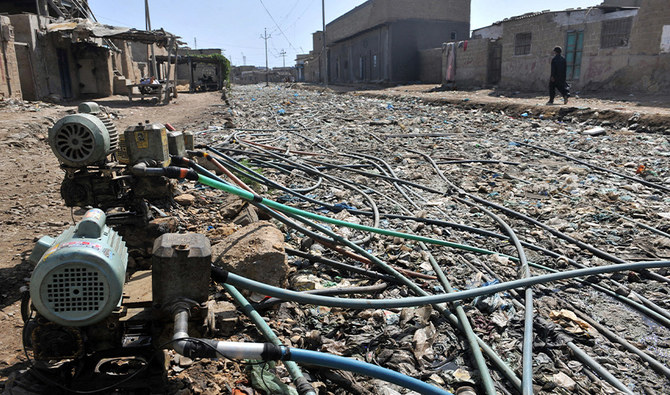
Residents, who had always insisted that the flooding was mainly caused by drains blocked with rubbish and sludge, teamed up with non-profit organizations to map the drainage network.
“They generated their own evidence to uncover the reasons – overlooked by authorities – why Karachi floods,” said Arif Hasan, an architect and planner who backed the mapping project.
“The communities believed that if these obstructions are removed and the drains are cleaned and maintained, flooding will not take place,” he told the Thomson Reuters Foundation.
About 12 million people out of Karachi’s 16 million population live in informal settlements, and are increasingly vulnerable as Pakistan’s largest city faces worsening inundations as the South Asian monsoon brings extreme weather.
Karachi, Pakistan’s financial hub, has a network of 550 stormwater drains that criss-cross the city and empty into the Arabian Sea. Many are blocked by illegal construction and waste.
Authorities say they clean out the drains every year before the monsoon, except last year when the provincial government did not provide funds. The unusually heavy rains killed dozens, submerged main roads and inundated hundreds of homes.
To map Manzoor Colony’s drains, a team from the non-profit Technical Training Resource Center (TTRC) walked along them with residents, photographing, marking and mapping more than a dozen blockages.
Their map showed only about 40 houses needed to be removed to leave the drains clear, said Mohammad Sirajuddin, head of TTRC, who led the mapping project.
“The authorities said thousands of houses would need to be demolished, but our maps showed otherwise,” he said.
In November, residents successfully halted the planned demolitions in Manzoor Colony.
While it is not certain whether authorities will use the community’s flood risk map in the future, the residents now know where the choke points are and how they can tackle the dangers, Sirajuddin said.
Two other informal settlements in Karachi are being mapped, with residents — especially young people — trained, he said, adding that the model can be replicated across the country.
These maps also generate crucial data on households, said Nausheen Anwar, director of Karachi Urban Lab, a think-tank.
“The maps provide a process through which consensus can be built and inclusion of all residents can be negotiated to stave off evictions and establish a basis for just compensation and resettlement,” she said.
By 2030, more than half of Pakistan’s projected 250 million population are expected to live in cities, compared to 36% now, according to the United Nations.
Prime Minister Imran Khan had pledged to build 5 million affordable homes within five years to address a chronic shortage, with housing rights groups warning that poorer residents face evictions as pressure on land increases.
“When youths in the settlements are trained in mapping, they better understand the risks they face,” said TTRC’s Sirajuddin.
“They understand their rights, and can fight evictions.”


Pakistan slum dwellers map flood risks to stop evictions
https://arab.news/nwq7n
Pakistan slum dwellers map flood risks to stop evictions

- Authorities say they clean out the drains every year before the monsoon, except last year when the provincial government did not provide funds
- Karachi, Pakistan’s financial hub, has a network of 550 stormwater drains that criss-cross the city and empty into the Arabian Sea

’All the pressure’ on Pakistan as USA out to inflict another T20 shock
- USA gave tournament favorites India a big scare in their opening match in Mumbai
- Pakistan cannot afford any slip-ups after saying they would not play India on Feb. 15
COLOMBO: USA leg-spinner Mohammad Mohsin said Monday that “the pressure will be on Pakistan” when the teams lock horns in the T20 World Cup again, two years after the Americans inflicted a shock defeat on the former champions.
But Pakistan quick bowler Salman Mirza insisted the stunning super over defeat in Dallas in the 2024 T20 World Cup would be firmly “in the past” when the two clash in Colombo on Tuesday.
The USA team gave tournament favorites India a big scare in their opening match in Mumbai, reducing them to 77-6 at one point, with Mohsin taking a wicket on his T20 World Cup debut, before losing by 29 runs.
They are confident they can repeat their stunning upset of two years ago in the Group A encounter.
“The pressure of losing the last game will be on Pakistan,” said Mohsin.
Born and brought up playing cricket in Pakistan, Mohsin migrated to the US five years ago and warned the USA were a better team now than two years ago.
“I have played with most of the players in this Pakistan team, so I have given my input to the team and we are a more skilled and confident team.”
Mirza was confident the last defeat will not prey on the Pakistan players’ minds.
“Winning and losing are part of the game, it happens in cricket,” Mirza said. “The defeat against the USA is now past and behind us.”
Pakistan, the 2009 champions, were close to suffering another shock in their opening match against the Netherlands on Saturday.
Pakistan were staring at defeat with 29 runs needed in the last two overs but all-rounder Faheem Ashraf’s big hitting bailed them out.
Pakistan cannot afford any slip-ups if they are to qualify for the super eight stage as one of the top two teams in Group A after saying they would not play India on February 15.
Defeat to the USA two years ago saw them fail to get out of the group.
Mirza admitted the smaller teams were dangerous opponents.
“Until now all the matches are close and no team is small or big in this format,” said Mirza, who took 3-24 against the Netherlands.
Pakistan may bring back experienced batsman Fakhar Zaman to replace Babar Azam who has been criticized for slow scoring.


