KARACHI: Slum dwellers in the Pakistani city of Karachi have stopped the demolition of thousands of homes by mapping flood risks from clogged drains, offering a feasible solution to other informal settlements facing climate change impacts, urban experts said.
After unexpectedly heavy rains flooded much of Karachi last year, authorities said some slum settlements would be removed to allow drains to be widened, with hundreds of homes in Manzoor Colony settlement earmarked for demolition.
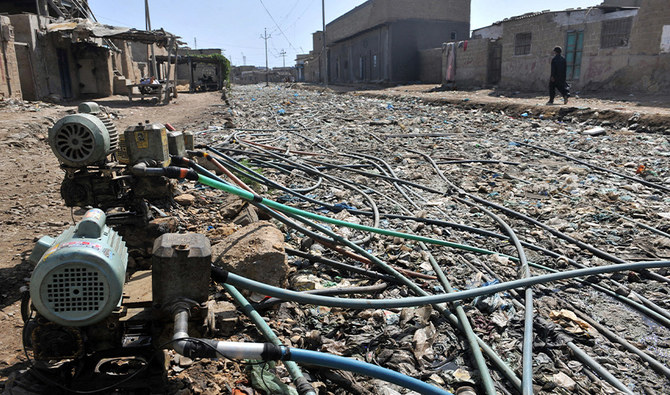
Residents, who had always insisted that the flooding was mainly caused by drains blocked with rubbish and sludge, teamed up with non-profit organizations to map the drainage network.
“They generated their own evidence to uncover the reasons – overlooked by authorities – why Karachi floods,” said Arif Hasan, an architect and planner who backed the mapping project.
“The communities believed that if these obstructions are removed and the drains are cleaned and maintained, flooding will not take place,” he told the Thomson Reuters Foundation.
About 12 million people out of Karachi’s 16 million population live in informal settlements, and are increasingly vulnerable as Pakistan’s largest city faces worsening inundations as the South Asian monsoon brings extreme weather.
Karachi, Pakistan’s financial hub, has a network of 550 stormwater drains that criss-cross the city and empty into the Arabian Sea. Many are blocked by illegal construction and waste.
Authorities say they clean out the drains every year before the monsoon, except last year when the provincial government did not provide funds. The unusually heavy rains killed dozens, submerged main roads and inundated hundreds of homes.
To map Manzoor Colony’s drains, a team from the non-profit Technical Training Resource Center (TTRC) walked along them with residents, photographing, marking and mapping more than a dozen blockages.
Their map showed only about 40 houses needed to be removed to leave the drains clear, said Mohammad Sirajuddin, head of TTRC, who led the mapping project.
“The authorities said thousands of houses would need to be demolished, but our maps showed otherwise,” he said.
In November, residents successfully halted the planned demolitions in Manzoor Colony.
While it is not certain whether authorities will use the community’s flood risk map in the future, the residents now know where the choke points are and how they can tackle the dangers, Sirajuddin said.
Two other informal settlements in Karachi are being mapped, with residents — especially young people — trained, he said, adding that the model can be replicated across the country.
These maps also generate crucial data on households, said Nausheen Anwar, director of Karachi Urban Lab, a think-tank.
“The maps provide a process through which consensus can be built and inclusion of all residents can be negotiated to stave off evictions and establish a basis for just compensation and resettlement,” she said.
By 2030, more than half of Pakistan’s projected 250 million population are expected to live in cities, compared to 36% now, according to the United Nations.
Prime Minister Imran Khan had pledged to build 5 million affordable homes within five years to address a chronic shortage, with housing rights groups warning that poorer residents face evictions as pressure on land increases.
“When youths in the settlements are trained in mapping, they better understand the risks they face,” said TTRC’s Sirajuddin.
“They understand their rights, and can fight evictions.”


Pakistan slum dwellers map flood risks to stop evictions
https://arab.news/nwq7n
Pakistan slum dwellers map flood risks to stop evictions

- Authorities say they clean out the drains every year before the monsoon, except last year when the provincial government did not provide funds
- Karachi, Pakistan’s financial hub, has a network of 550 stormwater drains that criss-cross the city and empty into the Arabian Sea

Pakistan president meets UAE counterpart, explores trade, investment opportunities
- Asif Ali Zardari is in UAE on four-day visit to strengthen bilateral ties, review bilateral cooperation
- Both sides discuss regional, international developments, reaffirm commitment to promote peace
ISLAMABAD: President Asif Ali Zardari met his UAE counterpart Sheikh Mohammed bin Zayed Al-Nahyan in Abu Dhabi on Tuesday during which both sides explored new opportunities in trade, investment, energy and other sectors, Zardari's office said.
Zardari arrived in Abu Dhabi on Monday evening with a high-level delegation on a four-day official visit to the UAE to review trade, economic and security cooperation.
"The leaders discussed ways to further deepen the longstanding and brotherly relations between Pakistan and the UAE," a statement from Zardari's office said about his meeting with the UAE president.
"They reviewed the full spectrum of bilateral cooperation and explored new opportunities in trade, investment, energy, infrastructure, technology, and people-to-people exchanges, highlighting the significant potential for expanding economic and strategic partnership.
Zardari highlighted the significance of Al-Nayhan's visit to Pakistan last month, the statement said, expressing appreciation for the UAE's continued support for strengthening bilateral ties.
It said both sides also exchanged views on a range of regional and international developments, reaffirming their commitment to promoting peace, stability and sustainable development.
The meeting was also attended by Pakistan's First Lady Aseefa Bhutto-Zardari, the Pakistani president's son Bilawal Bhutto-Zardari, who is also the chairman of the Pakistan Peoples Party, Interior Minister Mohsin Naqvi and Pakistan's ambassador to the UAE.
ZARDARI MEETS AD PORTS CEO
Zardari earlier met AD Ports Group CEO Captain Mohamed Juma Al-Shamisi to discuss the group's investment initiatives in Karachi.
"Both sides agreed that the expansion and modernization of port infrastructure would strengthen trade flows and support Pakistan’s broader economic development and country’s seaborne trade," the President's Secretariat said in a statement.
It added that Zardari described the AD Ports Group's long-term investment and expanding role in Pakistan's maritime and logistics sector as a key pillar of Pakistan–UAE economic cooperation.
Pakistan and the UAE maintain close political and economic relations, with Abu Dhabi playing a pivotal role in supporting Islamabad during periods of financial stress through deposits, oil facilities and investment commitments.
The UAE is Pakistan's third-largest trading partner, after China and the United States, and a key destination for Pakistani exports, particularly food, textiles and construction services.
The Gulf state is also home to more than 1.5 million Pakistani expatriates, one of the largest overseas Pakistani communities in the world, who contribute billions of dollars annually in remittances, a crucial source of foreign exchange for Pakistan’s economy.
Beyond trade and labor ties, Pakistan and the UAE have steadily expanded defense and security cooperation over the years, including military training, joint exercises and collaboration in counter-terrorism and regional security matters.


