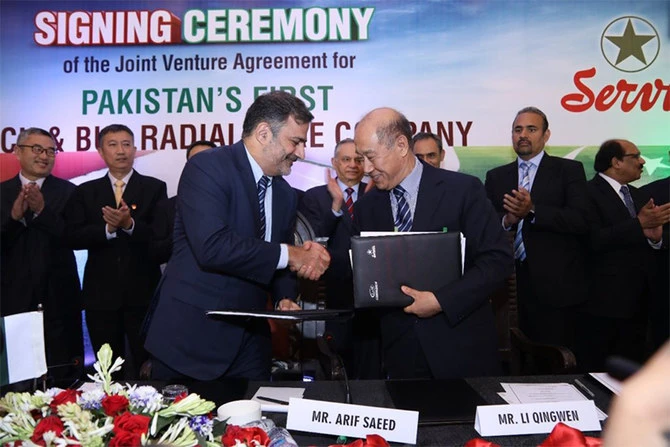
KARACHI: Service Global Footwear Limited (SGFL), Pakistan’s largest shoe exporter, on Thursday raised $14.23 million (Rs 2.2 billion) in an oversubscribed two-day book building process at the Pakistan Stock Exchange (PSX), financial advisers for the transaction said.
Last month Service said it was planning an initial public offering in the domestic market to raise funds to invest in its parent’s tire joint venture.
Service Global Footwear is part of Service Industries Ltd., which has more than 13,000 employees and is known for its shoes and tires in Pakistan. The footwear unit supplies brands including Inditex SA’s Zara, Levi Strauss & Co.’s Dockers and Reckitt Benckiser Group Plc’s Scholl. The business has an annual revenue of about $44 million and exports to European countries such as Germany, France and Italy. It has a capacity to produce 3.6 million pairs of shoes annually.
Thursday’s book building was oversubscribed 5.8 times, with the price closing at Rs53.2 per share against the floor price of Rs38.
Arif Habib Limited (AHL), the financial adviser for the transaction, said the book building saw a total demand of Rs8.95 billion received against the issue size of Rs1.55 billion million. Service received offers for 172 million shares against 40.9 million offered in the book building.
Around 454 investors participated in the book building, including major commercial banks, insurance companies, local and foreign institutions, asset management companies, TREC holders and high net worth individuals.
“This was one of the largest participation by investors,” Shahid Ali Habib, CEO at Arif Habib Limited (AHL), told Arab News. “The market is highly liquid, the interest rate regime is low, and the best asset class at present in the market is equity. These are major factors that induced large investor participation … Investors are taking interest in the equities which have potential growth and expansion with high returns”.
Service Global Footwear plans to use the IPO proceeds to buy about 18.91% stake in a joint venture set up by Service Industries and China’s Chaoyang Long March Tyre Co., Habib told media last month.
The joint venture, Service Long March Tyres (Private) Limited, is the first All Steel Radial Truck & bus (TBR) Tyre manufacturing unit in Pakistan. The project is expected to be completed by June this year.
SLM’s plant, estimated to cost Rs 16.43 billion, will have initial production capacity of 600,000 tires per annum — to be increased to 2,400,000 tires per annum by 2027 in three phases.
Pakistan’s largest shoe exporter raises $14.23 million to invest in Chinese tire company
https://arab.news/4uk3d
Pakistan’s largest shoe exporter raises $14.23 million to invest in Chinese tire company
- Service Global Footwear will use IPO proceeds to buy 18.91% stake in joint venture with China’s Chaoyang Long March Tyre Co
- Thursday’s book building was oversubscribed 5.8 times, with the price closing at Rs53.2 per share against the floor price of Rs38
Pakistan, global crypto exchange discuss modernizing digital payments, creating job prospects
- Pakistani officials, Binance team discuss coordination between Islamabad, local banks and global exchanges
- Pakistan has attempted to tap into growing crypto market to curb illicit transactions, improve oversight
ISLAMABAD: Pakistan’s finance officials and the team of a global cryptocurrency exchange on Friday held discussions aimed at modernizing the country’s digital payments system and building local talent pipelines to meet rising demand for blockchain and Web3 skills, the finance ministry said.
The development took place during a high-level meeting between Finance Minister Muhammad Aurangzeb, Pakistan Virtual Assets Regulatory Authority (PVARA) Chairman Bilal bin Saqib, domestic bank presidents and a Binance team led by Global CEO Richard Teng. The meeting was held to advance work on Pakistan’s National Digital Asset Framework, a regulatory setup to govern Pakistan’s digital assets.
Pakistan has been moving to regulate its fast-growing crypto and digital assets market by bringing virtual asset service providers (VASPs) under a formal licensing regime. Officials say the push is aimed at curbing illicit transactions, improving oversight, and encouraging innovation in blockchain-based financial services.
“Participants reviewed opportunities to modernize Pakistan’s digital payments landscape, noting that blockchain-based systems could significantly reduce costs from the country’s $38 billion annual remittance flows,” the finance ministry said in a statement.
“Discussions also emphasized building local talent pipelines to meet rising global demand for blockchain and Web3 skills, creating high-value employment prospects for Pakistani youth.”
Blockchain is a type of digital database that is shared, transparent and tamper-resistant. Instead of being stored on one computer, the data is kept on a distributed network of computers, making it very hard to alter or hack.
Web3 refers to the next generation of the Internet built using blockchain, focusing on giving users more control over their data, identity and digital assets rather than big tech companies controlling it.
Participants of the meeting also discussed sovereign debt tokenization, which is the process of converting a country’s debt such as government bonds, into digital tokens on a blockchain, the ministry said.
Aurangzeb called for close coordination between the government, domestic banks and global exchanges to modernize Pakistan’s payment landscape.
Participants of the meeting also discussed considering a “time-bound amnesty” to encourage users to move assets onto regulated platforms, stressing the need for stronger verifications and a risk-mitigation system.
Pakistan has attempted in recent months to tap into the country’s growing crypto market, crack down on money laundering and terror financing, and promote responsible innovation — a move analysts say could bring an estimated $25 billion in virtual assets into the tax net.
In September, Islamabad invited international crypto exchanges and other VASPs to apply for licenses to operate in the country, a step aimed at formalizing and regulating its fast-growing digital market.