WASHINGTON: President Joe Biden on Friday lifted sanctions that Donald Trump had imposed on two top officials of the International Criminal Court, undoing one of the past administration’s more aggressive moves targeting international institutions and officials.
Biden in a statement stressed that the United States still strongly disagreed with some actions by the court, which is a standing body based at The Hague in the Netherlands charged with handling genocide, crimes against humanity and war crimes. The United States is not one of the about 120 member countries of the court.
“We believe, however, that our concerns about these cases would be better addressed” through diplomacy “rather than through the imposition of sanctions,” Biden wrote, in lifting the measures.
The removal of the sanctions was the latest signal that the Biden administration is intent on returning to the multilateral fold. The Trump administration had unapologetically removed the United States from numerous international institutions and agreements and harshly criticized others, including the ICC, deeming them flawed and working against American interests.
Since Biden took office, his administration has rejoined the World Health Organization, re-engaged with the UN Human Rights Council, returned to the Paris climate accord and on Friday started talks aimed at returning to the Iran nuclear deal. Trump had pulled out of all five.
The court was created to hold accountable perpetrators of war crimes and crimes against humanity in cases where adequate judicial systems were not available. The US has not joined the ICC, which began operations in 2002 after enough countries ratified the treaty that created it, because of concerns the court might be used for politically motivated prosecutions of American troops and officials.
The US sanctions had targeted ICC chief prosecutor Fatou Bensouda and the court’s head of jurisdiction, Phakiso Mochochoko, for pressing ahead with investigations into the United States and its allies, notably Israel, for alleged war crimes. Two sets of sanctions were imposed, the first being a travel ban on Bensouda in March 2019, and then 18 months later a freeze on any assets she and Mochochoko may have in the United States or US jurisdictions. The second round also made giving the pair “material support” a potentially sanctionable offense.
Both sets of sanctions had been roundly denounced by the ICC itself as well as a number of court members and human rights groups. When former Secretary of State Mike Pompeo imposed the financial penalties in September 2020, he attacked the court as “a thoroughly broken and corrupt institution” and said “we will not tolerate its illegitimate attempts to subject Americans to its jurisdiction.”
US presidents since Bill Clinton have expressed deep reservations about the court, although some, including President Barack Obama, agreed to limited cooperation with it.
The Trump administration, however, was openly hostile to the tribunal and lashed out at Bensouda and others for pursuing prosecutions of Americans for actions in Afghanistan and Israelis for actions against the Palestinians. Israel is not a member of the ICC and, along with the US, rejects Palestinian membership because it is not a state.
Biden said the United States sees accountability for atrocities as a national security interest, and pointed to US support for other, often temporary, tribunals globally.


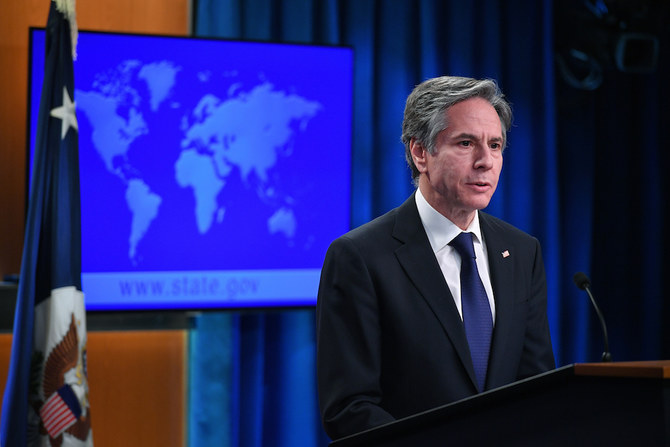
US lifts Trump-imposed sanctions on ICC prosecutor: Blinken
https://arab.news/n8pkt
US lifts Trump-imposed sanctions on ICC prosecutor: Blinken

- Both the sanctions and visa bans against Bensouda and her staff were being lifted
- She is leaving her job in June and will be replaced by British human rights lawyer Karim Khan


Nestle acknowledges delay before baby milk recall
- The company in December recalled batches of its infant formula in 16 European countries
- Nestle said routine checks at its Dutch plant at the end of November 2025 had detected “very low levels” of cereulide
GENEVA: Swiss food giant Nestle has acknowledged that it waited days for a health-risk analysis before alerting authorities after detecting a toxin in its baby milk at a Dutch factory.
But in an open letter to campaign group Foodwatch France Friday it denied accusations of negligence.
The company in December recalled batches of its infant formula in 16 European countries after detecting cereulide, a bacterial toxin that can cause diarrhea and vomiting.
French newspaper Le Monde reported Friday that traces of cereulide had been found in late November — 10 days before the first recalls of the product — because the company waited for a “health?risk analysis” before informing regulators.
Nestle said in a statement online that routine checks at its Dutch plant at the end of November 2025 had detected “very low levels” of cereulide after new equipment was installed in a factory.
It said there was no maximum limit for cereulide indicated by regulations.
The company halted production and launched further tests, which in early December confirmed minute quantities in products that had yet to leave the warehouse.
Nestle said it informed Dutch, European and other national authorities on December 10 and began a precautionary recall of all products made since the new equipment was installed — 25 batches across 16 European countries.
- Response to Foodwatch -
Friday’s open letter responded to claims by Foodwatch France, which a day earlier announced it was filing a legal complaint in the French courts against Nestle on behalf of several families whose babies had fallen ill.
Nestle denied Foodwatch’s suggestions that its product recall had been late without any reasonable excuse and that it had displayed “alarming negligence.”
They said they had acted in December and January as soon as they had identified there was an issue, said the company.
“We recognize the stress and worry that the recall has caused for parents and caregivers,” it said.
“To date, we have not received any medical reports confirming a link to illness associated with our products,” it added.
The company has said from the start of the affair that the recall stemmed from a “quality issue” and that it had seen no evidence linking its products to illness.
French authorities launched an investigation into the deaths in December and January of two babies who were thought to have drunk possibly contaminated powdered milk.
Nestle said in its statement that “nothing indicates any link between these tragic events in these two instances and the consumption of our products.”


