


British company launches first of its kind hijab line for female advocates

In this updated picture, a girl wears black hijab. (Photo courtesy: Ivy & Normanton)
Short Url
Updated 02 April 2021
Follow

British company launches first of its kind hijab line for female advocates

  • Barristers can now express ‘their identity as a Muslim and an advocate, and get on with the job,’ founder tells Arab News
  • ‘I hope this will encourage other people to come to the bar and not feel like it’s a place where they wouldn’t fit in,’ barrister tells Arab News

LONDON: In a first of its kind, a British company has launched a range of hijabs designed specifically for female advocates to wear in court.

British hijab-wearing barristers do not have to wear the country’s distinctive white wigs in court, but until now there had been no standard for what they should wear instead.

Seeking to change this, British legal-wear designer Ivy & Normanton on Wednesday launched a series of hijabs in keeping with court-attire norms.

Coming in both black and white, the hijabs will simplify a persistent problem faced exclusively by a subset of female Muslim barristers.

The designers said they could also help inspire more young Muslim women to join the legal profession.
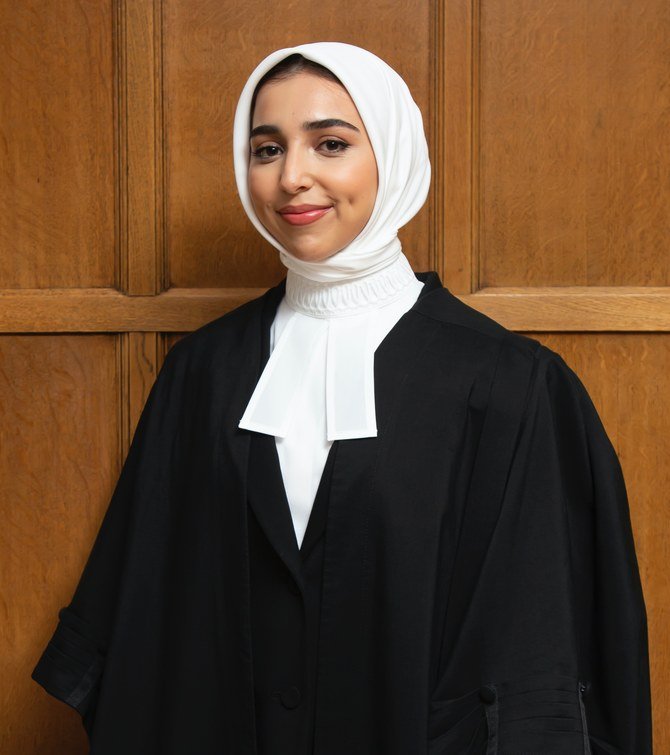


The hijabs come in both black and white — appropriate for any court setting. (Photo courtesy: Ivy & Normanton)

“I think people aspire to be what they can see,” Karlia Lykourgou, a barrister and founder of Ivy & Normanton, told Arab News. 

“To keep encouraging diversity at the bar, we have to make sure that those who don’t fit the white, male stereotype have the tools they need so other young people can see them and believe they have a place in the profession too,” she added.

“The Ivy & Normanton hijab was developed so other women could easily find a piece of clothing that expresses their identity as a Muslim and an advocate, and get on with the job.”

Sultana Tafadar, a human rights barrister at No5 Chambers, told Arab News that she has not yet tried the new hijabs, but the launch is as important symbolically as it is practically. “It’s a really great initiative — it normalizes women wearing the hijab at the bar,” she said. 

Practically, the design is perfect for barristers who have to adhere to strict dress guidelines in court, and from a symbolic perspective it is important that there is an outfitter that recognizes that there are Muslim women at the bar and that they need to be catered for, Tafadar added.

“I hope this will encourage other people to come to the bar and not feel like it’s a place where they wouldn’t fit in,” she said.

Maryam Mir, a barrister at London’s Doughty Street Chambers, told Arab News: “Women now make up almost 50 percent of the bar, and the diversity stats are slowly improving as people wake up to the multiple layers of discrimination women face in their professional careers.”

She added: “I’m regularly approached by Muslim women worried that they’d never be accepted in what they perceive to be a very stuffy white male profession. To them I say, ‘Carve out your space. Make it work for you’.”


Nestle acknowledges delay before baby milk recall

Updated 5 sec ago
Follow

Nestle acknowledges delay before baby milk recall

  • The company in December recalled batches of its infant formula in 16 European countries
  • Nestle said routine checks at its Dutch plant at the end of November 2025 had detected “very low levels” of cereulide

GENEVA: Swiss food giant Nestle has acknowledged that it waited days for a health-risk analysis before alerting authorities after detecting a toxin in its baby milk at a Dutch factory.
But in an open letter to campaign group Foodwatch France Friday it denied accusations of negligence.
The company in December recalled batches of its infant formula in 16 European countries after detecting cereulide, a bacterial toxin that can cause diarrhea and vomiting.
French newspaper Le Monde reported Friday that traces of cereulide had been found in late November — 10 days before the first recalls of the product — because the company waited for a “health?risk analysis” before informing regulators.
Nestle said in a statement online that routine checks at its Dutch plant at the end of November 2025 had detected “very low levels” of cereulide after new equipment was installed in a factory.
It said there was no maximum limit for cereulide indicated by regulations.
The company halted production and launched further tests, which in early December confirmed minute quantities in products that had yet to leave the warehouse.
Nestle said it informed Dutch, European and other national authorities on December 10 and began a precautionary recall of all products made since the new equipment was installed — 25 batches across 16 European countries.

- Response to Foodwatch -

Friday’s open letter responded to claims by Foodwatch France, which a day earlier announced it was filing a legal complaint in the French courts against Nestle on behalf of several families whose babies had fallen ill.
Nestle denied Foodwatch’s suggestions that its product recall had been late without any reasonable excuse and that it had displayed “alarming negligence.”
They said they had acted in December and January as soon as they had identified there was an issue, said the company.
“We recognize the stress and worry that the recall has caused for parents and caregivers,” it said.
“To date, we have not received any medical reports confirming a link to illness associated with our products,” it added.
The company has said from the start of the affair that the recall stemmed from a “quality issue” and that it had seen no evidence linking its products to illness.
French authorities launched an investigation into the deaths in December and January of two babies who were thought to have drunk possibly contaminated powdered milk.
Nestle said in its statement that “nothing indicates any link between these tragic events in these two instances and the consumption of our products.”