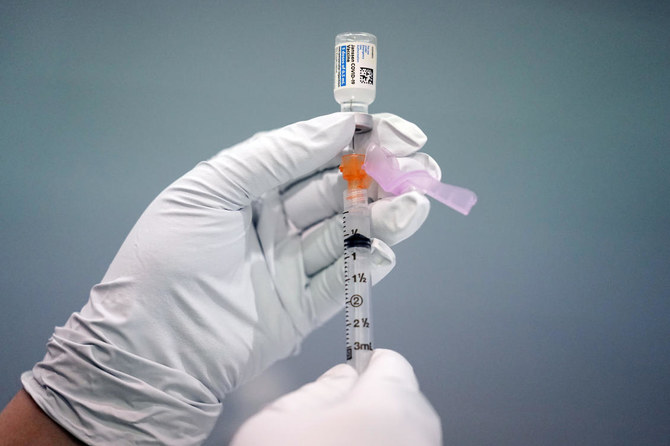
A batch of Johnson & Johnson’s COVID-19 vaccine failed quality standards and can’t be used, the drug giant said late Wednesday.
The drugmaker didn’t say how many doses were lost, and it wasn’t clear how the problem would impact future deliveries.
A vaccine ingredient made by Emergent BioSolutions — one of about 10 companies that Johnson & Johnson is using to speed up manufacturing of its recently approved vaccine — did not meet quality standards, J&J said.
J&J said the Emergent BioSolutions factory involved had not yet been approved by the US Food and Drug Administration to make part of the vaccine.
Emergent, which has been producing bulk drug substance at one of its factories in Baltimore, declined to comment.
J&J had pledged to provide 20 million doses of its vaccine to the US government by the end of March, and 80 million more doses by the end of May. Its statement on the manufacturing problem said it was still planning to deliver 100 million doses by the end of June and was “aiming to deliver those doses by the end of May.”
President Joe Biden has pledged to have enough vaccines for all US adults by the end of May. The US government has ordered enough two-dose shots from Pfizer and Moderna to vaccinate 200 million people to be delivered by late May, plus the 100 million shots from J&J.
A federal official said Wednesday evening the administration’s goal can be met without additional J&J doses.
A J&J spokesman said earlier Wednesday that J&J met the end-of-March goal, but did not respond to questions about whether the Emergent plant had been cleared by FDA.
As of Wednesday, J&J had provided about 6.8 million doses, according to the US Centers for Disease Control and Prevention’s online vaccine tracker. Some additional doses may not yet have been recorded as delivered, and the CDC said Wednesday that another 11 million doses of the vaccine would be available for shipments starting on Thursday.
It was not immediately clear where those 11 million doses originated, but Johnson & Johnson has been shipping finished vaccines from its factory in the Netherlands to the US
The FDA said it was aware of the situation but referred questions to Johnson & Johnson.
The problem with the vaccine batch was first reported by The New York Times.

Johnson & Johnson COVID-19 vaccine batch fails quality check
https://arab.news/wb4ne
Johnson & Johnson COVID-19 vaccine batch fails quality check
- J&J had pledged to provide 20 million doses of its vaccine to the US government by the end of March
Trump calls for one year cap on credit card interest rates at 10 percent
- Trump says Americans have been ‘ripped off’ by credit card companies
- Lawmakers from both parties have raised concerns about rates
WASHINGTON: US President Donald Trump said on Friday he was calling for a one-year cap on credit card interest rates at 10 percent starting on January 20 but he did not provide details on how his plan will come to fruition or how he planned to make companies comply.
Trump also made the pledge during the campaign for the 2024 election that he won but analysts dismissed it at the time saying that such a step required congressional approval.
Lawmakers from both the Democratic and Republican Parties have raised concerns about high rates and have called for those to be addressed. Republicans currently hold a narrow majority in both the Senate and the House of Representatives.
There have been some legislative efforts in Congress to pursue such a proposal but they are yet to become law and in his post Trump did not offer explicit support to any specific bill.
Opposition lawmakers have criticized Trump, a Republican, for not having delivered on his campaign pledge.
“Effective January 20, 2026, I, as President of the United States, am calling for a one year cap on Credit Card Interest Rates of 10 percent,” Trump wrote on Truth Social, without providing more details.
“Please be informed that we will no longer let the American Public be ‘ripped off’ by Credit Card Companies,” Trump added.
The White House did not immediately respond to a request for comment on details of the call from Trump, but said on social media without elaborating that the president was capping the rates.
Some major US banks and credit card issuers like American Express, Capital One Financial Corp, JPMorgan , Citigroup and Bank of America did not immediately respond to a request for comment.
US Senator Bernie Sanders, a fierce Trump critic, and Senator Josh Hawley, who belongs to Trump’s Republican Party, have previously introduced bipartisan legislation aimed at capping credit card interest rates at 10 percent for five years. This bill explicitly directs credit card companies to limit rates as part of broader consumer relief legislation.
Democratic US Representative Alexandria Ocasio-Cortez and Republican Congresswoman Anna Paulina Luna have also introduced a House of Representatives bill to cap credit card interest rates at 10 percent, reflecting cross-aisle interest in addressing high rates.
Billionaire fund manager Bill Ackman, who endorsed Trump in the last elections, said the US president’s call was a “mistake.”
“This is a mistake,” Ackman wrote on X.
“Without being able to charge rates adequate enough to cover losses and earn an adequate return on equity, credit card lenders will cancel cards for millions of consumers who will have to turn to loan sharks for credit at rates higher than and on terms inferior to what they previously paid.”
Last year, the Trump administration moved to scrap a credit card late fee rule from the era of former President Joe Biden.
The Trump administration had asked a federal court to throw out a regulation capping credit card late fees at $8, saying it agreed with business and banking groups that alleged the rule was illegal. A federal judge subsequently threw out the rule.



