

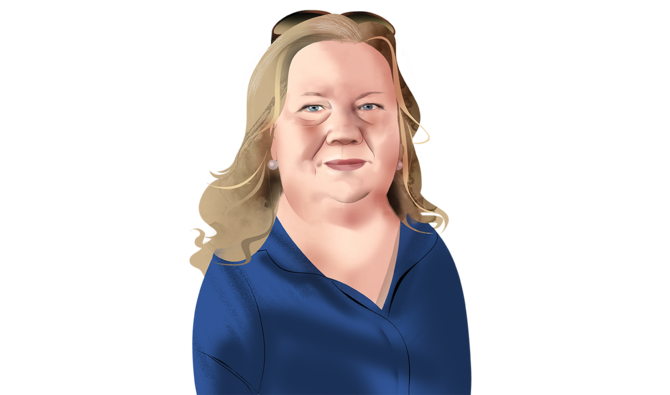

Being a senior executive at a medical company during the most serious health care crisis for a century puts you at the sharp end of events, as Marzena Kulis, managing director of the medical products business of Johnson & Johnson in the Middle East, is well aware.
“We were built for the times like this. We are a company with a 134-year legacy.
“We lived through the previous pandemics of smallpox and Spanish flu, and through the financial crises, through world wars, and our business has expanded and grown,” she told Arab News.
“But it would be wrong to say that what happened in the past few months had no impact on the local, regional and global businesses,” she added.
J&J, a multibillion-dollar giant of the global health care industry, has been in the region for more than 40 years, operating via the three pillars of its business — medical devices, pharmaceuticals and consumer products.
But there is no doubt that the company’s profile has been lifted during the pandemic through its work on a potential vaccine. J&J is one of several international companies working flat out to develop a treatment since virtually the first outbreak earlier this year.
Kulis, an economist by training who has spent almost her entire career in the health care sector, has seen that at first hand in recent months.
“I think our teams globally have been working tirelessly, without a break really, on finding the solutions and, as of now, we are saying that large quantities of the vaccine will be available in the first quarter of 2021,” she said.
“In September, we are planning to begin phase three trials on humans, which will be on a large number of the populations chosen for the trials, but we still believe that it will be early 2021 when we will be able to deliver the vaccine,” she added. Some health experts have criticized the tendency toward “vaccine nationalism” by some countries, eager to be first with a treatment in an international race, or to keep supplies of the medicine for their own people, rather than spreading it equably around the world.
“We are open to discussion with everyone,” Kulis said, pointing to agreements J&J has signed with the US and European authorities on vaccine collaboration, as well as with international organizations such as the GAVI immunization agency supported by many countries in the Middle East, including Saudi Arabia.
J&J also signed up for the “We Stand with Science” campaign to uphold the integrity of the medical scientific process in vaccine development and global regulatory standards.
Kulis is aware of the pressure to produce a vaccine “cure,” but believes safety is paramount. “Although we all would like it to be available tomorrow, the process has to take its time to ensure there are high ethical standards and scientific principles,” she said.
Meanwhile, while the world waits for a vaccine, Kulis has a business to run in the Middle East. The medical devices business in the region includes surgical equipment, and orthopedics and cardiovascular procedures — all affected by the heightened focus on COVID-19 treatments during the pandemic.
In particular, some elective surgeries have been pushed to the back of the queue by patients understandably anxious to protect their health during the pandemic. Lockdowns and economic pressure have also had an effect.
BIO
Born: Krakow, Poland
Education
- Master’s, Krakow Economic Academy
- MBA, Stockholm University
Career
- HD operations officer, World Bank
- Executive for Pfizer, Poland and Balkan countries
- Managing director, Johnson & Johnson, Middle East
“The UAE has restored or reopened some surgeries, but Saudi Arabia is still taking a bit more time reopening for elective surgeries, with the exception of some parts of the country. So, obviously, that has an impact,” Kulis said.
The financials of the business were better than expected in the second quarter, although still some way off what they would have been without the virus. One real positive is that the J&J global supply chain has remained intact, she said.
Kulis’ job gives her a unique insight into the medical problems of the region, and one issue stands out, she says — obesity and its associated complications. J&J sees the extent of the problem in its bariatrics specialism, which deals with the causes, prevention and treatment of obesity.
“This region is leading the obesity prevalence in the world and we provide medical solution for that as well,” she said, pointing out that three of the top five most obese countries in the world in terms of obesity incidence as a proportion of the population are from the Middle East.
Oncological and gynecological surgery is also a growing part of her division in Saudi Arabia.
In orthopedics, Kulis said with a hint of humor, “the world has been walking on our knees and our hips for decades.” But there is also an important link to obesity, too, she said, because overweight people are likely to face greater mobility challenges.
“Sooner or later, as a consequence of obesity, people require joint replacement or some other orthopedic intervention,” she said.
The third segment of the medical devices unit is also affected by obesity problems. The cardiovascular and stroke speciality focuses on remedies for heart arrythmia and stroke management.
“We’re still raising the awareness of availability of the surgical treatment for those two. It’s especially important to show that stroke is not a death or disability sentence but can be treated. People can be brought to mobility and quality of life,” Kulis said.
J&J sees as another increasing problem for Saudi Arabia — the treatment of traumatic injuries from traffic accidents.
“It’s really prevalent and a strong focus in Saudi Arabia. The treatment of road accident trauma is part of our orthopedic business. Road accidents are an important part of our work in the Kingdom,” she said.
Overall, the health benefits of Saudi Arabia’s young demographic is, to some extent, outweighed by obesity and other lifestyle issues, she said.
The Kingdom is a focus for expansion for J&J. It opened a headquarters office in Riyadh in 2017, and also has bases in Jeddah and Dammam, serving as a base not only for the medical devices business but also the consumer and pharmaceuticals units. There are about 180 employees in the Kingdom, of whom roughly 40 percent are citizens.
“We have made a conscious effort to ensure we can build up local capacity and help the local population to work with us,” she said. J&J has a local Saudi partner, takes part in official programs to promote health and lifestyle issues within the Kingdom, and has a joint flagship program with the Prince Sultan Humanitarian City Hospital.
The health sector has been earmarked for greater private sector participation in the Vision 2030 plans to diversify the Kingdom away from the government-dominated energy sector, and J&J is keen to take advantage of any opportunities in that respect.
“We are always exploring the option for enhancement of the business and definitely Saudi is our priority market.
We haven’t been in any discussions regarding takeover or merger activity so far, but if there are opportunities, we will put it forward to our senior management. We are looking at any opportunity to strengthen our footprint in Saudi Arabia,” she said.
Including Saudi Arabia and the UAE, Kulis’s responsibilities at J&J cover the medial needs of 500 million people in 16 countries stretching from Pakistan to Egypt. But she is keen not to lose sight of the importance of individual cases within the many thousands of patients that benefit from J&J products and procedures every year.
“What keeps me up at night is this question — how can we grow the scale of the business so that we can help more patients get treatment at the right time?
“We all know the stories of people and the families who don’t get care on time, or who wait too long for treatment. I want to shape my organization so that we can share the same dream of preventing that,” she said.


