

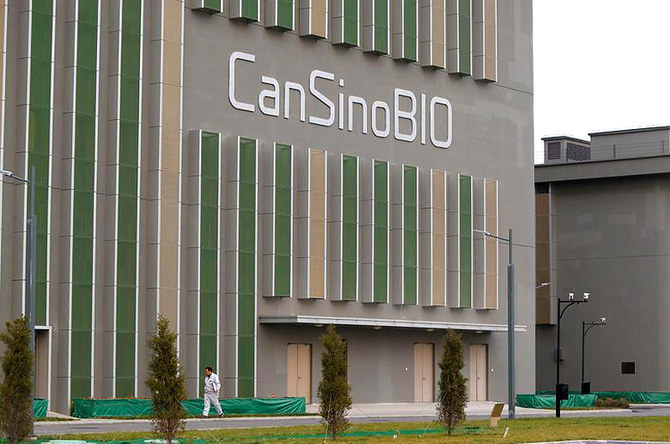

ISLAMABAD: Pakistan’s planning minister Asad Umar said on Tuesday Pakistan would receive its first batch today of the CanSino Biologics coronavirus vaccine purchased from China.
Last week, Umar said Pakistan had bought more than 1 million doses of the Chinese Sinopharm and CanSino Biologics COVID-19 vaccines, its first purchase from any manufacturer, having previously relied on donations.
“First batch of cansino vaccine procured being received today,” Umar wrote on Twitter. “This is the vaccine in which Pakistan participated in phase 3 trials, which was the first time ever that Pakistan had done so for any vaccine.”
First batch of cansino vaccine procured being recieved today. This is the vaccine in which Pakistan participated in phase 3 trials, which was the first time ever that Pakistan had done so for any vaccine.
— Asad Umar (@Asad_Umar) March 30, 2021
In a separate tweet, Umar said Pakistan would be getting “bulk vaccine” by mid-April from CanSino from which three million vaccine doses would be made:
“The bulk vaccine received will be formulated, sterilized and packed in Pakistan. For this purpose special equipment has been procured and manpower is being trained.”
We will be getting bulk vaccine by mid april from cansino from which 3 million vaccine doses can be made. The bulk vaccine recieved will be formulated, sterilized and packed in Pakistan. For this purpose special equipment has been procured and manpower is being trained
— Asad Umar (@Asad_Umar) March 30, 2021
Last year Pakistan had participated in the country’s first Phase 3 clinical trial for CanSino’s candidate, Ad5-nCoV, led by the government-run National Institute of Health (NIH) along with pharmaceutical company AJM — the local representative of CanSino.
Pakistan, a country of more than 220 million people, recorded 4,084 new infections in the last 24 hours, with 100 deaths, a three-month record for fatalities.
Also on Monday, President Arif Alvi as well as Defense Minister Pervez Khattak announced they had both tested positive for COVID-19.
Alvi oversaw an annual military parade in Islamabad on March 25, where Khattak was also present. The parade was smaller than in previous years over COVID-19 fears, but some 5,000 people still attended, including senior civilian officials as well as the heads of Pakistan’s armed forces.
Prime Minister Imran Khan was also criticized last week for holding an indoor in-person meeting with cabinet officials while he was still recovering from the virus. On Tuesday, a close aide to the PM said he was fully recovered:
Alhamdulillah, Prime Minister Imran Khan has fully recovered. He has
resumed work gradually & started building up his work routine as per doctors' instructions keeping in view national & intl guidelines. May ALLAH grant health to all. Ameen. Take care of urself & others #StaySafe— Faisal Javed Khan (@FaisalJavedKhan) March 30, 2021


