

Suez blockage could ‘take weeks’ to clear

This could lead to a shortage of containers vital for global trade, as well as a “shock” to the global supply chain. (File/AFP)
Short Url
Updated 30 March 2021
Follow

Suez blockage could ‘take weeks’ to clear

  • The 400 meter long Ever Given - owned by Taiwanese company Evergreen Marine Corporation - ran aground on March 23
  • The effects of the blockage are expected to remain a challenge to the shipping industry

It could take weeks to clear the tail-back of ships looking to use the Suez Canal, even as the gigantic container carrier Ever Given resumes its voyage through the world’s business shipping lane, data analysts have calculated.

“We currently expect a delay of at least 10 days to 2 weeks for all vessels reaching Suez henceforth and assuming the stuck container ship is refloated within the next couple of days for the transits to resume,” Ranjith Raja, oil research manager at data group Refinitiv, said.

The 400 meter long Ever Given - owned by Taiwanese company Evergreen Marine Corporation - ran aground on March 23, halting passage through the vital trade route and causing a log-jam of ships in the Mediterranean and the Red Sea.

After the ship was refloated on Monday and was preparing to exit the canal, resuming its voyage to Rotterdam, the effects of the blockage are expected to remain a challenge to the shipping industry, already dealing with volatile market conditions.

“The canal has handled about 100 ships making the transit on a single day according to the 2020 transit data. However, there are limitations due to the size of the ships making the transit and the tidal factors that prevail on the day. Factoring these, it will take weeks to clear the jam that has accumulated till date and not accounting for the additional vessels that would be added for the week,” he added.

Refinitiv calculates that a total of 369 ships are currently waiting on either side of the canal to make the transit once the Ever Given is re-floated and the channel cleared. This accounts for a total of 25 million tons, an increase of 80 percent in the past five days. An estimated 85 ships are currently enroute to join the jam before the end of the month.
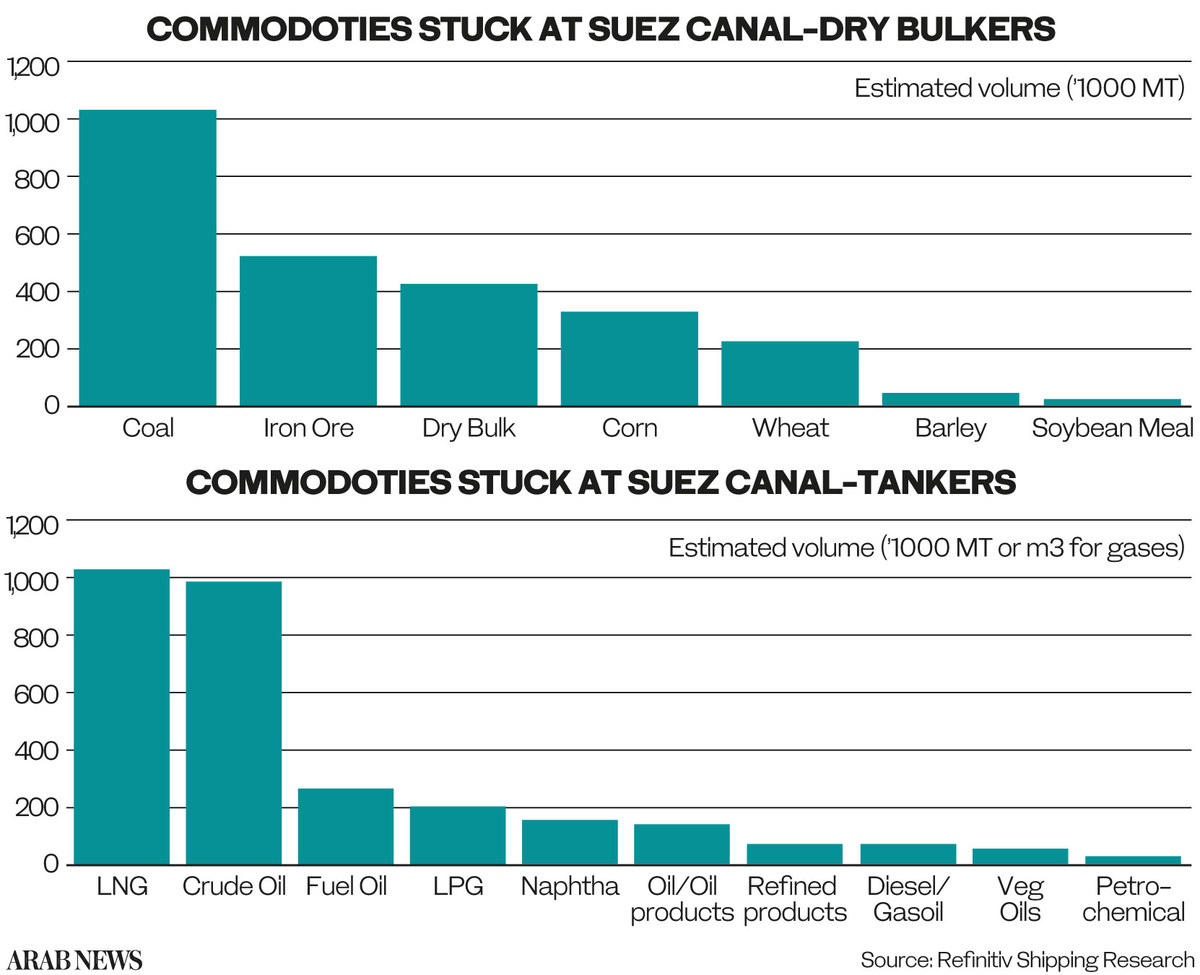
This could lead to a shortage of containers vital for global trade, as well as a “shock” to the global supply chain, especially in industries like manufacturing and car assembly, which relies on the “just in time” supply principle.

“Hence this isolated incident is expected to have subsequent cost implications and delays to the wider consumer goods mainly for the European, Middle East and Asian markets,” Refinitiv said.

The alternative for ships stuck in the canal is to go round the Cape of Good Hope route in southern Africa, which would add significantly to costs and increase security risks from piracy, with a resultant spike in insurance costs.

The impact of this sudden shortage of ships is global, with rates for containers rising on big global routes like Singapore to Rotterdam and from China to the US West Coast.

However, despite some volatility in the price of oil last week when the Ever Given’s problems became apparent, Refinitive does not expect a a major impact on the global crude markets.

“Given the crude oil volumes handled by the Canal and the current scenario of demand and inventory in Asia and in the West, it is unlikely that the blockage in the Suez Canal will have a significant impact on crude oil balances as well as prices,” it said.


Saudi investment pipeline active as reforms advance, says Pakistan minister

Updated 08 February 2026
Follow

Saudi investment pipeline active as reforms advance, says Pakistan minister

ALULA: Pakistan’s Finance Minister Mohammed Aurangzeb described Saudi Arabia as a “longstanding partner” and emphasized the importance of sustainable, mutually beneficial cooperation, particularly in key economic sectors.

Speaking to Arab News on the sidelines of the AlUla Conference for Emerging Market Economies, Aurangzeb said the relationship between Pakistan and Saudi Arabia remains resilient despite global geopolitical tensions.

“The Kingdom has been a longstanding partner of Pakistan for the longest time, and we are very grateful for how we have been supported through thick and thin, through rough patches and, even now that we have achieved macroeconomic stability, I think we are now well positioned for growth.”

Aurangzeb said the partnership has facilitated investment across several sectors, including minerals and mining, information technology, agriculture, and tourism. He cited an active pipeline of Saudi investments, including Wafi’s entry into Pakistan’s downstream oil and gas sector.

“The Kingdom has been very public about their appetite for the country, and the sectors are minerals and mining, IT, agriculture, tourism; and there are already investments which have come in. For example, Wafi came in (in terms of downstream oil and gas stations). There’s a very active pipeline.”

He said private sector activity is driving growth in these areas, while government-to-government cooperation is focused mainly on infrastructure development.

Acknowledging longstanding investor concerns related to bureaucracy and delays, Aurangzeb said Pakistan has made progress over the past two years through structural reforms and fiscal discipline, alongside efforts to improve the business environment.

“The last two years we have worked very hard in terms of structural reforms, in terms of what I call getting the basic hygiene right, in terms of the fiscal situation, the current economic situation (…) in terms of all those areas of getting the basic hygiene in a good place.”

Aurangzeb highlighted mining and refining as key areas of engagement, including discussions around the Reko Diq project, while stressing that talks with Saudi investors extend beyond individual ventures.

“From my perspective, it’s not just about one mine, the discussions will continue with the Saudi investors on a number of these areas.”

He also pointed to growing cooperation in the IT sector, particularly in artificial intelligence, noting that several Pakistani tech firms are already in discussions with Saudi counterparts or have established offices in the Kingdom.

Referring to recent talks with Saudi Minister of Economy and Planning Faisal Alibrahim, Aurangzeb said Pakistan’s large freelance workforce presents opportunities for deeper collaboration, provided skills development keeps pace with demand.

“I was just with (Saudi) minister of economy and planning, and he was specifically referring to the Pakistani tech talent, and he is absolutely right. We have the third-largest freelancer population in the world, and what we need to do is to ensure that we upscale, rescale, upgrade them.”

Aurangzeb also cited opportunities to benefit from Saudi Arabia’s experience in the energy sector and noted continued cooperation in defense production.

Looking ahead, he said Pakistan aims to recalibrate its relationship with Saudi Arabia toward trade and investment rather than reliance on aid.

“Our prime minister has been very clear that we want to move this entire discussion as we go forward from aid and support to trade and investment.”