

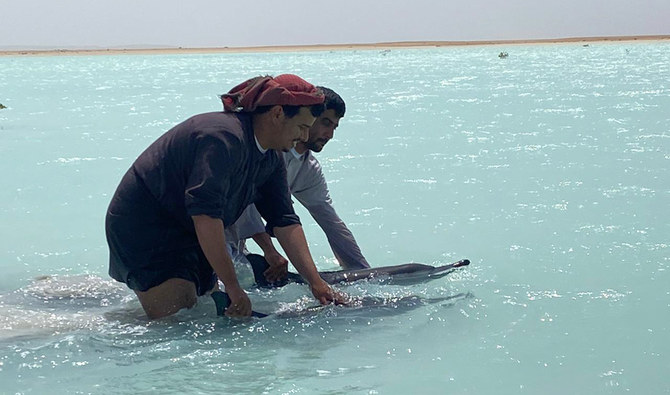
Dozens of dolphins rescued at Ras Al-Shabaan in Saudi Arabia’s Umluj

1 / 9
Stranding might also occur due to an attempt by a pod to save a trapped individual, or due to misdirection leading them to shallow waters. (Supplied/SPA)
2 / 9
Stranding might also occur due to an attempt by a pod to save a trapped individual, or due to misdirection leading them to shallow waters. (Supplied/SPA)
3 / 9
Stranding might also occur due to an attempt by a pod to save a trapped individual, or due to misdirection leading them to shallow waters. (Supplied/SPA)
4 / 9
Stranding might also occur due to an attempt by a pod to save a trapped individual, or due to misdirection leading them to shallow waters. (Supplied/SPA)
5 / 9
Stranding might also occur due to an attempt by a pod to save a trapped individual, or due to misdirection leading them to shallow waters. (Supplied/SPA)
6 / 9
Stranding might also occur due to an attempt by a pod to save a trapped individual, or due to misdirection leading them to shallow waters. (Supplied/SPA)
7 / 9
Stranding might also occur due to an attempt by a pod to save a trapped individual, or due to misdirection leading them to shallow waters. (Supplied/SPA)
8 / 9
Stranding might also occur due to an attempt by a pod to save a trapped individual, or due to misdirection leading them to shallow waters. (Supplied/SPA)
9 / 9
Stranding might also occur due to an attempt by a pod to save a trapped individual, or due to misdirection leading them to shallow waters. (Supplied/SPA)
Short Url
Updated 27 March 2021
Follow

Dozens of dolphins rescued at Ras Al-Shabaan in Saudi Arabia’s Umluj

  • What happened in Umluj would require investigation and research to establish the real reason why the dolphins were stranded, expert says

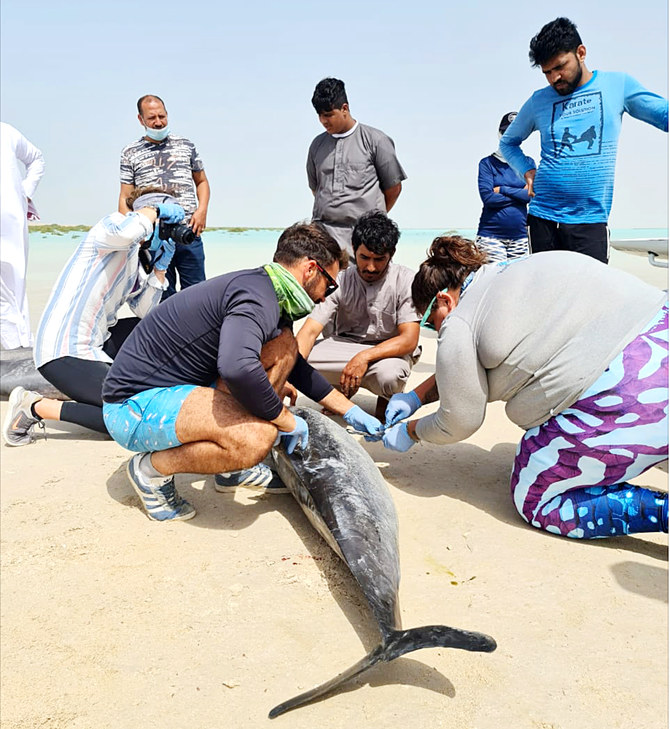
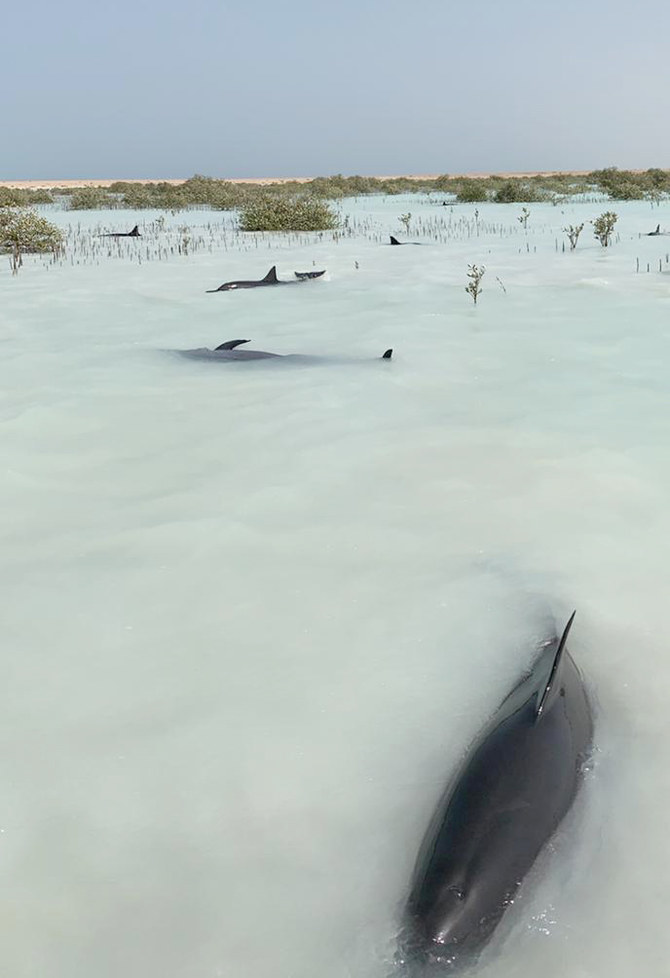
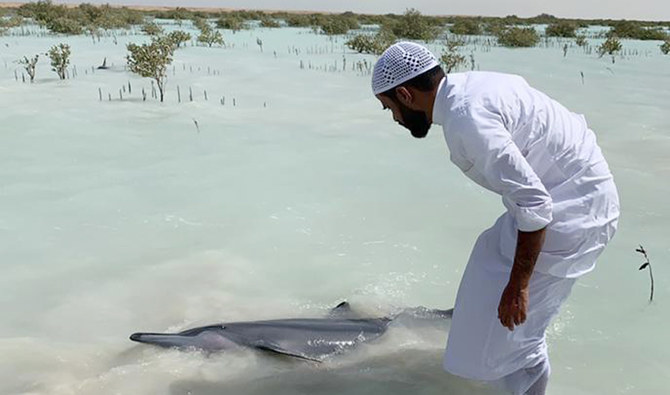
Strong winds and tides caused the deaths of a number of dolphins in Ras Al-Shabaan region, 35 kilometers south of Umluj governorate, while dozens more were rescued and returned to their natural habitat in the Red Sea.

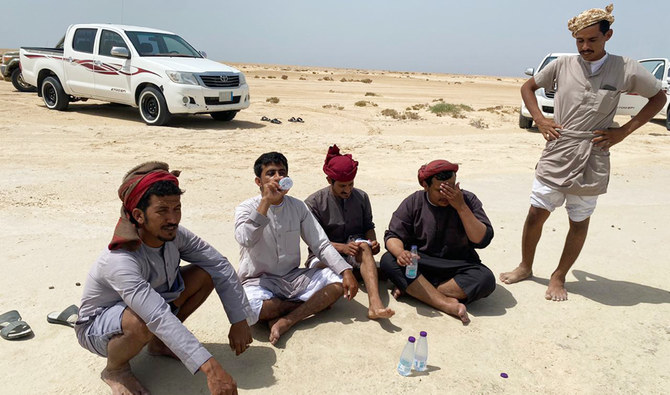
Members of the Saudi Border Guard and the Ministry of Environment, Water and Agriculture, with a number of volunteers, participated in the rescue operation.
“A man from the village spotted the dolphins nearby and reported the incident to us, a group of 14 people. We rushed to the place right away,” said Mohammed Nami Al-Hamdi, one of the rescuers in Ras Al-Shabaan.
He added: “We saw the dolphins on Wednesday at 8 a.m. and we were able to save about 40, while seven others died because they were too far from us.”
Dr. Lafi Saed Al-Sulami, a lecturer in marine biology of the Faculty of Marine Sciences at King Abdul Aziz University (KAU), said: “A number of dolphins got stranded on the beaches of Umluj governorate due to natural factors, after the sea level decreased due to the ebbing tide, which caused shallow waters and prohibited the dolphins from going back out to sea.”
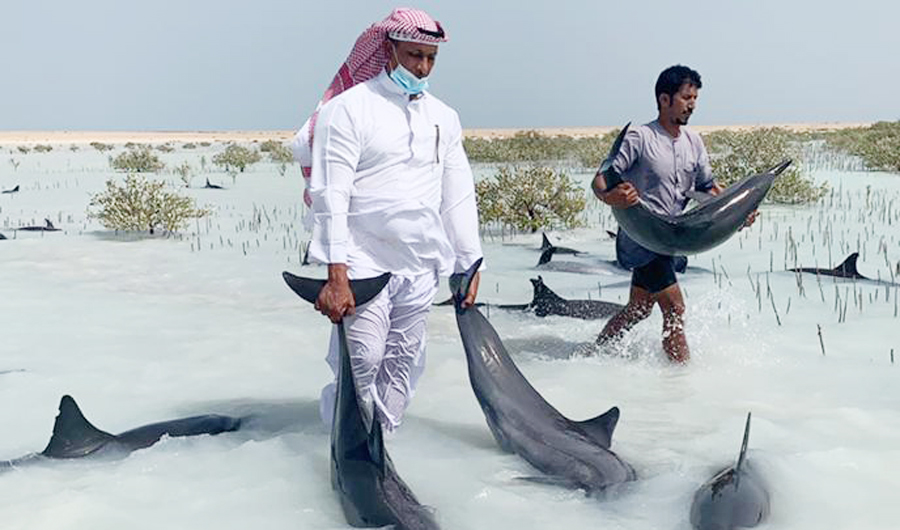
Al-Sulami, a specialist in marine fisheries management, told Arab News that the deaths of some of the dolphins was because their bodies could not sustain the pressure resulting from stranding. “Dolphins might get stranded on a beach either because they were running from a predator, or while in search of prey,” he added.
Stranding might also occur due to an attempt by a pod to save a trapped individual, or due to misdirection leading them to shallow waters.
Al-Sulami pointed out that what happened in Umluj would require investigation and research to establish the real reason why the dolphins were stranded.
“Based on the published photos, the dolphins were spinner dolphins, and are between 129-235 centimeters long, weigh between 23-79 kilograms, and are prey for sharks,” he said.
“Unlike sharks, dolphins are human friendly and as far as we know, they have never shown hostile behavior towards humans, especially in their habitats where they feed and breed,” he added.

HIGHLIGHTS

• Mohammed Nami Al-Hamdi, one of the rescuers in Ras Al-Shabaan, said: ‘We saw the dolphins on Wednesday at 8 a.m. and we were able to save about 40, while seven others died because they were too far from us.’

• There are around 40 different species of dolphin around the world, eight of which can be found in the Red Sea, according to Dr. Mamdouh Al-Harbi, assistant professor specializing in fish farming and cultivation at KAU’s department of marine biology.

• Al-Harbi pointed out that dolphins are intelligent and social animals, though they have poor sight and depend on sounds to determine their directions, noting that they have strong and flexible muscles that help them swim for long distances.

There are around 40 different species of dolphin around the world, eight of which can be found in the Red Sea, according to Dr. Mamdouh Al-Harbi, assistant professor specializing in fish farming and cultivation at KAU’s department of marine biology.
He pointed out that dolphins are intelligent and social animals, though they have poor sight and depend on sounds to determine their directions, noting that they have strong and flexible muscles that help them swim for long distances.
“Rough-toothed and bottlenose dolphins are the most common species in the Red Sea. They are distinguished by their black backs and white abdomens,” he added.


Experimental farm in Al-Lith looks into future of Saudi Arabian agriculture

Updated 02 February 2026
Follow

Experimental farm in Al-Lith looks into future of Saudi Arabian agriculture

  • Research initiative reflects strategic transformation

JEDDAH: An experimental farm in Saudi Arabia’s Al-Lith Governorate is one of the research initiatives reflecting the strategic transformation taking place in the Kingdom’s agricultural sector.

The farm uses highly efficient, sustainable production models that combine scientific research with commercial application, contributing to strengthening the country’s food security system and the sustainability of water resources.

Located in the Ghumaiqa Center on an area of about 10 hectares, the cutting-edge farm is a testing platform for modern agricultural technologies that tackle the challenge of water scarcity.

The farm includes developed open fields and modern greenhouses, supported by smart irrigation encompassing drip and sprinkler irrigation alongside surface and subsurface technologies.

All the systems operate via smart controls that enable the monitoring of water consumption and ensure improved efficiency, thereby achieving a balance between agricultural production and water conservation.

The farm also uses treated and diluted low-salinity seawater.

It aims to diversify agricultural water sources, reduce reliance on freshwater, and open new horizons for agriculture in coastal and semi-arid environments.

A view of the experimental farm in Al-Lith. (SPA)

The project represents a promising investment opportunity in the field of smart agriculture, enabling the development of commercially scalable production models, particularly for high-value vegetables and fruits, while reducing operational costs associated with water and energy, enhancing the economic feasibility of future agricultural projects.

In addition, the project contributes to transferring and localizing agricultural expertise, supporting local food supply chains, and creating an attractive environment for agricultural investment.

This aligns with Sustainable Development Goals and enhances the efficiency of the private sector in adopting innovative agricultural solutions.

Yahya bin Abdulrahman Al-Mahabi, the director of the Ministry of Environment, Water and Agriculture office in Al-Lith Governorate, told the Saudi Press Agency that the project represented the future of agriculture in the Kingdom.

He explained that the vision was based on investing in technology, enhancing the return on water per unit, and integrating scientific research with investment opportunities.

Al-Mahabi spoke of the experimental farm as a modern, scalable and replicable model applicable in several regions of the Kingdom, particularly in coastal environments.

Al-Mahabi highlighted the Ministry of Environment, Water and Agriculture’s commitment to supporting distinctive projects that contributed to achieving food security while developing rural areas and enhancing agricultural production efficiency, in line with the objectives of the Kingdom’s Vision 2030.