

Saudi ambassador offers Pakistan medical assistance for conjoined twins from poor families

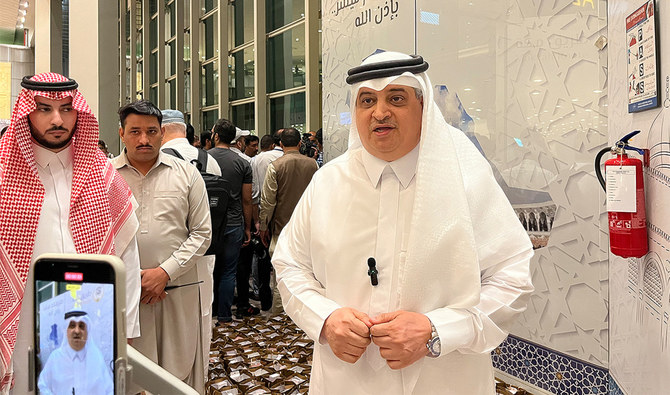
Saudi Ambassador to Pakistan Nawaf bin Saeed Al-Malki talks to media in Islamabad, Pakistan, on May 21, 2023. (AN photo/File)
Short Url
Updated 06 March 2024
Follow

Saudi ambassador offers Pakistan medical assistance for conjoined twins from poor families

  • For over 30 years, surgeons at Saudi Arabia’s Conjoined Twins Program have allowed children to enjoy healthy, normal lives
  • Their skilled work has made the Kingdom a world leader in one of the most complex surgical procedures in modern medicine

ISLAMABAD: Saudi Arabia’s Ambassador to Pakistan Nawaf bin Saeed Al-Malki on Tuesday offered generous assistance for the medical treatment of conjoined twins born to economically disadvantaged families in Pakistan, Pakistani state media reported.

For more than 30 years, the skilled work of surgeons at Saudi Arabia’s Conjoined Twins Program has allowed such children to enjoy healthy, normal and independent lives, making the Kingdom a world leader in one of the most complex surgical procedures in modern medicine.

The Saudi ambassador offered the assistance at a meeting with Syed Tariq Mahmood-ul-Hassan, managing director of Pakistan Bait-ul-Mal (PBM), in Islamabad, Pakistan’s state-run APP news agency reported.

“The Saudi Envoy announced that conjoined children, referred by PBM, would be offered the modern medical services in a state-of-the art hospital in Saudi Arabia sponsored by King Salman Humanitarian Aid & Relief Center (KSrelief),” the report read.

“While expressing his gratitude to Saudi envoy for extending such a kind aid for the poor populace of the country, the MD marked this initiative an imperative allowing the children to enjoy healthy, normal and independent lives.”

The development comes days after surgeons in Saudi Arabia successfully completed a complex procedure of separating Nigerian conjoined twins, Hassana and Hasina, at King Abdullah Specialist Children’s Hospital in King Abdulaziz Medical City in Riyadh.

The twins, who arrived in Saudi Arabia last October, shared areas in the lower abdomen, pelvis, lower spine, and lower spinal nerves. The separation surgery took about 16 and a half hour and involved 39 consultants, specialists, technical, nursing, and support staff.

This was the 60th operation performed by the Saudi program for separating conjoined twins. Over the past 34 years, the program has cared for 135 sets of conjoined twins from 25 countries.

Islamabad steps up vehicle checks to boost security as 166,000 cars get electronic tags

Updated 18 January 2026
Follow

Islamabad steps up vehicle checks to boost security as 166,000 cars get electronic tags

  • Authorities say over 3,000 vehicles registered in past 24 hours as enforcement intensifies
  • Extended service hours introduced to push full compliance with digital monitoring system

ISLAMABAD: Authorities in the Pakistani capital have intensified enforcement against vehicles without mandatory electronic tags with more than 166,000 cars now registered, according to data released on Sunday evening, as Islamabad moves to strengthen security and digital monitoring at key entry and exit points.

The Islamabad Capital Territory (ICT) administration introduced the electronic tagging system late last year as part of a broader effort to regulate traffic, improve record-keeping and enhance surveillance in a city that hosts the country’s main government institutions, foreign missions and diplomatic enclaves.

Under the system, vehicles are fitted with electronic tags that can be read automatically by scanners installed at checkpoints across the capital, allowing authorities to identify unregistered vehicles without manual inspections. Vehicles already equipped with a motorway tag, or m-tag, are exempt from the requirement.

“A total of 166,888 vehicles have successfully been issued M-Tags so far, including 3,130 vehicles in the last 24 hours,” the ICT administration said, according to the Excise Department.

Officials said readers installed at checkpoints across Islamabad are fully operational and are being used to stop vehicles still without tags, as enforcement teams carry out checks across the city.

To facilitate compliance, authorities have expanded installation facilities and extended operating hours. The Excise Department said m-tag installation is currently available at 17 booth locations, while select centers have begun operating beyond normal working hours.

According to Director General Excise Irfan Memon, m-tag centers at 26 Number Chungi and 18 Meel are providing services round the clock, while counters at Kachnar Park and F-9 Park remain open until midnight to accommodate motorists unable to visit during daytime hours.

Officials said the combination of enforcement and facilitation was aimed at achieving full compliance with minimal disruption, adding that operations would continue until all vehicles operating in the capital are brought into the system.

The enforcement drive builds on a wider push by the federal government to integrate traffic management, emergency response and security monitoring through technology-driven “safe city” initiatives. Last month, Interior Minister Mohsin Naqvi reviewed Islamabad’s surveillance infrastructure and said reforms in monitoring systems and the effective use of technology were the “need of the hour.”

Authorities have urged motorists to obtain electronic tags promptly to avoid delays and penalties at checkpoints as enforcement continues across the capital.