

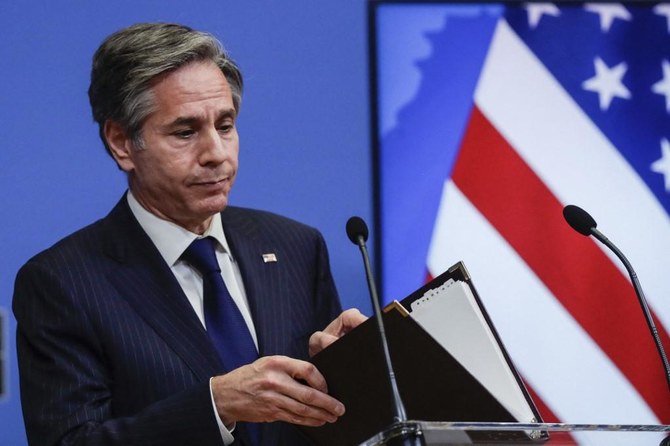
LONDON: The US secretary of state called for a nationwide cease-fire in Yemen and a “durable peace agreement” during a phone call with the country’s prime minister on Thursday.
“Secretary (Antony) Blinken welcomed the Republic of Yemen Government’s support for a comprehensive, nationwide cease-fire and UN-led political talks and its continued engagement with UN Special Envoy Griffiths,” the State Department said.
During the call, Blinken also thanked Prime Minister Maeen Abdulmalek Saeed for his efforts to ease the suffering of Yemenis, including authorizing the arrival of four fuel ships at Hodeidah port on Wednesday.
Saudi Arabia announced a new peace initiative on Monday to end the six-year war.
The initiative included a comprehensive cease-fire, the reopening of Sanaa airport, easing restrictions on Hodeidah port and a resumption of political negotiations.
The US welcomed the initiative on Monday and Blinken told Foreign Minister Prince Faisal bin Farhan that Washington supported efforts to end the conflict, “starting with the need for all parties to commit to a cease-fire and facilitate the delivery of humanitarian aid.”
US envoy to Yemen Tim Lenderking also welcomed Saudi Arabia and the Yemeni government’s commitment to a cease-fire and political process.
The State Department said Lenderking will travel to the Middle East on Thursday for meetings with senior government officials to discuss international efforts to promote a cease-fire and peace agreement in Yemen.
Blinken and Yemen PM discuss cease-fire after Saudi peace initiative
https://arab.news/24t8h
Blinken and Yemen PM discuss cease-fire after Saudi peace initiative
- Blinken thanked the Yemeni premier for his efforts to ease the suffering of Yemenis
- US envoy to Yemen will travel to the Middle East Thursday for talks with senior officials
Israel’s main airport receives passenger boost from Gaza ceasefire
- Separately, Israel’s Statistics Bureau said tourist numbers to Israel rose 38 percent in 2025 to 1.34 million, but remained below the 2023 level of 3.24 million
- Israeli strikes since the deal was struck have killed more than 400 Palestinians — most of them civilians, according to Gaza health officials — and Palestinian militants have killed three Israeli soldiers
JERUSALEM: Passenger traffic at Ben Gurion International Airport near Tel Aviv rose 33 percent in 2025, the Israel Airports Authority reported on Tuesday, reflecting the return of foreign carriers after many airlines halted flights during the two-year Gaza war.
A US-brokered ceasefire in October gave way to the resumption of flights to Israel by carriers who had not yet resumed routes to Tel Aviv. In December, the number of passengers rose 59 percent.
In all of 2025, passenger traffic at Israel’s main air gateway Ben Gurion reached 18.5 million, versus 13.9 million in 2024. The airport handled 21.8 million people in 2023, the year war broke out after the October 7 attacks by Hamas.
Flag carrier El Al Israel Airlines, which did not halt flights during the war other than last June during a 12-day conflict with Iran, showed a 5 percent annual gain to 6.9 million passengers, though its market share slipped to 37 percent from 48 percent.
El Al has posted steep gains in revenue and profit as a result of the conflict, in which just a handful of carriers were operating.
Smaller rivals Israir, with an 11 percent market share, and Arkia at 9 percent followed El Al.
Wizz Air was the largest foreign carrier in Israel with 1.23 million passengers — double its 2024 level — for a 7 percent market share. Wizz is seeking to establish a hub in Israel.
Aegean, flydubai, Etihad, Lufthansa and United also posted large gains in the number of passengers last year.
Separately, Israel’s Statistics Bureau said tourist numbers to Israel rose 38 percent in 2025 to 1.34 million, but remained below the 2023 level of 3.24 million. Outgoing tourism by Israelis grew 33 percent to 9.42 million last year.
The Gaza war broke out in October 2023. While the ceasefire halted most fighting, it has not stopped entirely.
Israeli strikes since the deal was struck have killed more than 400 Palestinians — most of them civilians, according to Gaza health officials — and Palestinian militants have killed three Israeli soldiers.
Both sides have accused one another of violating the deal’s provisions.


