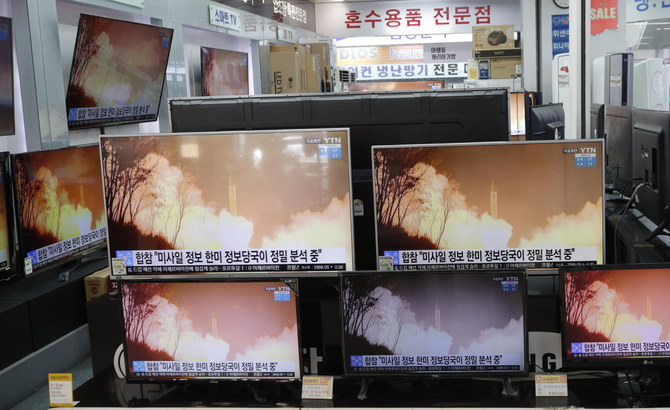
SEOUL: North Korea on Thursday test-fired its first ballistic missiles since President Joe Biden took office as it expands its military capabilities and increases pressure on Washington while nuclear negotiations remain stalled.
Japanese Prime Minister Yoshihide Suga said North Korea’s resumption of ballistic testing threatens “peace and safety in Japan and the region,” and that Tokyo will closely coordinate with Washington and Seoul on the North’s military activities.
South Korean Foreign Minister Chung Eui-yong, after meeting his Russian counterpart in Seoul, expressed “deep concern” and urged the North to uphold its commitments for peace. Russian Foreign Minister Sergey Lavrov called for a swift resumption of dialogue to resolve the standoff with North Korea.
South Korea’s Joint Chiefs of Staff said the two short-range missiles were fired at 7:06 a.m. and 7:25 a.m. on the North’s eastern coast and flew 450 kilometers on an apogee of 60 kilometers before landing in the sea.
A senior US official, who spoke on condition of anonymity to discuss military observations, matched the information from Tokyo and Seoul, saying that initial assessments suggest the North fired two short-range ballistic missiles.
“This activity highlights the threat that North Korea’s illicit weapons program poses to its neighbors and the international community,” said US Indo-Pacific Command spokesperson Capt. Mike Kafka.
The launches came a day after US and South Korean officials said the North fired short-range weapons presumed to be cruise missiles into its western sea over the weekend.
North Korea has a history of testing new US administrations with missile launches and other provocations aimed at forcing the Americans back to the negotiating table.
Still, Thursday’s launches were a measured provocation compared to the nuclear and intercontinental missile tests in 2017 that inspired war fears before the North shifted toward diplomacy with the Trump administration in 2018.
Analysts expect the North to gradually dial up its weapons displays to gain bargaining power as it angles to get back into stalled talks aimed at leveraging nuclear weapons for badly needed economic benefits.
North Korea has so far ignored the Biden administration’s efforts to reach out, saying it won’t engage in meaningful talks unless Washington abandons its “hostile” policies.
It’s unclear how the Biden administration will respond before it completes its policy review on North Korea in coming weeks.
The missile launches followed a trip by Secretary of State Antony Blinken and Defense Secretary Lloyd Austin to Japan and South Korea last week as Washington pushes to restore its alliances in Asia.
During the trip, Blinken sternly criticized North Korea’s nuclear program and human rights record and pressed China to use its “tremendous influence” to convince the North to denuclearize.
North Korean state media had said Tuesday that leader Kim Jong Un reaffirmed his country’s traditional alliance with China while exchanging messages with Chinese President Xi Jinping in an apparent response to Biden’s efforts to coordinate action on North Korea with his allies.
The negotiations over the North’s nuclear program faltered after the collapse of Kim’s second summit with President Donald Trump in February 2019, when the Americans rejected North Korean demands for major sanctions relief in exchange for a partial surrender of its nuclear capabilities.
Since Trump’s first meeting with Kim in 2018, the North has not conducted nuclear or long-range missile tests, although analysts believe it has pressed ahead with both programs.
The North has continued short- and medium-range missile testing during its suspension of nuclear and long-range tests, expanding its ability to strike targets in South Korea and Japan, including US bases there.
Kim Dong-yub, an analyst from South Korea’s Institute for Far Eastern Studies, said the flight data suggests the North possibly tested a new solid-fuel system modeled after Russia’s 9K720 Iskander mobile ballistic missiles.
The low-flying missiles, which analysts see as potentially nuclear capable, are designed to be maneuverable so they have a better chance at evading missile defense systems.
The North had conducted at least 16 launches of these missiles and other new short-range systems from 2019 to 2020.
Trump had been accused of giving North Korea room to advance its weaponry by repeatedly dismissing its short-range missile tests despite the threat they posed to South Korea and Japan.
If Biden takes a different approach by imposing additional sanctions over short-range ballistic launches, the North may use it as an excuse for more provocative tests, including those involving submarine-launched missile systems, said Cheong Seong-Chang, an analyst at South Korea’s Sejong Institute.
Kim Jong Un’s powerful sister last week berated the United States over its latest round of combined military exercises with South Korea this month, warning Washington to “refrain from causing a stink” if it wants to “sleep in peace” for the next four years.
The North’s short-range tests on Sunday were its first known missile firings since April 2020. Biden played down those launches, telling reporters, “There’s no new wrinkle in what they did.”


![]()

North Korea test-fires ballistic missiles in message to US
Short Url
https://arab.news/2u764
North Korea test-fires ballistic missiles in message to US
- The two short-range missiles were fired at 7:06 a.m. and 7:25 a.m. on the North’s eastern coast
- It’s unclear how the Biden administration will respond before it completes its policy review on Pyongyang


Latest updates





© 2026 SAUDI RESEARCH & PUBLISHING COMPANY, All Rights Reserved And subject to Terms of Use Agreement.