Philippines deploys more patrol ships amid rift with China

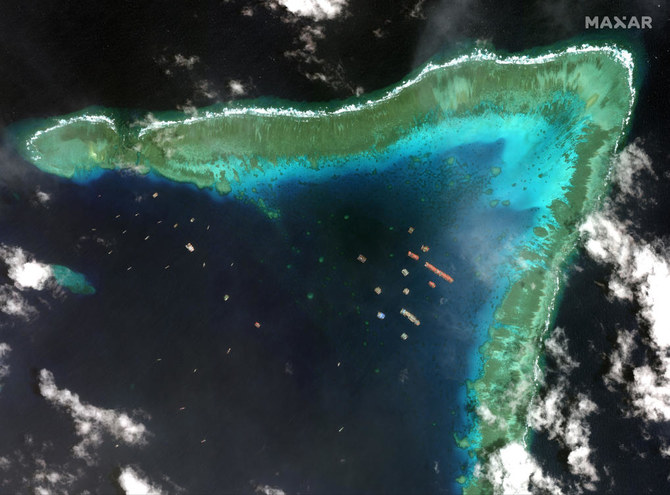
Above, Chinese vessels in the Whitsun Reef located in the disputed South China Sea in this satellite photo on March 23, 2021. (Maxar Technologies via AP)
Short Url
Updated 25 March 2021
Follow

Philippines deploys more patrol ships amid rift with China

  • The US said it is backing the Philippines in the new feud with Beijing
  • The Philippine government says the reef is well within the country’s internationally recognized exclusive economic zone

MANILA: The Philippine military has ordered more navy ships to be deployed for “sovereignty patrols” in the South China Sea, where a Chinese flotilla has swarmed around a disputed reef and ignored Manila’s demand to leave the area.
Philippine Defense Secretary Delfin Lorenzana has asked about 200 Chinese vessels he described as militia boats to immediately leave Whitsun Reef, a shallow coral region about 175 nautical miles (324 kilometers) west of Bataraza town in the western Philippine province of Palawan. China ignored the call, insisting it owns the offshore territory and that the vessels were sheltering from rough seas.
Military chief Gen. Cirilito Sobejana ordered the deployment of additional navy ships to beef up the country’s “maritime sovereignty patrols” in the disputed waters, the military said Thursday.
It did not say how close the Philippine navy ships would maneuver from the Chinese vessels, whose presence Lorenzana has called an “incursion” and “provocative action of militarizing the area.”
“By the increased naval presence in the area, we seek to reassure our people of the Armed Forces of the Philippines’ strong and unwavering commitment to protect and defend them from harassment and ensure that they can enjoy their rights over the country’s rich fishing ground,” military spokesman Maj. Gen. Edgard Arevalo said in a statement.
The United States said Tuesday it’s backing the Philippines in the new feud with Beijing and accused China of using “maritime militia to intimidate, provoke, and threaten other nations, which undermines peace and security in the region.”
The Philippines has filed a diplomatic protest but China insisted it owns the reef, which it calls Niué Jiao, and said the Chinese vessels converged in the area to avoid rough waters. The US, however, said “Chinese boats have been mooring in this area for many months in ever increasing numbers, regardless of the weather.”
Beijing denied the vessels were maritime militias. “Any speculation in such helps nothing but causes unnecessary irritation,” the Chinese Embassy said Monday.
The Philippine government says the reef is well within the country’s internationally recognized exclusive economic zone over which it “enjoys the exclusive right to exploit or conserve any resources.”
Philippine military officials discussed the impasse with Chinese People’s Liberation Army Wednesday and conveyed Lorenzana’s demand for the Chinese vessels to leave the reef, which Manila calls Julian Felipe, Arevalo said.
President Rodrigo Duterte asserted Manila’s position in a meeting with Chinese Ambassador Huang Xilian, presidential spokesman Harry Roque said, but reported no resolution.
Greg Poling of the Asia Maritime Transparency Initiative, a US-based think tank closely monitoring the territorial conflicts, said more Chinese fishing and militia vessels had recently frequented Whitsun Reef at the northeastern edge of Union Banks, an atoll where China maintains two bases. Vietnam, which also claims the area, has four bases.
“This deployment at Whitsun Reef is not new, but the numbers are way up,” Poling told The Associated Press.
China, the Philippines, Vietnam, Malaysia, Taiwan and Brunei have been locked in a tense territorial standoff over the resource-rich and busy South China Sea for decades.


Moscow made an offer to France regarding a French citizen imprisoned in Russia, says Kremlin

Updated 26 December 2025
Follow

Moscow made an offer to France regarding a French citizen imprisoned in Russia, says Kremlin

  • Laurent Vinatier, an adviser for Swiss-based adviser Center for Humanitarian Dialogue, Vinatier was arrested in Moscow in June 2024
  • He is accused of failing to register as a “foreign agent” while collecting information about Russia’s “military and military-technical activities” 

The Kremlin on Thursday said it was in contact with the French authorities over the fate of a French political scholar serving a three-year sentence in Russia and reportedly facing new charges of espionage.
Kremlin spokesman Dmitry Peskov told reporters that Russia has made “an offer to the French” regarding Laurent Vinatier, arrested in Moscow last year and convicted of collecting military information, and that “the ball is now in France’s court.” He refused to provide details, citing the sensitivity of the matter.
French President Emmanuel Macron is following Vinatier’s situation closely, his office said in a statement. French Foreign Ministry spokesperson Pascal Confavreux said Thursday that all government services are fully mobilized to pay provide consular support to Vinatier and push for his liberation as soon as possible.
Peskov’s remarks come after journalist Jérôme Garro of the French TF1 TV channel asked President Vladimir Putin during his annual news conference on Dec. 19 whether Vinatier’s family could hope for a presidential pardon or his release in a prisoner exchange. Putin said he knew “nothing” about the case, but promised to look into it.
Vinatier was arrested in Moscow in June 2024. Russian authorities accused him of failing to register as a “foreign agent” while collecting information about Russia’s “military and military-technical activities” that could be used to the detriment of national security. The charges carry a maximum penalty of five years in prison.
The arrest came as tensions flared between Moscow and Paris following French President Emmanuel Macron’s comments about the possibility of deploying French troops in Ukraine.
Vinatier’s lawyers asked the court to sentence him to a fine, but the judge in October 2024 handed him a three-year prison term — a sentence described as “extremely severe” by France’s Foreign Ministry, which called for the scholar’s immediate release.
Detentions on charges of spying and collecting sensitive data have become increasingly frequent in Russia and its heavily politicized legal system since Moscow invaded Ukraine in February 2022.
In addition to criticizing his sentence, the French Foreign Ministry urged the abolition of Russia’s laws on foreign agents, which subject those carrying the label to additional government scrutiny and numerous restrictions. Violations can result in criminal prosecution. The ministry said the legislation “contributes to a systematic violation of fundamental freedoms in Russia, like the freedom of association, the freedom of opinion and the freedom of expression.”
Vinatier is an adviser for the Center for Humanitarian Dialogue, a Switzerland-based nongovernmental organization, which said in June 2024 that it was doing “everything possible to assist” him.
While asking the judge for clemency ahead of the verdict, Vinatier pointed to his two children and his elderly parents he has to take care of.
The charges against Vinatier relate to a law that requires anyone collecting information on military issues to register with authorities as a foreign agent.
Human rights activists have criticized the law and other recent legislation as part of a Kremlin crackdown on independent media and political activists intended to stifle criticism of the war in Ukraine.
In August 2025, Russian state news agency Tass reported that Vinatier was also charged with espionage, citing court records but giving no details. Those convicted of espionage in Russia face between 10 and 20 years in prison.
Russia in recent years has arrested a number of foreigners — mainly US citizens — on various criminal charges and then released them in prisoner swaps with the United States and other Western nations. The largest exchange since the Cold War took place in August 2024, when Moscow freed journalists Evan Gershkovich and Alsu Kurmasheva, fellow American Paul Whelan, and Russian dissidents in a multinational deal that set two dozen people free.