Duterte orders Philippine troops to South China Sea reefs

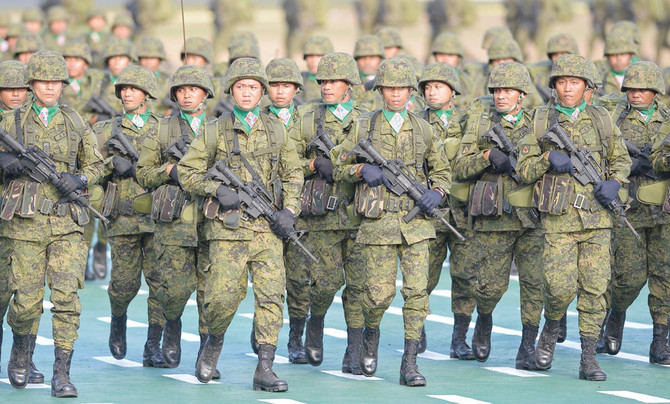
Philippine soldiers marching during the army’s 120th anniversary ceremony at Fort Bonifacio camp in Manila on Tuesday. President Rodrigo Duterte attended the event. (AFP)
Updated 06 April 2017
Follow

Duterte orders Philippine troops to South China Sea reefs

MANILA: Philippine President Rodrigo Duterte said Thursday he has ordered troops to deploy on unoccupied South China Sea islands and reefs claimed by Manila, in a move that could provoke rival claimants including Beijing.
“It looks like everybody is making a grab for the islands there, so we better live on those that are still vacant,” he told reporters during a visit to a military camp on the western island of Palawan, near the disputed Spratly group.
China asserts sovereignty over almost all of the resource-rich South China Sea despite rival claims from Southeast Asian neighbors and has rapidly built reefs into artificial islands capable of hosting military planes.
Duterte has previously sought to improve his nation’s relations with China by adopting a non-confrontational approach over their competing claims in the strategically vital waters.
But the president appeared to alter his tone with his announcement Thursday, saying it was time to “erect structures there and raise the Philippine flag.
“I have ordered the armed forces to occupy all.
“At least, let us get what is ours now and make a strong point there that it is ours,” he said, adding Manila was claiming “nine or 10” Spratly islands, reefs or cays.
Duterte also said he “may” visit the Philippine-claimed areas on June 12 to mark Philippine Independence Day.
An official at the Chinese Embassy in Manila seemed surprised when asked to comment on Duterte’s declaration, but referred questions on the matter to the Chinese Foreign Ministry in Beijing.
The Philippines under Duterte’s predecessor Benigno Aquino had actively challenged China’s claim to control most of the South China Sea, despite counter-claims by several other nations.
But the controversial Duterte, who took office last year on promises to kill thousands of people in a drug war, reversed that policy as he sought billions of dollars worth of investments and grants from Beijing.
The two neighbors are scheduled to hold talks in China in May to tackle issues related to the sea row.
The Philippine military currently has garrisons on Thitu, the largest of the Filipino-claimed islands.
After China occupied Mischief Reef in the mid-1990s, the Philippines marooned a derelict navy vessel atop nearby Second Thomas Shoal to assert Manila’s territorial claim.
Vietnam, Malaysia, Brunei and Taiwan have also sparred with Beijing over territory in the disputed waterway.
US President Donald Trump’s administration so far has taken a tough stance on China’s claims in the South China Sea, insisting it will defend international interests there.
Trump is set to sit down with his Chinese counterpart Xi Jinping later in the day to discuss a range of issues, which will likely including tensions in the South China Sea.


Tarique Rahman takes oath as Bangladesh’s PM after landslide election win

Updated 5 sec ago
Follow

Tarique Rahman takes oath as Bangladesh’s PM after landslide election win

  • 49 members of new cabinet, including ministers and state ministers, have also been sworn in
  • Experts say restoring law and order will be the new government’s main immediate task

DHAKA: Bangladesh Nationalist Party Chairman Tarique Rahman took the oath as prime minister on Tuesday, days after his party secured more than a two-thirds majority in the first vote since a student-led uprising expelled former Premier Sheikh Hasina.

The son of former Prime Minister Khaleda Zia and former President Ziaur Rahman — the BNP’s founder — Rahman returned to Bangladesh in late December after nearly two decades of self-imposed exile.

He led his party to a landslide victory last week, winning an absolute majority with 209 seats in the 300-seat parliament, followed by the Jamaat-e-Islami party, which won 68 seats.

The swearing-in ceremony was held publicly for the first time, under the open sky at the south plaza of the national parliament building.

Rahman’s administration takes over from an interim government led by Nobel laureate Muhammad Yunus who during the 18 months after Hasina’s ouster in August 2024, prepared the country for reform and the next election.

One of the most immediate tasks expected of the new leadership of the country of 170 million is the restoration of law and order — an area in which the caretaker cabinet faced widespread criticism.

A crisis that swept through the police force, which was implicated in the deadly crackdown on the July to August 2024 protests, has left law enforcement significantly weakened and some of its tasks were taken over by the military.

“The law-and-order situation during the interim’s period became very volatile ... The government will have to immediately step in to stop mobocracy,” said Dr. Zahed Ur Rahman, a Dhaka-based political commentator.

“The government must think about withdrawing the military from the streets because they’ve been there for one and a half years, and the military chief repeatedly said that it is having some impact on their professionalism. The regular police should take charge fully.”

In the long-term, the new government will have to focus on reviving the economy.

Under the interim administration the country has recorded little foreign or domestic investment — a situation expected as an elected government will mean more stability to potential investors, Rahman said, warning that the process will also require better energy security.

“We do not have good energy security. Supplying energy at a cheap or affordable price will be tough because this sector suffered rampant corruption during Sheikh Hasina’s regime.

“When investment increases, energy consumption or demand increases. So, it will be a severe problem to manage the power supply,” he told Arab News.

As the BNP leader took the oath of office, he appointed 24 ministers and 25 state ministers, with former commerce minister Amir Khasru Mahmud Chowdhury taking the finance and planning portfolio, former attorney general Md. Asaduzzaman as law minister, and former state minister of power, Ikbal Hasan Mahmud Tuku, at the helm of the Ministry of Power, Energy and Mineral Resources.

The appointment of the foreign minister is still pending.

The new government’s foreign policy will have to address the influence of key players — the US, China, and India, a neighbor that was Bangladesh’s main partner during the 15-year rule of Hasina’s Awami League and with whom Dhaka has been at loggerheads since the former leader fled to New Delhi following her ouster.

Since 2024, India has suspended key transshipment access that allowed Bangladeshi exports to go via Indian ports and airports. It also put on hold most normal visa services for Bangladeshis, who were among its largest groups of medical tourists.

Bangladesh needs to revive the relationship as the “next priority” after restoring law and order, according to Mohiuddin Ahmad, a political historiographer.

“The revival of a good relationship with India will increase people-to-people contact, bilateral trade and commerce, and so on,” he said.

“The next priority should be the normalization of the relationship with India. We need such a relationship with India, which will promote all the elements of a good neighborhood.”