

Indus water talks: Pakistan requests India for information on design of hydro projects  

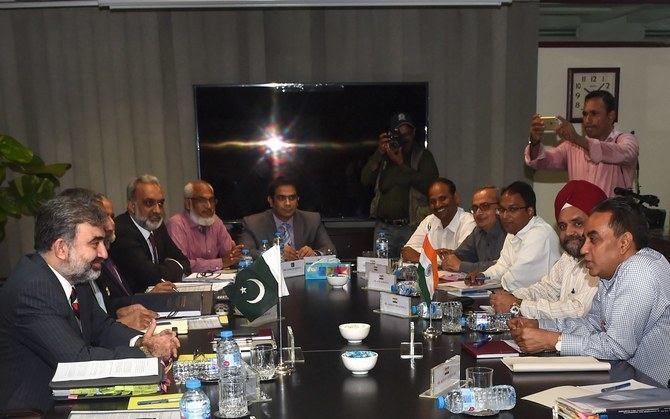
Pakistan's commissioner for Indus waters, Mehr Ali Shah, left, talks to India's Indus water commissioner, Pradeep Kumar Saxena, with other members of the committees during a first day of a meeting to discuss the Indus Waters Treaty in Lahore on August 29, 2018. (AFP/File)
Short Url
Updated 24 March 2021
Follow

Indus water talks: Pakistan requests India for information on design of hydro projects  

  • Pakistani delegates arrived in New Delhi on Monday for talks with their Indian counterparts
  • They discussed host of issues, including Islamabad’s concerns over construction of Indian upstream dams

ISLAMABAD: Pakistan has requested India to share information on the hydropower projects it was planning to develop, the Indian foreign ministry said on Wednesday, after a meeting of the Indus water commissioners of both countries.

Pakistani delegates led by Indus water commissioner Mehr Ali Shah arrived in New Delhi on Monday for two-day talks with their Indian counterparts led by Pradeep Kumar Saxena. The meeting took place after a gap of around two and half years, although water commissioners are required to meet at least once a year, alternately in Pakistan and India. The last meeting was held in Lahore in August 2018.

As per the Indus Waters Treaty, brokered by the World Bank and signed by the two nuclear-armed neighbors in 1960, India has control over the waters of the Beas, Ravi and Sutlej rivers, while control over the waters of the Indus, Chenab and Jhelum rivers lies with Pakistan.

“Pakistan side requested India for sharing of information on design of other Indian hydropower projects being planned to be developed. Indian side assured that the information will be supplied as and when required to be supplied under the provisions of the Treaty,” the Indian foreign ministry said in a statement.

Both countries can approach the World Bank for arbitration in case of disputes over the use of water resources. Pakistan approached the World Bank in August 2016 to constitute a court of arbitration over two disputed Indian projects: the 330 megawatts Kishanganga and 850 megawatts Ratle hydropower projects.

The bank has not yet set up the court as India has sought the appointment of a neutral expert to resolve the conflict. Pakistan is also taking up two ongoing disputes with India — over the 1000MW Pakal Dul and 40MW Lower Kalnai — at the Indus commissioners’ level. Islamabad says it will take the issues to the World Bank for mediation if it fails to resolve them at the bilateral level.

“Discussions continued on designs of two Indian projects, namely, Pakal Dul (1000 MW) and Lower Kalnai (48 MW). Indian side held that these projects are fully compliant with the provisions of the Treaty and provided technical data in support of its position,” the Indian foreign ministry said, adding that the meeting was held “in a cordial manner.”

In recent years India has also begun ambitious irrigation plans and construction of many upstream dams, saying its use of upstream water is strictly in line with the treaty.

Pakistan has opposed some of these projects saying they violate the World Bank-mediated treaty on the sharing of the Indus waters, upon which 80 percent of its irrigated agriculture depends.

Shortly after the partition of the sub-continent into Pakistan and India in August 1947, tensions soared over water rights of the rivers flowing between them. Since the ratification of the treaty after nine years of negotiations, both neighbors have not engaged in any water wars, despite waging full-scale wars over the Muslim majority Kashmir valley, which both claim in full and rule in part. 


Pakistan, Oman navies discuss maritime security, ink agreement to share shipping data

Updated 9 sec ago
Follow

Pakistan, Oman navies discuss maritime security, ink agreement to share shipping data

  • Visiting Oman royal navy commander calls on Pakistan Naval Chief Admiral Naveed Ashraf in Islamabad
  • White shipping agreement refers to exchange of prior information on movement of commercial ships

ISLAMABAD: The naval commanders of Pakistan and Oman discussed regional maritime security on Wednesday and signed an agreement to share shipping information with each other, the Pakistan Navy said in a statement.

The press release followed a meeting between Pakistan Naval Chief Admiral Naveed Ashraf and the visiting Oman Royal Navy Commander Rear Admiral Saif Bin Nasser Bin Mohsin Al Rahbi at Naval Headquarters in Islamabad.

Both navies maintain close professional relations, reflected in expert-level staff talks, joint training, bilateral exercises, and participation in multilateral exercises between the Pakistan Navy and the Royal Navy of Oman.

“During the meeting, matters of mutual interest, regional maritime security and bilateral naval cooperation were discussed,” the Pakistan Navy said.

The MoU was signed by both sides at a ceremony at the Naval Headquarters, the navy’s media wing confirmed. 

“The MoU is aimed at establishing of guidelines and procedures for information sharing in order to enhance mutual awareness of white shipping,” the Pakistan Navy said in a statement. 

White shipping agreement refers to the exchange of prior information on the movement and identity of commercial non-military merchant vessels.

Information regarding the identity of vessels helps countries tackle potential threats from sea routes. This particularly helps in the development of a proper regional maritime domain awareness

The statement said Al Rahbi lauded Pakistan Navy’s professionalism and acknowledged its ongoing contributions to maritime security and regional stability.

Pakistan and Oman share geographical proximity and common maritime boundaries. Bilateral relations between the two brotherly countries span a wide range of areas, including economic cooperation, people-to-people contacts and strong defense ties.

In December, a Royal Navy flotilla from Oman visited Karachi to take part in the annual bilateral Thamar Al Tayyib (TAT) 2025 exercise. 

Pakistan Navy and the Royal Navy of Oman have been conducting the TAT series of exercises regularly since 1980.