

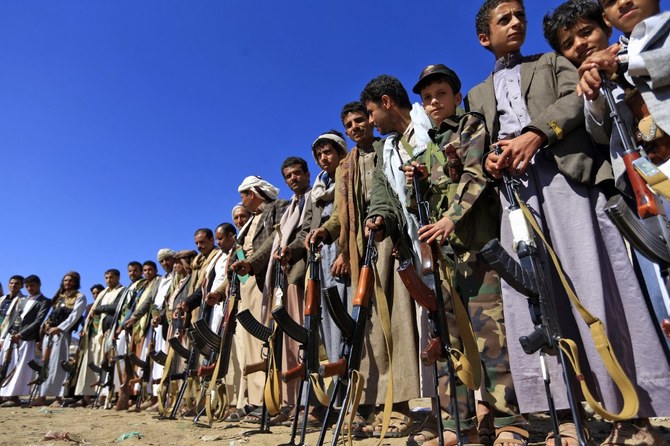

LONDON: The Iran-backed Houthi militia is using graphic violent imagery, including pictures of dead children, in educational materials to condition young Yemenis to support violence and hate the US, Saudi Arabia and Jews, according to a new report.
“Houthi educational materials are rife with violence and imagery of death, irrespective of the age of the target audience,” said the report, released on Tuesday by education watchdog IMPACT-se.
Images of dead children, for example, are used “to portray the Houthis’ enemies as monstrous and inhumane.”
Adversaries of the Houthis, in particular countries participating in the Saudi-led coalition’s military campaign against the group, are “presented as an inhuman, absolute evil.”
The report found that through magazines such as their signature publication Jihad, the Houthis are indoctrinating young Yemenis into an overtly violent and radical ideology.
“The Houthi materials grossly violate the ideal of peacemaking, entirely dismissing peace as an option in international conflict resolution, and condemning those who advocate for it as cowardly, foolish or traitorous,” IMPACT-se said.
“Instead, violent jihad, sacrifice in battle, and supporting the war effort in any way possible is held up as an ideal and a central virtue.”
Marcus Sheff, CEO of IMPACT-se, told Arab News: “Extremist education has always been a focal point of the Houthis’ agenda since the movement’s inception.”
He warned that this kind of education is likely to cause serious harm to the children exposed to it.
“Exposure to violence harms children’s emotional and psychological development, and presents an increased risk of developing school-related problems, including mental health issues and learning disabilities,” Sheff said.
“Children are easily influenced and impressionable — that’s why societies protect them from harm. But equally, children can be radicalized through extremist educational materials. That’s clearly the intent here,” he added.
“They may also experience many of the same symptoms as children who are victims of violence themselves. The authors of this material wouldn’t be unaware of the trauma these images can engender.”


