Police: 10 people killed at Colorado supermarket

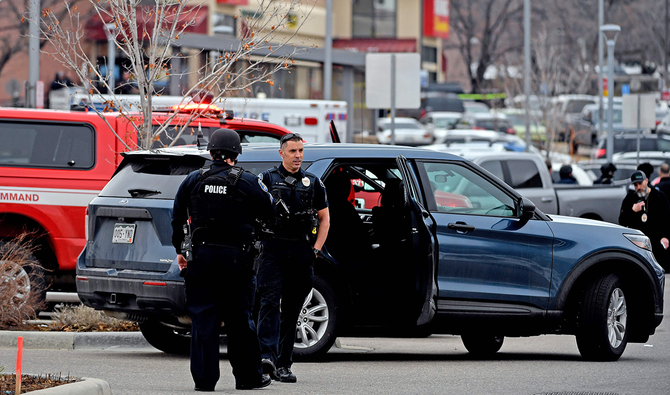
Police officers stand outside the parking lot of the King Soopers grocery store in Boulder, Colorado on March 22, 2021 after reports of an active shooter. (AFP)
Short Url
Updated 23 March 2021
Follow

Police: 10 people killed at Colorado supermarket

  • Video posted on YouTube showed one person on the floor inside the King Soopers store and two more outside on the ground

BOULDER, Colorado: A shooting at a Colorado supermarket killed 10 people Monday, including a police officer, and a suspect was in custody, authorities said.
Boulder police Chief Maris Herold announced the death toll at a news conference Monday night, fighting back tears.
The suspect was getting medical treatment and there was no further threat to the public, authorities said. Officers had escorted a shirtless man with blood running down his leg out of the store in handcuffs but authorities would not say if he was the suspect.
The officer who was killed was Eric Talley, 51, who had been with Boulder police since 2010, Herold said.
Victims’ families were still being notified so their names weren’t released, Boulder County District Attorney Michael Dougherty said.
“This is a tragedy and a nightmare for Boulder County, and in response, we have cooperation and assistance from local, state and federal authorities,” Dougherty said.
Yamaguchi said police were still investigating and didn’t have details on a motive for the shooting at the King Soopers store in Boulder, which is about 25 miles (40 kilometers) northwest of Denver and home to the University of Colorado.
Dean Schiller told The Associated Press that he had just left the supermarket when he heard gunshots and saw three people lying face down, two in the parking lot and one near the doorway. He said he “couldn’t tell if they were breathing.”
Video posted on YouTube showed one person on the floor inside the store and two more outside on the ground. What sounds like two gunshots are also heard at the beginning of the video.
Law enforcement vehicles and officers massed outside the store, including SWAT teams, and at least three helicopters landed on the roof. Some windows at the front of the store were broken.
At one point, authorities said over a loudspeaker that the building was surrounded and that “you need to surrender.”
Sarah Moonshadow told the Denver Post that two shots rang out just after she and her son, Nicolas Edwards, finished buying strawberries. She said she told her son to get down and then “we just ran.”
Once they got outside, she said they saw a body in the parking lot. Edwards said police were speeding into the lot and pulled up next to the body.
“I knew we couldn’t do anything for the guy,” he said. “We had to go.”
James Bentz told the Post that he was in the meat section when he heard what he thought was a misfire, then a series of pops.
“I was then at the front of a stampede,” he said.
Bentz said he jumped off a loading dock out back to escape and that younger people were helping older people off of it.
One person was taken from the shooting scene to Foothills Hospital in Boulder, said Rich Sheehan, spokesman for Boulder Community Health, which operates the hospital.
Colorado Gov. Jared Polis tweeted a statement that his “heart is breaking as we watch this unspeakable event unfold in our Boulder community.”
Police had told people to shelter in place amid a report of an “armed, dangerous individual” about 3 miles (5 kilometers) away from the grocery store but said at the news conference later that it wasn’t related to the shooting.
The FBI said it’s helping in the investigation at the request of police.
White House press secretary Jen Psaki tweeted that President Joe Biden had been briefed on the shooting.
In a statement, the King Soopers chain offered “thoughts, prayers and support to our associates, customers, and the first responders who so bravely responded to this tragic situation. We will continue to cooperate with local law enforcement and our store will remain closed during the police investigation.”
Kevin Daly, owner of Under the Sun Eatery and Pizzeria Restaurant a block or so from the supermarket, said he was in his shop when he saw police cars arriving and shoppers running from the grocery store. He said he took in several people to keep them warm, and others boarded a bus provided by Boulder police and were taken away.


A month on, flood-struck Aceh still reels from worst disaster since 2004 tsunami

Men wait to receive privately donated aid in in eastern Aceh regency of Aceh Tamiang, on Dec. 14, 2025. (AFP)
Updated 58 min 35 sec ago
Follow

A month on, flood-struck Aceh still reels from worst disaster since 2004 tsunami

  • Aceh accounts for almost half of death toll in Sumatra floods that struck in November
  • Over 450,000 remain displaced as of Friday, as governor extended state of emergency

JAKARTA: Four weeks since floodwaters and torrents of mud swept across Aceh province, villages are still overwhelmed with debris while communities remain inundated, forced to rely on each other to speed up recovery efforts.

The deadly floods and landslides, triggered by extreme weather linked to Cyclone Senyar, hit the provinces of North Sumatra, West Sumatra and Aceh in late November.

Aceh, the westernmost province of Indonesia, was the worst-hit. Accounting for almost half of the 1,137 death toll, a month later more than 450,000 people are still unable to return to their homes, as many struggle to access clean water, food, electricity and medical supplies.

“We saw how people resorted to using polluted river water for their needs,” Ira Hadiati, Aceh coordinator for the Medical Emergency Rescue Committee, or MER-C, told Arab News on Friday.

Many evacuation shelters were also lacking toilets and washing facilities, while household waste was “piling up on people’s lawns,” she added.

In many regions, people’s basic needs “were still unmet,” said Annisa Zulkarnain, a volunteer with Aceh-based youth empowerment organization Svara.

“Residents end up helping each other and that’s still nowhere near enough, and even with volunteers there are still some limitations,” she told Arab News. 

Volunteers and aid workers in Aceh have grown frustrated with the central government’s response, which many have criticized as slow and ineffective.

And Jakarta continues to ignore persistent calls to declare the Sumatra floods a national disaster, which would unlock emergency funds and help streamline relief efforts.

“It seems like there’s a gap between the people and the government, where the government is saying that funds and resources have been mobilized … but the fact on the ground shows that even to fix the bridges, it’s been ordinary people working together,” Zulkarnain said.

After spending the past two weeks visiting some of the worst-affected areas, she said that the government “really need to speed up” their recovery efforts.

Aceh Gov. Muzakir Manaf extended the province’s state of emergency for another two weeks starting Friday, while several district governments have declared themselves incapable of managing the disasters.

Entire villages were wiped out by the disastrous floods, which have also damaged more than 115,000 houses across Aceh, along with 141 health facilities, 49 bridges, and over 1,300 schools.

The widespread damage to roads and infrastructure continue to isolate many communities, with residents traveling for hours on foot or with motorbikes in search of basic supplies.

“Even today, some areas are still inundated by thick mud and there are remote locations still cut off because the bridges collapsed. For access, off-road vehicles are still required or we would use small wooden boats to cross rivers,” Al Fadhil, director of Geutanyoe Foundation, told Arab News.

“From our perspective, disaster management this time around is much worse compared to how it was when the 2004 tsunami happened.”

When the Indian Ocean earthquake and tsunami struck in 2004, Aceh was the hardest-hit of all, with the disasters killing almost 170,000 people in the province.

But MER-C’s Hadiati said that the impact of the November floods and landslides is “more extensive and far worse than the tsunami,” as 18 Acehnese cities and regencies have been affected — about twice more than in the 2004 disaster.

As Friday marks 21 years since the cataclysmic tsunami, Fadhil said the current disaster management was “disorganized,” and lacked leadership and coordination from the central government, factors that played a crucial role after 2004. 

“The provincial and district governments in Aceh, they’ve now done all they could with what they have,” he said.

“But their efforts stand against the fact that there’s no entry of foreign aid, no outside support, and a central government insisting they are capable.”