


ATHENS: Greece and Turkey remain at loggerheads over the delimitation of their maritime zones, diplomats said, after the conclusion of the latest round of exploratory talks last week in Athens between officials and experts from each country’s foreign ministry.
Ankara stuck to its traditional strategy of raising all issues considered disputes with Greece, even questioning the sovereignty of various Greek islands or requesting their demilitarization.
“This has been a common feature of Turkey’s tactics in exploratory talks with Greece since their inception” Petros Liacouras, professor of international law at the University of Piraeus, told Arab News.
“Each time bilateral relations were going through difficult times and tensions were running high, Turkey kept bringing (up) the sovereignty of Greek islands, and (putting) their demilitarization on the table.”
Liacouras said Turkey’s foreign policy is today heavily influenced by the Minister of Defense Hulusi Akar.
“This is a factor which has brought the aforementioned issues back to the front line in the exploratory talks” he said.
The resumption of talks after last summer’s crisis between Turkey and Greece in the eastern Mediterranean arose following mediation by Germany and the US.
Greek officials who spoke to Arab News on condition of anonymity, though, were pessimistic on the prospect of a positive outcome, given Turkish insistence on splitting areas of the Aegean Sea and the eastern Mediterranean while maintaining a hard stance on the expansion of Greek territorial waters.
However, Athens believes that exploratory talks remain the ideal format to keep diplomatic channels open while not engaging in formal negotiations.
“Exploratory talks allow each side to learn (about) the other and search for common ground,” Liacouras said. “If they manage to reach an understanding on some preliminary aspects, this will ease the burden before the two sides start formal negotiations on the delimitation of the continental shelf and the exclusive economic zone.”
Turkey tried, before the latest round of exploratory talks, to change their nature by framing them as “consultative talks” in a bid to solidify a negotiating framework, Greek diplomatic sources said. In the past, both foreign ministries would issue identical statements announcing the next round of exploratory talks.
Additionally, Ankara proposed that Ibrahim Kalin, senior diplomatic advisor to President Recep Tayyip Erdogan, would visit Athens and participate in the talks, having been present during previous discussions.
However, Athens insisted that such a move would add unnecessary tension to an already fragile situation.
The Greek government remains committed to a successful outcome to the talks — a message that was passed on to the Turkish delegation on behalf of Prime Minister Kyriakos Mitsotakis.
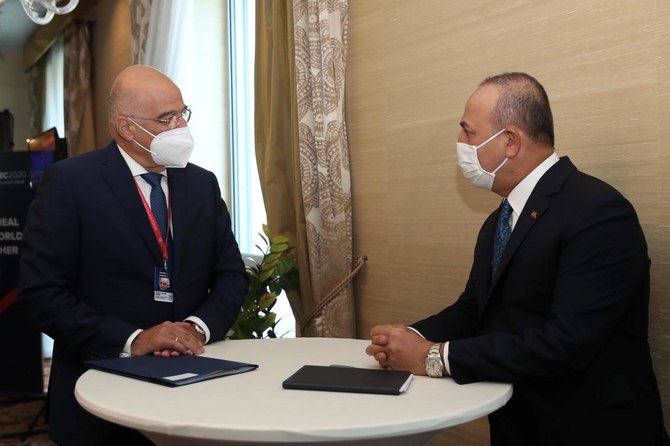
Greek Foreign Minister Nikos Dendias, meanwhile, accepted an invitation from his Turkish counterpart Mevlut Cavusoglu to visit Ankara on April 14. However, a possible trilateral meeting between Dendias, Cavusoglu and NATO Secretary-General Jens Stoltenberg was postponed.
Keeping as many diplomatic channels as possible open is one of the core pillars of Greece’s strategy.
The second pillar concerns EU-Turkey relations. Athens welcomed a report prepared by the European Commission, and the high representative on foreign policy, Josep Borrell, which was presented to EU foreign ministers on March 22 in Brussels.
The report treads a delicate balance between offering some diplomatic carrots to Ankara, such as the modernization of an EU-Turkey customs union, while keeping open the possibility for more restrictive measures (even in sectors such as energy and tourism) if Turkey insists on provocations against the EU and its member states, with Dendias saying the report should have specifically mentioned Ankara’s “casus belli” threats against Greece.


