

President Abbas rebuffs Israeli intelligence chief

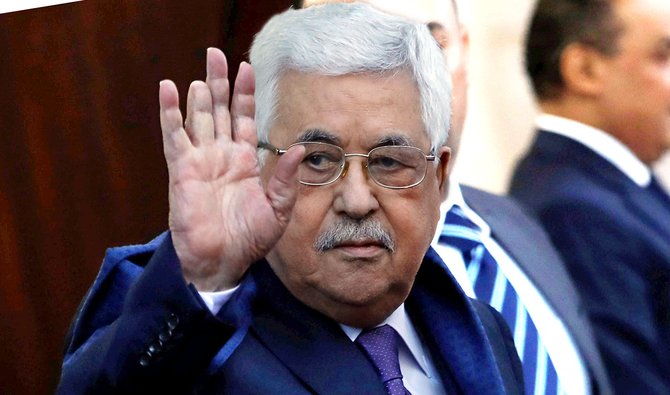
Palestinian President Mahmoud Abbas used an Arab proverb to rebuff attempts by Israelis to intervene in the Palestinian elections. (Reuters/File)
Short Url
Updated 22 March 2021
Follow

President Abbas rebuffs Israeli intelligence chief

  • Hamas, which had acceded not to contest the presidential elections, then agreed to allow for legislative polls to take place two months before presidential elections

AMMAN: Palestinian President Mahmoud Abbas used an Arab proverb to rebuff attempts by Israelis to intervene in the Palestinian elections.

Jibril Rajoub, the secretary of the Fatah movement, said the head of Shabak (internal Israeli elections), Nadav Argaman, tried to stop their efforts to create a joint list with Hamas.

“He visited the Palestinian presidential compound and made threats to all of us,” Rajoub said on Palestine TV. The Israeli official who said he was carrying a message from the Israeli prime minister was accompanied by an American official. Palestinian sources say that they believe the US official is part of a US intelligence service.

Abbas reportedly answered the Israeli official, who is fluent in Arabic, using an Arabic proverb: “Drink your coffee and may God be with you.” It is a polite way of rejecting the request.

Lina Haddad, an expert on Arab proverbs, said that people use proverbs as an indirect way of avoiding saying something harsh.

“He wanted to send a message that I am being kind to you by serving you coffee as a guest of mine but do not abuse my hospitality,” Haddad told Arab News.

Rajoub fiercely criticized Argaman’s boss, Israeli Prime Minister Binyamin Netanyahu, saying he “is worse than Mussolini.” 

The idea of a joint Fatah-Hamas list was first mentioned in the Istanbul talks between Rajoub and the deputy head of Hamas, Saleh Aruri, in 2020.

Hamas, which had acceded not to contest the presidential elections, then agreed to allow for legislative polls to take place two months before presidential elections.

Former Fatah central committee member Naser Al-Qudwa issued a strongly worded statement opposing the idea regarding the joint list, calling it “undemocratic” and that it “smells of personal gains on the account of the people.” 

Al-Qudwa has since created the Palestinian Democratic Assembly and is planning to run on a non-Fatah list of independent Palestinians. Abbas has ordered that Al-Qudwa be removed from the Fatah movement and has fired him as the head of the Yasser Arafat Foundation.

Mohammad Daraghmeh, a veteran Palestinian journalist, told Arab News that the joint list faces many problems, especially with Hamas’ demand to have the same number of seats as Fatah. Daraghmeh said the Israeli security chief also threatened to stop the elections and warned against the efforts by Palestinians to try Israelis for war crimes.

Fadi Elasalameen, senior fellow with the American Security Project, told Arab News that he was not surprised that Israel does not want Hamas in the West Bank. “But, I find it hard to believe that Abbas, who depends entirely on Israeli security to stay in power in the West Bank, would speak in such a way to the Israeli head of Shabak. It is election season and it does not hurt Abbas to flex his political muscle.”

Three lists, including one by the Democratic Front for Palestine, have officially registered to run. The window of nominations closes on March 31.

Salam Fayyad, Al-Qudwa, and others have yet to propose their list for the elections. Efforts are also being made to unify left-wing Palestinian factions into a single list.


Fledgling radio station aims to be ‘voice of the people’ in Gaza

Updated 5 sec ago
Follow

Fledgling radio station aims to be ‘voice of the people’ in Gaza

  • The electricity crisis is one of the most serious and difficult problems in the Gaza Strip, says Shereen Khalifa Broadcaster

DEIR EL-BALAH: From a small studio in the central city of Deir El-Balah, Sylvia Hassan’s voice echoes across the Gaza Strip, broadcast on one of the Palestinian territory’s first radio stations to hit the airwaves after two years of war.

Hassan, a radio host on fledgling station “Here Gaza,” delivers her broadcast from a well-lit room, as members of the technical team check levels and mix backing tracks on a sound deck. “This radio station was a dream we worked to achieve for many long months and sometimes without sleep,” Hassan said.

“It was a challenge for us, and a story of resilience.”

Hassan said the station would focus on social issues and the humanitarian situation in Gaza, which remains grave in the territory despite a US-brokered ceasefire between Israel and Hamas since October.

“The radio station’s goal is to be the voice of the people in the Gaza Strip and to express their problems and suffering, especially after the war,” said Shereen Khalifa, part of the broadcasting team.

“There are many issues that people need to voice.” Most of Gaza’s population of more than 2 million people were displaced at least once during the gruelling war.

Many still live in tents with little or no sanitation.

The war also decimated Gaza’s telecommunications and electricity infrastructure, compounding the challenges in reviving the territory’s local media landscape. “The electricity problem is one of the most serious and difficult problems in the Gaza Strip,” said Khalifa.

“We have solar power, but sometimes it doesn’t work well, so we have to rely on an external generator,” she added.

The station’s launch is funded by the EU and overseen by Filastiniyat, an organization that supports Palestinian women journalists, and the media center at the An-Najah National University in Nablus, in the occupied West Bank.

The station plans to broadcast for two hours per day from Gaza and for longer from Nablus. It is available on FM and online.

Khalifa said that stable internet access had been one of the biggest obstacles in setting up the station, but that it was now broadcasting uninterrupted audio.

The Gaza Strip, a tiny territory surrounded by Israel, Egypt, and the Mediterranean Sea, has been under Israeli blockade even before the attack on Oct. 7, 2023, which sparked the war. Despite the ceasefire, Israel continues to strictly control the entry of all goods and people to the territory.

“Under the siege, it is natural that modern equipment necessary for radio broadcasting cannot enter, so we have made the most of what is available,” she said.