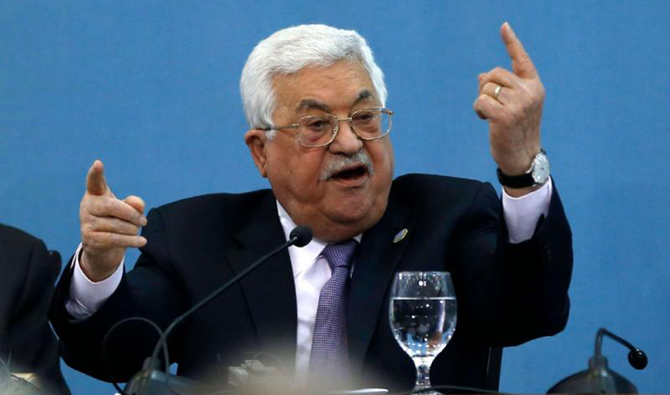
Does Abbas intend to run for president after all?

Palestinian leader Mahmoud Abbas
Short Url
Updated 18 February 2021
Follow

Does Abbas intend to run for president after all?

  • The 85-year-old repeatedly said he won’t, but as election approaches there are signs he is planning do so

AMMAN: Palestinian leader Mahmoud Abbas, who signed the decree for this year’s elections, has yet to announce whether he intends to run for president.

In the past 10 years, he said on at least three occasions that if and when elections take place he will not stand. But Fatah strongman Jibril Rajoub has repeatedly stated that 85-year-old Abbas is the party’s only candidate for president.

Polls conducted as recently as December suggest that Abbas would lose in a head-to-head contest against Hamas leader Ismail Haniyeh. Under the current power-sharing understanding between Fatah and Hamas, however, the Islamist movement has agreed not to challenge the Fatah nominee.

While the largely youthful Palestinian population under occupation has not known any leader other than Abu Mazen (Abbas’s nom de guerre), he faces a mix of apathy and rejection.

Senior advisers to the president told Arab News that it is “too early” to talk about the presidential race, scheduled for July 31, because all attention now is on making sure the legislative elections take place on May 22 and a new government is formed to represent all of the Palestinian areas occupied in 1967.

Najeeb Qadoumi, a member of the Palestinian National Council, told Arab News that the Palestinian leader’s achievements cannot be dismissed. Abbas persuaded 138 nations in the UN general assembly to recognize Palestine as a nonmember observer state, he said, and also stood up to “the most powerful man in the world,” US President Donald Trump, in defeating the so-called “deal of the century.”

Qadoumi highlighted Abbas’s boycott of the Trump administration after it moved the US Embassy to Jerusalem and announced its vision for peace that included the annexation of a third of the West Bank. US President Joe Biden and his team have announced that they plan to reverse many of Trump’s decisions that affected Palestinians, including its legalization of Israeli settlement activities. The new US administration also unambiguously stated its support for a two-state solution, and has resumed dialogue with the Palestinians.

SPEEDREAD

Polls conducted as recently as December suggest that Mahmoud Abbas would lose in a head-to-head contest against Hamas leader Ismail Haniyeh.

While many in Fatah’s Central Committee favor Abbas as a consensus leader, it is still unclear whether he will decide to run for the highest office. However his followers have in recent weeks noticed a sharpening of nationalistic rhetoric from him, especially in publicly disclosed statements encouraging Palestinians in the Jordan Valley to resist Israeli policies and attempts at settlement expansion.

“These are the words of a man who is planning to run,” a senior Palestinian leader told Arab News.

Whether his previous statements that he would not run were genuine or a bluff, if he does decide to stand he will have a significant problem to deal with: The publicly announced intention of imprisoned Fatah leader Marwan Barghouti to run for president from behind the bars of an Israeli cell, where he has been held for almost 20 years.

The most recent poll suggested that if Barghouti runs, he could expect to receive 62 percent of the Palestinian vote. His ally Hatem Abdel Qader, a Fatah leader in Jerusalem, said Barghouti has no plans to run for the legislative council and will only stand for president.

Fatah Central Committee member Hussein Sheikh visited Barghouti in jail on Feb. 11 and reportedly offered him top spot on the Fatah list of candidates, along with the chance to name 10 others on the party’s official list, but the offer was rejected.

A possible compromise solution that has been suggested is the creation of the office of vice president and have the Fatah ticket include candidates for both positions. However this would require a change in the law that could only be implemented after the elections for the legislative council take place.

If it happens, Barghouti could be included on the ticket as the candidate either for president or vice president, which could help increase his chances for release, especially considering Abbas’s age.


A look at Ramadan and how Muslims observe the holy month

Updated 4 sec ago
Follow

A look at Ramadan and how Muslims observe the holy month

  • Ramadan is the ninth month of the Islamic lunar calendar; the month cycles through the seasons
  • Ramadan is followed by the Islamic holiday of Eid Al-Fitr
CAIRO: Observant Muslims the world over will soon be united in a ritual of daily fasting from dawn to sunset as the Islamic holy month of Ramadan starts. For Muslims, it’s a time for increased worship, religious reflection and charity. Socially, it often brings families and friends together in festive gatherings around meals to break their fast.
Ramadan is followed by the Islamic holiday of Eid Al-Fitr.
First day of Ramadan expected around Feb. 18-19
Ramadan is the ninth month of the Islamic lunar calendar; the month cycles through the seasons.
The start of the month traditionally depends on the sighting of the crescent moon. This year, the first day of Ramadan is expected to be on or around Feb. 18 or 19. The actual start date may vary among countries and Muslim communities due to declarations by multiple Islamic authorities around the globe on whether the crescent had been sighted or different methodologies used to determine the beginning of the month.
This year, the start of Ramadan is expected around the same time as Ash Wednesday, a solemn day of fasting and reflection that signals the start of Lent, the most penitential season of the church calendar for Catholics and many other Christians.
Fasting is one of the pillars of Islam
Fasting is one of the Five Pillars of Islam, along with the profession of faith, prayer, almsgiving and pilgrimage.
Muslims see various meanings and lessons in observing the fast.
It’s regarded as an act of worship to attain piety and one of submission to God. The devout see benefits, including practicing self-restraint, cultivating gratitude and empathizing with people who are poor and hungry.
The daily fast in Ramadan includes abstaining from all food and drink — not even a sip of water is allowed — from dawn to sunset, before breaking the fast in a meal known as “iftar” in Arabic.
Muslims typically stream into mosques for congregational prayers and dedicate more time to religious contemplation and the reading of the Qur’an, the Muslim holy book.
Charity is a hallmark of Ramadan. Among other ways of giving, many seek to provide iftar for those in need, distributing Ramadan boxes filled with pantry staples, handing out warm meals alongside such things as dates and juice or helping hold free communal meals.
Muslims eat a predawn meal, called “suhoor,” to hydrate and nurture their bodies ahead of the daily fast.
Exemptions from fasting
There are certain exemptions, such as for those who are unable to because of illness or travel. Those unable to fast due to being temporarily ill or traveling need to make up for the missed days of fasting later.
Cultural and social traditions associated with Ramadan
Muslims are ethnically and racially diverse and not all Ramadan traditions are rooted in religion. Some customs may transcend borders, while others can differ across cultures.
Many social rituals center on gathering and socializing after the daily fast. Some Muslims decorate their homes, put out Ramadan-themed tableware and centerpieces or throng to markets and Ramadan bazaars.
In Egypt, Ramadan is typically a festive time. Colorful lanterns, in different shapes and sizes, dangle from children’s hands and adorn homes. Ramadan songs may be played to welcome the month.
Ramadan’s soundscape in Egypt has traditionally included the predawn banging on drums by a “mesaharati” who roams neighborhoods, calling out to the faithful, sometimes by name, to wake them up for the suhoor meal.
New TV shows and communal meals
A lineup of new television series is another social fixture of the month in some countries, and advertisers compete for viewers’ attention.
In various regions, some Muslims worry that the month is getting commercialized, and say an emphasis on decorations, TV shows, outings or lavish iftar banquets can detract from Ramadan’s religious essence. Others say that a balance can be struck and that, in moderation, such rituals are part of the month’s festive spirit.
In Indonesia, Ramadan rituals vary across regions, reflecting the diversity of cultures. In deeply conservative Aceh province, animals are slaughtered during Meugang festivities, the meat cooked and shared with family, friends, poor people and orphans.
Hundreds of residents in Tangerang, a city outside the capital, Jakarta, flock to the Cisadane River to wash their hair with rice straw shampoo and welcome the fasting month with a symbolic spiritual cleansing.
Across the island of Sumatra, after evening prayers, many boys and girls parade through the streets, carrying torches and playing Islamic songs.
In the United States, where Muslims make up a racially and ethnically diverse minority, gathering at mosques and Islamic centers when possible for iftar meals and prayers provides many Muslim families with a sense of community. Some Muslims also organize or attend interfaith iftar meals.