

Why won’t Twitter ban Khamenei when it permanently suspended Trump?

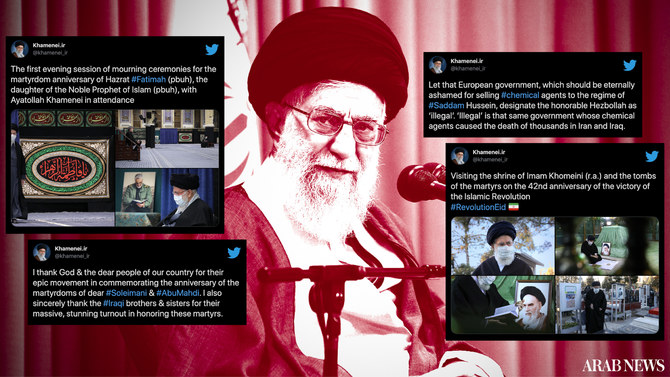
Iran’s Supreme Leader Ayatollah Ali Khamenei is notorious for using his Twitter accounts to incite hate, violence and disinformation. Yet his many accounts in multiple languages still exist on the platform. (AN Design)
Short Url
Updated 22 March 2021
Follow

Why won’t Twitter ban Khamenei when it permanently suspended Trump?

  • Twitter took action last year against ex-president Donald Trump by adding fact-checking and violence labels to his tweets and eventually suspending his account @realDonaldTrump permanently on January 8
  • On March 18, Twitter wrote in a blog post that it is “calling for public input” on its approach to world leaders

DUBAI: Iran’s Supreme Leader Ayatollah Ali Khamenei is notorious for using his Twitter accounts to incite hate, violence and disinformation. Yet his many accounts in multiple languages still exist on the platform.

These accounts, in languages including Persian, English, and Spanish, regularly post content that would – and should – violate Twitter’s policies.

In January, an account linked to Khamenei’s personal office posted a graphic threatening “revenge” while appearing to depict former President Trump under the shadow of a looming airstrike, which was retweeted by one of Khamenei’s personal accounts. Following public backlash, Twitter suspended the account that posted the tweet but not the personal account.


It said it suspended the account due to a violation of its policy against fake accounts.

“The justification that Twitter reportedly gave for why it shut down that particular account but not others was not just unpersuasive, it was preposterous,” David Weinberg, Washington director for international affairs of the US-based anti-hate organization Anti-Defamation League (ADL), told Arab News.

“For one thing, it was followed by and frequently retweeted by other central Khamenei accounts (which were not suspended). It had also been allowed to promote all kinds of problematic content for half a year until then. So, why all of a sudden did it get removed – just a day or two after posting material that was incitement to violence?” he said.

Following the incident, ADL wrote a letter to Twitter CEO Jack Dorsey calling to deplatform all accounts linked to Khamenei without delay for repeated violations of Twitter’s rules that prohibit incitement to hatred and violence.

The letter gave examples of how Khamenei’s tweets have continually violated three specific policies – Glorification of Violence, Hateful Conduct and COVID-19 Misleading Information – and urged Twitter to suspend the associated accounts.

Signed by ADL CEO and National Director Jonathan Greenblatt, the letter ends:

“But given that you have already suspended an American president from your platform earlier this month, and just removed one of Khamenei’s many Twitter accounts for its blatant and threatening violations of Twitter’s policies, that standard must urgently be applied to Khamenei’s panoply of other Twitter accounts, which so clearly pose a danger to public safety and routinely violate Twitter’s terms of service.”

Twitter took action last year against ex-president Donald Trump by adding fact-checking and violence labels to his tweets and eventually suspending his account @realDonaldTrump permanently on January 8.

“After close review of recent Tweets from the @realDonaldTrump account and the context around them — specifically how they are being received and interpreted on and off Twitter — we have permanently suspended the account due to the risk of further incitement of violence,” it said.

However, when US Senate Commerce Chair Roger Wicker asked Dorsey in a hearing last year about tweets from Khamenei that “glorified violence,” Dorsey defended the decision to keep them unlabeled on the platform.

He said, “We did not find those to violate our terms of service because we considered them ‘saber rattling,’ which is part of the speech of world leaders in concert with other countries.”

Weinberg commented: “The lesson over and over again from modern human history, as I read it, is that when a fanatical dictator responsible for the slaughter of thousands of his own citizens, as well as horrific violence, and calls for genocide against the other, says what they’re going to do, the international community needs to take that seriously; not just dismiss it as tough talk or posturing or playing to a domestic audience.”


He went on to add that sometimes when “murderous fanatics” say they’re going to commit genocide or eliminate countries or “demonize entire religions and nations of people,” it is genuine.

“It is an expression of their genuine worldview and their genuine intent.”

It was around the same time that Twitter had put labels on Trump’s tweets about widespread fraud in voting by mail and other tweets that it said violated its policies “regarding the glorification of violence based on the historical context of the last line, its connection to violence, and the risk it could inspire similar actions today.”

Replying to the Senator about the double standards of labeling Trump’s tweets but not those of other world leaders, Dorsey said, “We saw the confusion it might encourage and we labeled it accordingly. The goal of our labeling is to provide more context, to connect the dots so people can have more information so they can make decisions for themselves.”

On March 18, Twitter wrote in a blog post that it is “calling for public input” on its approach to world leaders.

“Politicians and government officials are constantly evolving how they use our service, and we want our policies to remain relevant to the ever-changing nature of political discourse on Twitter and protect the health of the public conversation.”

It said that it is consulting with human rights experts, civil society organizations, and academics and has released a public survey in 14 languages including Arabic, English, Spanish and Farsi.

“Ultimately, our aim is to have a policy that appropriately balances fundamental human rights and considers the global context in which we operate,” the post said.

Critics are asking why Twitter does not apply the same policies to all users whether they are private citizens or world leaders.

“Twitter should enforce its terms of service for all users, whether private citizen, elected official or unelected tyrant. Propagating hate, glorifying terrorism and encouraging Holocaust denial should get you kicked off Twitter permanently,” Weinberg said in an ADL blog post titled “Twitter Must De-Platform Iran’s Supreme Leader.”

While there certainly is public interest in being able to have free access to a broad array of information, “it is not in the public interest to have companies providing a platform for incitement to hatred and violence,” he told Arab News.


Furthermore, the public interest argument ignores the fact that “heads of states have their own ways to get their message out” from their own websites and media outlets to proxy organizations.

“To suggest that Khamenei needs to have a Twitter account so people can know his hateful and murderous messages is not just not serving the public interest, but it ignores the fact that he has many other avenues for spreading his propaganda,” said Weinberg.

This argument also misses the fact there is heavy censorship on Twitter within Iran.

“The main thing in terms of information in the public interest, as relates to the Iranian people, is that they should have free access to the Internet, which their government does not permit them to.”

A hearing titled “Disinformation Nation: Social Media’s Role in Promoting Extremism and Misinformation” by the Energy and Commerce Committee, scheduled for March 25, marks the start of a new inquiry on misinformation and disinformation plaguing online platforms.

Twitter CEO Jack Dorsey, Facebook CEO Mark Zuckerberg, and Google CEO Sundar Pichai will testify.

Soleimani’s shadow
Qassem Soleimani left a trail of death and destruction in his wake as head of Iran’s Quds Force … until his assassination on Jan. 3, 2020. Yet still, his legacy of murderous interference continues to haunt the region

Enter


keywords

From injury to influence: Khaled Olyan — the new voice of Arab football

Updated 30 January 2026
Follow

From injury to influence: Khaled Olyan — the new voice of Arab football

  • The Saudi social media star — TikTok’s Arab Creator of the Year — recounts how a setback ended his playing ambitions and pushed him to redirect his passion 
  • Known for memes and commentary that blend football, travel, culture and everyday life, Olyan is FIFA-accredited as a sport informant and covered AFCON 2025 in Morocco

LONDON: A broken dream launched Khaled Olyan’s unexpected rise as a Saudi social media star. Passion and perseverance took him from shattered ambitions to the Africa Cup of Nations 2025 in Morocco, where he surfed the hype while representing Arab culture.

“The journey began with a child who dreamed of becoming a football player to fulfill his own dreams and those of his family and community. After an injury ended that path, I didn’t break, I redirected my passion toward football media,” he said.

In an interview with Arab News, shortly after being crowned TikTok’s Arab Content Creator of the Year, Olyan — who has 13.2 million followers on that platform and 5 million on Instagram — credited his rise to “pure passion and honest content,” and said he had learned over time that “consistency matters more than fast virality.”

He added: “The turning point came when I realized that content can genuinely impact people, not just generate numbers or views. (Then I) stepped outside the traditional sports-content framework and linked football to culture, people, and place. It wasn’t a guaranteed path, but it shaped my identity today as a creator with a clear message and purpose.”

Olyan made history as the first regional creator to be accredited by FIFA as a ‘sport informant,’ a milestone that, he said, has given “local content global credibility and reach.”

Most recently, he was in Morocco to document AFCON, where he highlighted both the host country’s hospitality and the electric atmosphere in the grounds.

“It felt like a responsibility before it was an achievement,” he said. “I felt that my role went beyond coverage to building cultural bridges between people.”


A post shared by KHALID ALOLAYAN (@olyan15k)

Known for his memes and commentaries blending football, travel, culture and everyday life with feel-good humor, fans hail his “unmatched enthusiasm” and refer to him as “the voice of Saudi football fans.”

“Content today is no longer just entertainment,” he said. “It has become documentation of moments and an influence on collective awareness, especially in sports and culture across the Arab world. That (means there is) a much greater responsibility on everything I create.”

Saudi Arabia’s content-creator ecosystem has evolved dramatically in recent years, driven by a wider national transformation that has reshaped almost all aspects of public life, including sports and entertainment.

“The transformation has been rapid and significant, opening unprecedented opportunities for creators,” Olyan said. As the country moves “quickly toward global leadership in sports,” he added, it has also raised ambitions and created new routes for people to turn dreams into reality.

Across the region, the creator economy is booming, powered by a young audience, government investment and platforms such as TikTok. In 2025, the GCC alone was home to 263,000 social media influencers — a 75-percent increase in just two years according to data from Qoruz, an influencer-marketing intelligence platform.

Globally, fashion and entertainment dominate the influencer industry, but the GCC market has followed a slightly different trajectory. Lifestyle and travel also lead the charts, reflecting both regional affluence and a cultural emphasis on luxury, aesthetics, and experience-led content.

href="https://www.tiktok.com/tag/%D8%AE%D8%A7%D9%84%D8%AF_%D8%A7%D9%84%D8%B9%D9%84%D9%8A%D8%A7%D9%86?refer=embed">#خالد_العليان #المغرب #كاس_امم_افريقيا #هدايا #سحوبات ♬ original sound - KHALID ALOLYAN

While sport is not a major category, the research underscores what makes the GCC ecosystem distinctive: high digital penetration, brand-conscious audiences, and multilingual, multi-ethnic creators, with campaign planning often shaped by strategic decisions about language and identity.

Olyan said he sees many regional influencers following the same path as him — though not necessarily through sport. “I believe we are contributing to clearer roadmaps for anyone aiming for success through creative, values-driven content rooted in strong human principles,” he added. “Opportunities are abundant, but the real challenge lies in consistency and maintaining quality amid pressure and high expectations.”

For Olyan, Arab culture is not an add-on to, but the backbone of, his storytelling. He frames the region’s passion for football alongside questions of Arab identity, delivering it in an entertaining format that can travel beyond the usual language barriers.

“What makes sport special is that it’s a universal language. Many non-Arab audiences already follow my content daily, supported by AI tools. Arabic is my language and a core part of my identity, and I won’t change it. Instead, I’ll rely on smart translation tools and solutions to reach wider audiences.”

Olyan also noted that the region has long been framed through the narratives of people from elsewhere, often in ways that highlight only its darker corners.

“The Arab world is full of inspiring stories and a rich culture that deserves to be told through the eyes of its people, not only from the outside,” he said, adding that he hopes viewers value his videos for “changing their perspective and helped them see the truth more clearly.”

Olyan was crowned TikTok Arab Content Creator of the Year 2026 at a ceremony held in partnership with the 1 Billion Followers Summit in Dubai.

He said the recognition was a result of more than just a run of viral moments, explaining that it came about “through structured, institutional work, team development, and linking content to long-term goals. Sustainability comes from creating moments and building value, not relying on trends or short-lived hype.”

Underscoring the double-edged nature of social media, Olyan argued that attention alone is not the point. “Real impact happens when content is used to educate and inspire people, not just capture their attention.”

He also expressed skepticism about banning under-16s from social media. Regulation matters, he said, but “awareness, smart supervision, and teaching safe usage matter more than complete bans.”

Creators, he added, are not immune to the platforms’ darker side. Psychological pressure, mental exhaustion, and long periods away from family due to frequent travel are part of the job. “I manage it through time organization, temporary breaks, and returning with renewed passion,” he explained.


href="https://www.tiktok.com/tag/%D8%AE%D8%A7%D9%84%D8%AF_%D8%A7%D9%84%D8%B9%D9%84%D9%8A%D8%A7%D9%86?refer=embed">#خالد_العليان #كاس_العرب #السعودية #المغرب ♬ original sound - KHALID ALOLYAN

Olyan is also the founder of the O15 Football Academy, a project rooted in his childhood dream and one he sees as part of a broader sporting movement gaining traction in the Kingdom. For him, the academy is not just about competition, but about giving children a supportive environment where sport becomes a formative social practice.

“As a child, I wished such an academy existed for me and my friends,” he said. “Many talents were playing in local neighborhoods without professional guidance or support, causing real potential to be lost due to the absence of proper training environments, follow-up, and opportunities. The environment was often challenging and unmotivating.”

His academy aims to identify talent early, develop it “scientifically,” and prepare players to compete at club and national levels, but Olyan added that even those who do not pursue the sport professionally can also benefit “educationally, culturally, and socially.” 

Football, he said, is “a form of soft power that, by God’s will, can positively impact many aspects of life.”

Whether creating content or helping others pursue their sporting dreams, Olyan said his guiding principle comes from a line by the late Saudi politician and poet Ghazi Al-Qusaibi — a reminder that what you hope for in small measure can arrive, unexpectedly, in abundance: “You wish for a drop of good news, but God wishes to help you with rain.”